By Bob Socci
This story was published in the Navy Gameday football program on November 3, 2012.
 In the coming days, coaches who know him well and players who know him best will echo one another on the subject of Josh Cabral, a senior offensive guard at the Naval Academy.
His head coach, Ken Niumatalolo, will concisely characterize Cabral as a “quiet, humble leader.”
“He’s not the most vocal guy in the world,” assistant Ashley Ingram will disclose, before explaining how the player he oversees on the Midshipmen’s interior still manages to speak volumes, despite a daily economy of words.
“I’ve known him for four years,” line mate and classmate Ryan Paulson will qualify, before adding: “I’ve always known him to be a pretty quiet guy, but he gets things done.”
“He’s not much of a vocal leader,” is how another senior toiling in Navy’s offensive trenches, Kahikolu Pescaia, phrases it. “Josh is a leader by example. But when he does speak, people will listen.”
By now, after nearly a full half hour of a phone conversation in which there have often been long pauses following personal questions, the talking point others are soon to repeat is easily understood.
It’s not that Cabral is uncooperative; but exactly the opposite. He patiently listens and replies to what have to seem like endless inquiries into his business as a college football player, a Midshipman, a son. His reticence is less a reluctance to respond than a reflection of someone who simply isn’t self indulgent.
The mere fact that he’s hung on this long, first for a radio interview and now for more than a few follow-ups for print, suggest something else Paulson will confirm: Cabral definitely seems to be “a cool guy.” He even laughs, absent any exasperation, at an apology for taking up so much of his so-called free period in an effort to peel back the layers of his personal story.
There’s a lot there, uncovered bit by bit, about football and family. And, naturally at Navy, football family. In the 27th minute of this Q and A, his interrogator wonders what Cabral seeks in the final weeks of a remarkably consistent and durable career.
He begins by slowly reciting the usuals. “Well, definitely beat Army,” as Cabral and teammates have done the past three seasons. “Work toward getting a bowl bid,” which would be his third in four years. He then offers the predictable, “Our goal is to win every game we go into, but…”
Cabral’s voice trails off, before it fades back in and out. “It’s been a great ride,” he assures.
And with that, Cabral suddenly shifts. His tone, like his pace, picks up. He speaks enthusiastically, without the slightest hesitation.
“I remember in 2007, on November third, when Navy played Notre Dame and finally beat them. It was actually my birthday,” Cabral reminisces, a lilt to his words. “I wasn’t being recruited then. But we always cheered for Navy, because my mom went there and my dad was in the Navy. That was just a great moment. I didn’t even know any of those guys.”
Cabral recalls eventually meeting one of the stars of that day. “Just awesome,” he says of his encounter with linebacker Ram Vela, whose leap over a Fighting Irish blocker remains one of the game’s iconic moments.
Continuing, Cabral then connects that third of November, as a teenager fixed on the television from home in Orange County, Calif., to this third of November.
“It’s my birthday and I’m playing one of my last home games at Navy-Marine Corps (Memorial Stadium),” he fondly reflects. “It’s crazy to think it’s almost over.”
Yet it all makes perfect sense.
That his birthday marks one of the most significant milestones in the modern era of Navy football. That his mother made infinitely more important history at the Academy, as one of its first women graduates. That his father devoted decades to Naval service. That his buddy, Paulson asserts, “When you think of a Navy offensive lineman, you think of Josh.”
And that Niumatalolo goes so far as to say of Cabral: “This is the mold, this is how you’re a Navy football player and a Midshipman.”
The signs — they can’t all be mere coincidences — and superlatives make it easy to see what Cabral doesn’t say. He was meant to be here, today; in Annapolis, opposite Florida Atlantic, celebrating his 22nd birthday. He was born to be a Navy football player.
Cabral is the son of all-Navy parents who met playing all-Navy volleyball.
Susan Stapler was a three-year letter winner and two-time captain in the sport, before graduating with the Naval Academy’s precedent-setting Class of 1980. After enduring the hard road of a trail blazer in Annapolis, she worked in Naval Intelligence.
Meanwhile, Dan Cabral enlisted, leaving home in Hawaii and what his son describes as an environment that wasn’t exactly island paradise. Seeking something better for him, and eventually his, a career as an aviation technician offered that much and more.
Susan and Dan had a daughter, Hanna, now 24. Then Josh came along. He grew, and grew some more, to his current height of 6-foot-3 and weight of 297 pounds. He came to embody athleticism matched by intelligence and toughness. All qualities, he believes, that are equal parts of both parents.
Though Josh’s mother rarely, if ever, dwelled on the challenges unique to her gender on the way to becoming a true Academy Firstie, he understands enough to appreciate what she went through.
“She seems to play it off as if it wasn’t a very big deal,” Josh says more than 30 years after Susan’s commissioning with the inaugural class of female grads. “She doesn’t give it, I think, the amount of respect it needs. She’s kind of happy go lucky about her time here. But I think she’s very proud of where women at the Academy have gone.
 “It was definitely a lot rougher (for her) than I have it now. She’s one tough lady. The first class of women, I understand, was controversial back then, and they suffered a lot more hazing than I (have).”
If she didn’t turn back in her time, neither will he in his.
“I can’t quit, because my mom got through it,” Cabral laughs. “At least, that’s what people keep telling me.”
Those people should know, if they don’t already, there’s no give-up on the other side of the family as well.
“My dad grew up in a tough family. It wasn’t the best scene,” Cabral shares. “Joining the military for him was a way out. He made a life for himself and for our family, and gave my sister and me more than he ever had. I think that’s what motivates him.”
A little later, Cabral expounds on his parental guidance.
“(My) parents (were) always being there for me, teaching me to keep fighting through,” he says. “They were always supportive of what my sister and I wanted to do, as long as we did it with all our effort, all our might. Never quit on anything because it was too hard.”
Their message helped form the perfect makeup for this next generation of Midshipman, who wound up being recruited out of Tesoro High School. But while Navy assistant Steve Johns worked to lure Cabral to Annapolis, Susan and Dan weren’t necessarily pushing him there. If he was headed in that direction, they wanted him pulled on his own.
“They were a little concerned that I was picking the Naval Academy because I felt pressure from them,” says Josh. “But I had always, since a young age, thought about joining the military. I thought it was a great opportunity.
“When I was growing up my mom was already out, but my dad was still in the Navy. One of my best friends, his dad was a Navy SEAL…The way they talked about people they met in the service, it seemed like a great deal.”
Because Dan was based in Coronado, Josh was spared the peripatetic upbringing of many military brats. He lived near San Diego his first 10 years, before moving to Rancho Santa Margarita in the OC. Following back-to-back league titles for Tesoro, Cabral went straight to the Academy.
In time, that first year, like any other plebe prior or since, he thought about a return home.
“If you don’t think about quitting here, there might be something wrong with you,” Cabral confesses.
The parents who taught so much about persevering asked him to stick with, at least a little longer.
“My mom and dad, they would definitely support me if I wanted to leave, but they kept telling me to give it to Christmas, or give it to the end of the year,” says Cabral, who did just that. “They were right. It’s definitely well worth it, especially playing on the football team, with these people that I’ve become family members with. It’s all worth it.”
Others concur, from Navy coaches to Cabral’s brothers among the Brigade.
“I know exactly who I’m getting every day,” said Ingram, the fifth-year coach of the Mids’ centers and guards.
Every day is the operative term when it comes to Cabral. No one in the Navy program is more reliable. He went into last week’s visit to East Carolina on a streak of 32 consecutive starts.
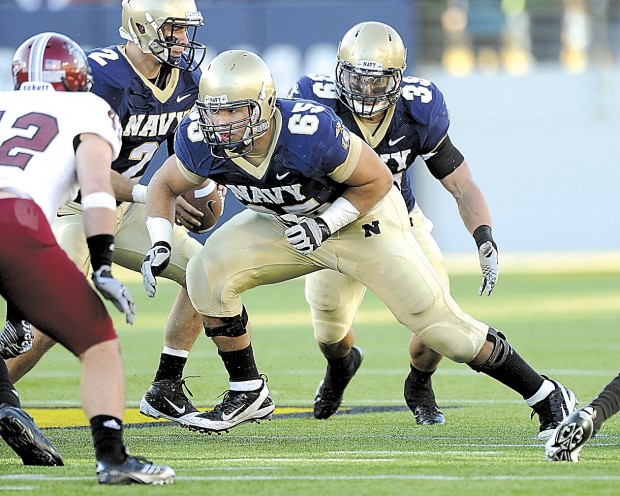
And who Ingram gets is a quick study, whether the subject is his major, ocean engineering, or his athletic calling, blocking in an option offense.
“In the coach’s world, there are two types of players,” Ingram explains. “There are ‘rep guys.’ You have to pound (information) into their heads. And there are guys who immediately understand concepts. It’s pretty easy for (Josh). Since day one, if I told him something, he understood.”
Ingram doesn’t mean simply guard play, although Cabral has played only the one position his entire career.
“He knows every position on the line,” Ingram asserts. “He’s an observant kid and a smart kid.”
Cabral is also unselfish, willing to impart his knowledge onto others. Perhaps no one has benefitted more from his insights than a starting tackle in his first season on offense.
A year ago, Paulson was a backup on the Mids’ defensive line. But last spring, he switched sides and, in a remarkably short period, adapted well enough to earn the first seven starts of 2012 at left tackle. He credits Cabral with expediting his adjustment.
“Just being his personality, (Josh) automatically stepped into (a leadership) role and helped me with my transition,” Paulson said.
During the summer, they studied video, as well as the playbook, and worked out together. Frequently after their workouts, Cabral and Paulson stayed to improve footwork or blocking techniques.
But Cabral’s reach doesn’t stop at Paulson.
When Pescaia was summoned for a rare appearance at center midway through last month’s victory at Central Michigan, Cabral was at his side. On the field, of course, but also on the bench. As offensive series ended and they retreated to the sideline, Cabral revealed his vision for Pescaia.
“He has so much experience, there were times he would see things that only he could see, and he would talk about them to help me make the right blocks,” says Pescaia, who shares Hawaiian heritage with Cabral. “Definitely when times are hard, in preseason camp or practice, Josh is definitely there to motivate guys.”
“Josh takes ownership of the group,” Ingram says, “trying to help other guys.”
“He’s the one we all look to, as far as senior o-lineman go,” says Paulson. “He’s the definition of the Navy offensive lineman. He’s smart, tough, big. He doesn’t do a lot of talking, but he walks the walk.”
As far as Niumatalolo is concerned, nothing else matters.
“Here’s a guy who’s a three-year starter who works as hard as anybody on our team,” says Niumtatalolo. ”The adjectives run out for him, because he’s such a wonderful young man to coach. His actions tell you what kind of person he is.”
So does Cabral’s middle name, if you understand Hawaiian language like native Islander Niumatalolo. Susan and Dan chose to call their son Joshua Kekoa. Pronounced keh-KOE-ah, it means ‘brave soldier.’
Cabral jokes that he’d “probably slaughter the language” and poor mouths what steps he’s taken attempting a version of the Haka Dance, which is a specialty of several Hawaiian teammates. But setting self-deprecation aside, he’s well on his way to living up to his middle name.
This month Cabral and classmates discover if their service selection is approved. His top choice is Naval Flight Officer, which would require about a 60-pound weight loss. If he doesn’t wind up in the back seat of a plane, Cabral will land aboard a ship as a Surface Warfare Officer.
 In either role, he’ll be commanding young men and women — kids in many cases — who joined the Navy for the very reasons his father did long ago. Cabral is a legacy of both an officer and an enlistee.
“I think it’s important to remember they’re people too, not just someone you can just order around,” he says of his perspective. “They’re young kids. I’ve had friends right out of high school go enlist in the Marines and be deployed over to Afghanistan. They have their own troubles and their own stories, yet they sacrifice so much for our country and each other. It’s just amazing.”
It sounds like Cabral will treat them the same way he does Navy teammates; regardless of class or position, no matter if on or off the field.
“I try my best with younger teammates and encourage them,” he says, before offering his own key to succeeding.
“It’s tough here at the Academy. But here they give you a lot of assistance. No one here wants to see you fail; teachers, coaches, company officers, classmates. You’ve got to put in the work. It’s rough, but you can get through it.”
You can do it by heeding the few words of a quiet leader. Or by observing his actions, which give you so much to emulate.
“I’ll give you an example,” says Niumatalolo. “Josh was going to miss a meeting and be late for practice recently because he had some appointments for his service selection assignments. When he came to ask me (for permission), he came in sheepishly, like he did something wrong. I had to explain to him, ‘Josh, that’s for your career. That’s fine.’
“If there’s anybody who’d be allowed to miss a meeting or be late for something, it’s him. He’s deserved it, he’s earned that right.”
Nevertheless, Cabral couldn’t justify missing a lunch-time pre-practice session with Ingram, so he asked his coach to reschedule for 6:30 in the morning. Ingram arrived at 6:25, found the door to his meeting room closed and detoured for a cup of coffee.
Upon returning, the door was still shut. Huh, Ingram thought, it isn’t like Josh to be late.
“Ashley opened the door and Cabral was sitting there, waiting for him in his full uniform,” Niumatalolo continued. “That’s him. You can count on him to be there.
“There are so many variables in sports and in life, but one constant I know for our football team and our program, you can count on Josh Cabral to do things right. To me, he is the epitome of integrity and doing what’s right at all time and all places. That’s Josh.”








 BOB SOCCI