A specialist on stand-by for the NFL, seeking another shot at a dream

By Bob Socci

The carry-on sat in a corner of a closet, out of the way but always at the ready, waiting on a call that could come at any time or never at all. Half of the suitcase was packed with football pads and cleats, leaving room for a couple of outfits and toiletries that Tucker Addington could hastily stuff inside in case the phone rang and he had to zip off to the airport.

No stranger to the quick getaway, Addington knew the drill well. If and when a team beckoned, he would likely have little notice to catch his plane, probably out of Austin-Bergstrom International. San Antonio was closer to home in New Braunfels, but Austin offered more direct flights. He would need  about an hour to get there by way of I-35 North. So he wouldn’t have long for ‘goodbye’ – and they for ‘good luck’ – before leaving wife Kensie and their three kids. 

This is what life is like on stand-by for the NFL, longing for an audition on the league’s ‘workout circuit.’ You wait and wait for teams to come to you, understanding that they can’t wait for you to get to them.

“Sometimes it’s a last-minute notice kind of thing. Somebody’s either (injured) or somebody’s not performing well and (teams) are trying to do a lot moving around,” Addington says. “So you have to always be ready.”

Once out the door, he might return almost as soon as he left. Teams are always bringing guys in for a brief look. Sometimes to update their Rolodex, in the event of injury. Sometimes for an actual tryout. Last year alone, Addington reckons, he  whisked off to “eight or nine workouts.”

Of course, he also might be gone a little longer. There was 2022, when he spent the spring in the upstart USFL, followed by a week in October on the Dallas Cowboys practice squad. And then, best and longest of all, there were his extended stays in New England and Washington, including six games played in back-to-back winters of 2022-23.

If the uncertainty and all the coming and going were enough to turn his world upside down, it was more than okay. In fact, it was exactly how he wanted it.

Addington is a long snapper. Upside down is literally how he yearns to make his living, performing a singular skill unique to football. Bending over to grip a ball out of a wide stance, he can fire it backwards between his legs, hitting a target as tiny as a holder’s hand being held out eight yards behind him, or a punter’s belt buckle fifteen yards away. 

In the more than four years since graduating from Sam Houston State University, he’s become one of the best in the world at it. Unfortunately, there have almost always been at least 32 others considered more worthy of full-time NFL gigs. So for most of that time, Addington has kept his half-packed bag close by at home in South Central Texas, while honing his quirky craft, eager to answer the call whenever and from wherever it originated across the league.

Earlier this month, his phone rang and a familiar area code popped up on screen — 508. The call was from Foxborough. The Patriots had dialed his number before. In fact, they had given Addington his first pro workout several years ago. They got in touch again the following season, when Joe Cardona, their long snapper since 2015, got hurt. 

Addington was signed to the practice squad, then promoted to the active roster. He debuted on Christmas Eve of 2022, played in the final three games of the season and remained in the organization through mid-August of 2023. Let go, he later joined the Commanders and appeared in three more regular-season games.

On Aug. 5, the Pats brought Addington in again to relieve Cardona, who was dealing with a minor injury, and serve as a long-snapping equivalent to a (training) ‘camp arm’ at quarterback. While they have split snaps on punts, field goals and extra points in practice, Tucker has delivered 17 snaps to Joe’s three in two preseason games.

Yet, almost certainly, Cardona will be in Cincinnati when the Patriots play their first regular season game on Sept. 8 while Addington will go back to playing the waiting game. That’s not to imply that he hasn’t been competing for a job.

Past impressions on teammates, coaches and front-office types led to Addington’s latest opportunity in New England. By performing and (equally important) handling himself well, this one can lead to another.

“The ability to get around might help me out in the long run,” Addington says. “I’m getting to meet these guys and create relationships and bonds, whether it’s with front office people or players.

“I’ve met some awesome people, had some great times and just continued to be disciplined, working on my craft. (I’ll) see where it takes me. If the right team comes, the time will be there and I’ll be ready.”

Specialists are a subset within each NFL team. There are only three of them during the regular season – the kicker, punter/holder and long snapper. The Patriots currently have five, including Addington, Cardona, kickers Chad Ryland and Joey Slye and punter Bryce Baringer.

They usually practice separately from teammates, and often are inseparable outside of practices. When a new member is introduced to their small circle, he must earn trust and create chemistry instantly. 

Addington has done it with veterans like ex-Pats kicker Nick Folk and Washington punter Tress Way, who’ve combined for 28 NFL seasons; Ryland and Baringer as rookies in New England; and Slye as both a Commander and Patriot. He also gets along great with Cardona.

“We add Tuck in and it’s like nothing really changes,” Baringer says. “We’re friends, we work really well together and it’s just fun to be able to go through this process with one another.”

Beyond personal feelings, Baringer sees this summer in particular as a benefit to Addington’s professional prospects. Though very familiar with his fellow specialists, he’s had to adapt to a different scheme under new special teams coordinator Jeremy Springer and assistant Tom Quinn.

“The fact that he can come here, play, get a good amount of film and also still be able to talk and learn from Joe is huge,” Baringer says. “I think it’s also good for him that he’s learning a different type of scheme with different coaches than were here in the past, because this year compared to last year is a little bit different, especially from a snapper’s perspective.

“(He) understands why he’s here, understands his ‘why,’ and he’s taking full advantage of it. And he’s snapping really well.”

No one on the team works more closely and extensively with long snappers than Baringer. Since his rookie spring of 2023, he’s handled hundreds, maybe thousands of snaps in practices and games – enough to instantly discern a delivery by Cardona from one by Addington.

“It’s not saying one’s better than the other, but you can just tell the difference, you can feel the difference,” Baringer says. “The timing is a little bit different.”

That timing is roughly equivalent to the snap of his fingers on a field-goal try. Between the snapper’s release and kick of the ball, Baringer must catch it, spot it exactly where and how the kicker prefers and ensure that its laces are facing the goal post. The entire operation averages 1.3 seconds.

 “Our job is so attentive to details, even just the little things,” Baringer continues. “We do a lot of snap (and) holds. We do a lot of just punt snaps. We do a lot of work together, so you build that connection.”

Snaps reach him at different spin rates and, thus, a varied number of rotations. For efficiency’s sake, Baringer wants to receive the ball with its laces already out. Knowing – really knowing – the snapper tells him where his hands should be relative to his body when he catches the snap. Any adjustment he makes can be a matter of centimeters.  

“(One guy’s) miss is in this spot with these laces, where another guy’s miss is in a different spot with a different type of laces,” he explains. “And then you get into the real-nitty gritty of catch location for me, where depthwise at eight yards I have to catch this guy’s snap for him to have perfect laces. Because it’s all based on his rotation.”

Every time he spins a ball to Baringer, Addington is aiming for what can be most elusive to aspiring pros and under appreciated by the general public: consistency.

“I think consistency is probably something that’s hard to explain to people. They’re kind of like, ‘Oh, you’re just throwing it between your legs,’” he says. “But with variations in spots, especially on field goals and even punts, you can take punters off their line (and) you can mess up a kick. At the end of the day, (people) say, ‘Oh, this guy missed a kick’ or ‘he went 2-for-4.’ That’s when we have to either step up or the people that are actually watching the position understand that was the long snapper’s fault.”

Before he started tossing footballs backwards, Addington was a junior high quarterback in New Braunfels, a growing city of 104,000 deep in the heart of Texas. Devoted solely to the state’s unofficial official sport, as a football-only athlete at Canyon High School, he moved to tight end on offense and played linebacker on defense. 

As a sophomore, his coach JJ Sierra assigned him a third position.

“(He) said, ‘Hey, you’re going to be the long snapper,’” Addington smiles. “I said, ‘How do you do it?’”

Sierra demonstrated the basics and advised him to simply “Let it loose.” The more he did it, the more he liked it, especially after realizing that long-snapping could be his means to an education. Addington is a triplet, raised by a single mom.

“Going into my junior year of high school I found out about scholarship availability,” he says. “I thought, ‘Let’s try to get to college somehow.’

“Obviously, I love the game of football. But I fell in love with the art of long snapping.”

The owner of the gym where he trained, Aldo DeLaGarza, introduced Addington to a former linebacker and long snapper at Sam Houston State, Doug Conrey, who founded the Texas Long Snapping camp in 2011. Addington snapped for Conrey at Aldo’s Gym. Impressed, Conrey took Addington on as a client.

They drilled down on techniques, from hand position to follow-through, transforming Addington from an accidental snapper to a college prospect. Training under DeLaGarza and Conrey, he eventually grew to 6-2, 230 pounds and followed the latter to Sam Houston State in Huntsville “on a full athletic scholarship!” as his mother Heather Addington wrote in a testimonial for Aldo’s website.  

Addington played 48 games for the Bearkats, earned a bachelor’s degree in Kinesiology and enrolled in a master’s program at Texas A&M Corpus Christi. He also interned in physical therapy at a hospital in Huntsville, before taking a part-time job as a patient care technician at the New Braunfels Regional Rehab Hospital. 

Married with children – oldest daughter, Payton, was born when Addington was a college sophomore – he kept snapping and started teaching too. If he wasn’t running patients through exercises, Addington was working with youngsters at Texas Long Snapping or practicing in the backyard, where he snapped into a net while Payton and her sister Presley retrieved the footballs.

Well over a year after his last collegiate appearance, Addington heard from the Patriots. 

“It honestly kind of kick-started my transition back into football,” he recalls, noting that he left the rehab hospital to commit more time to football. “I said, ‘Maybe they didn’t forget about me.’”

But without a callback from the Pats or overture from anyone else into 2022, Tucker and Kensie did some hard thinking. He came close to giving up on a possible playing career. Then the USFL came along.

His agent persuaded Addington to buy a ticket to San Diego and take one more shot at a league tryout camp. He nailed it and on March 10, 2022, while alongside Kensie and their two girls, learned that the Houston Gamblers had chosen him in the USFL’s supplemental draft.

Nine months later, he was summoned back to Foxborough. Cardona had reportedly suffered a partially torn tendon in his foot at Arizona, so the Patriots signed Addington to the practice squad as insurance. The following weekend, amid Cardona’s 127th consecutive game at Las Vegas, his condition worsened. His season was over.  

Promoted to the active roster on Dec. 23, Addington dressed out the next day for a matchup with the Bengals. He was the first player to emerge from the locker room in full uniform for warmups and went on to snap eight times in a heartbreaking 22-18 loss; six on punts by Michael Palardy and twice for PAT tries by Travis Vizcaino. That night, he flew home for Christmas.

Tucker and Kensie have since welcomed son Luke to the family, as Dad has continued to go where needed as a part-timer in hopes of full-time duty. Just in the past year, he’s gone from Foxborough to Jacksonville to Washington, paying other visits in between, to Foxborough again.

“I think a lot of people slide under the radar, but if you keep pursuing things and (are) grateful for the opportunities you get and keep working, keep training…” Addington’s sentence pauses, as his thoughts shift to his young family. “I’ve got three little kids at home, my beautiful wife at home, so it’s been a little different road for me than others. It’s not for the faint of heart.”

Speaking softly through his well-groomed, light brown beard after practice on the final Tuesday of training camp, Addington credits the so-called workout circuit for hardening his resolve. He also believes each experience transitioning between holders only makes the next one more seamless. 

But more valuable than what he gains professionally is what he reaps personally. 

“Man, it’s gotten me more than I can ask for: friends, relationships and where I’ve been now, a couple of different teams, floating around here and there,” Addington says. “I’ve been able to play six games in my career thus far and I’m excited to see what the Lord has in store for me going forward. 

“If you prepare and stay consistent, you’ll be amazed at what actually happens. I think some guys get down sometimes and, as you’re away from a (team), kind of start to wonder and think, ‘What comes tomorrow?’ In all reality, tomorrow isn’t guaranteed, so let’s work today and see what happens next.”

The following afternoon, at the end of a Wednesday practice, Addington and Baringer got together for some extra snaps. The next day, they made time for more of the same during individual-drill periods. 

Flanked by one group of defensive backs reacting to passes and a second group refining technique for jamming receivers at the line, Addington put his head down and hands on the ball and fired away to Baringer. 

In the middle of a practice field, they looked like a pitcher and catcher in the center of a diamond. Addington stuck with fastballs, trying to locate within Baringer’s strike zone, from mid-thighs to right in the ribs. They continued for a good 10 minutes. 

Chances are, Addington will soon be snapping again into his backyard net in New Braunfels, his carry-on stored in its corner of the closet and his phone’s ringer turned up to its loudest volume. Like every time before, the next time it sounds, he’ll be ready to go.

“Whatever comes my way, opportunity wise, I’ll be grateful,” Addington promises, “and take all I can from it.”

This story was originally published at www.985thesportshub.com on Friday, Aug. 23, four days before the NFL’s deadline for teams to announce their initial 53-man, regular-season rosters. Tucker Addington was among the first players informed of his release.

A player’s retirement and broadcaster’s lament

THERE’S A LOT TO SAY ABOUT MATTHEW SLATER, AN ALL-TIME GREAT IN HIS FOOTBALL SPECIALTY, AND, FOR ME, ONE THING I WISH WENT UNSAID.

Ten-time Pro Bowler Matthew Slater retired after 16 seasons with the New England Patriots.

Open your mouth to a live microphone for three unscripted hours at a time, trying to instantly frame the unpredictable action of an NFL game unfolding before you, and there are bound to be a few words and phrases you’d like to have back at the end of the day.

Add up mostly Sundays and a few weeknights per year over 11 seasons and, at least for this New England Patriots announcer, lines you wish you could rewind and re-word are too numerous to rue.

Except for one, spoken on Sept. 29, 2019.

The Patriots were in Orchard Park, N.Y., leading Buffalo, 6–0, on a cloudy and cool afternoon, as the Bills set up to punt from their 33-yard line midway through the first quarter. Poised for an all-out rush, the Pats stacked 10 players in tight, including Matthew Slater tucked well inside of J.C. Jackson on the right edge.

Fourteen yards away, Buffalo’s Corey Bojorquez, who began his career in New England, caught a low snap inches below his knee caps. Righting himself, he took two steps and dropped the ball onto his left instep, just as Jackson instantaneously extended his arms.

There was a loud thud. The ball popped high in the air before plummeting to the Bills’ 11, on the field’s far side. It bounced straight up to Slater, who in a singular act plucked it, carried it across the goal line and held it in his outstretched right hand while dropping to his knees.

Given a clear view of Jackson, I saw the block correctly. But the score I botched. Seeing the “8” of Slater’s “18” as a zero, to my unending regret, I blurted out the name of №10, Josh Gordon. 

The word bubble barely off my tongue, I realized it was Slater in the end zone; Gordon wasn’t even on the field. The error of my words hit me with the bluntness of Jackson’s block. Thud! 

“Make it Matthew Slater,” I uttered a split second later, sinking where I stood in our booth. “Matthew Slater with the recovery and the score.”

Leaving out an exclamation mark, I barely punctuated the play with a period.

It was the first, and would turn out to be the only touchdown in the brilliant career of the Patriot I most respected then, as now. If ever there was someone whose milestone merited a clean call, it was Slater, whose suffix, to hear coaches and teammates sing his praises, might as well be: Great player. Better person.

The following day, I encountered him in the Patriots locker room, back home in Foxborough, Mass. I apologized for my gaffe, and was received with a smile. No need to feel bad, he assured, gently shaking his head.

Still, it bothers me now, as then. Maybe more, knowing there won’t be another opportunity to nail the call of a score by Slater. At age 38, after 16 seasons as a Patriot, including 13 as a captain and 10 as a Pro Bowler, and with his one career touchdown, Matthew retired.

Expectation became official

Following a lopsided 2021 Wild Card playoff loss at Buffalo, Slater joined veteran teammate Devin McCourty in opting to play one more year. At least. When another loss at Buffalo in the 2022 finale kept the Pats out of the postseason, even as McCourty stepped aside, Slater committed to one more year. Again. But as the 2023 season spiraled toward a disastrous four-win, 13-loss end, it was obvious there’d be no ‘one more year’ for the three-time Super Bowl champ.

One such sign was in November on the Pats’ trip to Frankfurt, Germany, where Matthew was joined by wife Shahrzad and their family. Sleep deprived on the morning of arrival thousands of miles from home, he was nonetheless in his element: a husband and father doting on four little kids over a hotel breakfast.

More signs appeared en route to January’s season-ender vs. the Jets. For days leading up to the game, Slater repeatedly obliged team and media requests, reflective and relaxed. A year removed from pushing away from a podium in Buffalo, teary eyed, emotional and uncertain of his future, he seemed at peace.

 Slater appears at his final post-game press conference on Jan. 7, 2024.

On game day, teammates stepped into a Nor’easter for warmups wearing special sweatshirts in his honor. Navy blue, with red and white lettering, they read “The Patriot” across the front. “Captain,” they said, above an “18” on the back. And on the left shoulder, in perfect order: “SON, FATHER, HUSBAND, TEAMMATE,” along with a list of career achievements.

Shortly before kickoff, the Slaters reunited there on the field. Matthew embraced his parents, Jackie and Annie, and brother David. Shahrzad and the kids cheered him on in their own “18” jerseys.

We’d later learn from a team-produced video that word was getting around, even among New York players. Slater confirmed to Jets contemporaries Thomas Morstead, 37, in his 15th season, and Aaron Rodgers, 40, in his 19th: this was it.

Three hours later, the snowy, slushy end to Slater’s 239th game — 264th, if you count playoffs — was marked by mutual admiration. Helmet off, he lingered on the field, heading toward the Northeast opening of Gillette Stadium as remaining fans offered a collective salute.

Slater returned it by raising his right hand, just as he did years earlier in the Bills end zone. Only this time, his extended right thumb, index and pinky fingers formed an offering of his love in sign language.

In recent years, I’ve listened to a handful of special teams coordinators around the league pay tribute to Slater, having watched him mature from unsure rookie to master craftsman. Among them, Dave Fipp of the Detroit Lions, once penned his respect for Slater, writing a personal letter of congratulations the first time Matthew made the Pro Bowl.

No special teamer reached more, which may be why a another, John Bonamego, who coordinated kicking units for 19 NFL seasons, more recently called Slater “a first-ballot Hall of Famer.” Bonamego won’t get much of an argument from his peers. Nor from me.

A Patriots Hall of Fame blazer for Slater is all but guaranteed. A Pro Football Hall of Fame jacket like the one his dad Jackie got as a legendary offensive tackle, is hardly a given. But here’s hoping this year’s selection of returner Devin Hester gets Matthew one too. Because nobody covered returners as well, for as long as he did.

Not that a clothing item — in Foxborough red or Canton gold — makes the man who finds validation in faith, family, relationships to others (in and out of the game) and community service. Humility was “a core value of our home,” Slater told me last spring, stressing that Jackie and Annie also imbued in their sons the importance of blending a strong sense of self with keen self-awareness. 

That balance helps explain the player Matthew became, as a post-high school athlete generally devoid of an offensive or defensive position. At UCLA and in the NFL, Slater was mostly rostered as a receiver. He concluded his career with one catch (for the Pats in 2011) and four carries (including two as a Bruin and netting five yards overall).

Adept at returning kickoffs in college, Slater struggled as a pro. Ask him about it, and in typical self-deprecating manner, he laughingly labels himself “a bust.”

Obviously, Slater found a way to hold his place, regardless of listed position. Drafted by Bill Belichick as a fifth-rounder in 2008, he was determined to “become the best (kick) coverage player that (he) could be.”

Belichick has called him the best ever, a special teams equal to Tom Brady on offense and Lawrence Taylor on defense.

Tireless and egoless

On the Wednesday after returning from Frankfurt, the Pats held a practice before dispersing for a bye weekend. And as the doors to the locker room closed on an ensuing media availability, one player remained: Slater. 

Of course. Still in workout gear; headed to the weight room. Sixteen seasons in; no different than his younger self, who former special teams coach Scott O’Brien described as a guy who shows up everyday like he might get cut that day.

Football’s so-called Turk never ran down Slater. Tuesday the ‘gunner’ opponents couldn’t keep down despite double and often triple teams, did what few in his unforgiving game can: he stopped running on his terms.

“It is time,” he told us in a statement through the team, “for (his) relationship with the game to evolve.”

As a player, Slater was an exemplar: of his specialty, of leadership, of the Patriots’ culture when at their best. On and off the field. In the football facility and community. 

Slater was also an eloquent voice: for teammates, for the team, for special teams and for others whose stories need to be told. However his relationship with the game evolves, one expects he’ll keep advocating for all of the above.

In turn, there’s so much to say about Slater. And for me, there will always be one thing I wish had gone unsaid.

This is an updated version of an article originally published at www.985thesportshub.com. Bob Socci has been the New England Patriots radio broadcaster since 2013.

Mayo, a leader of men in his own way

The following first appeared on 985thesportshub.com on Friday, Jan. 12, after former Patriots linebacker Jerod Mayo was hired as the team’s new head coach.

Author (left) with Jerod Mayo (center) and Scott Zolak at a pre-Super Bowl LIII rally at Gillette Stadium on Jan. 27, 2019. (Photo by David Silverman)

The first time I met Jerod Mayo, he poked fun at my stentorian cadence behind a microphone in the middle of a high school field. True, before Hardy on 98.5, I was mimicked by Jerod, from Hampton Roads.

We were in Newtown, Conn. for a day-long event centered around a youth football clinic conducted by Patriots players and assistant coaches in the spring of 2013. As emcee, it was my first ‘official’ role as the team’s newly-hired broadcaster.  

Drills concluded, and I introduced Mayo for a few words to the kids and their families seated all around us. Naturally, as always with him, a captain since his second season, he connected with the crowd. First, though, he hit yours truly with a playful jab, making note (and light) of my ‘announcer’s voice.’ Naturally, as always with Mayo, he did it smiling in a way that let me know: he was just busting my chops to break the ice.

Unfortunately, I didn’t get to lend my voice to enough of his games. A torn pectoral muscle in the season’s sixth week – overshadowed by Tom Brady to Kenbrell Thompkins to beat the Saints – robbed Mayo of most of 2013. Further injury robbed him of most of the next year, too. 

Rather than “wallow in (his) pain,” as Mayo told Gautam Mukunda on the NASDAQ World Reimagined podcast in March 2021 (the listen is well worth your time), he worked to help the team win. Mayo dived into film study with Steve Belichick, then a coaching assistant, and involved himself on the sidelines during games. Long a ‘coach on the field’ as an inside linebacker making defensive calls, he was a de facto ‘player-coach’ for an eventual Super Bowl champ.

We would later learn, watching the collaboration of Mayo and the young Belichick running the Pats defense in recent years, that they became very close in Jerod’s final ‘playing’ days; just as one can learn by listening to him chat with Mukunda, or by reading or watching features like TheAthletic.com or Patriots.com profiles from last year, that he simultaneously formed relationships to help him excel outside football.

A younger Mayo – he’s still very young, at 37 – probed owner Robert Kraft for insights into the business world. He sipped wine and listened intently in intellectual circles and sought mentorships that prepared him for success as an angel investor and an executive rising to vice president of business development for Optum, a subsidiary of UnitedHealth Care.

Mayo also made time for television, shining in spots alongside Tom E. Curran, Phil Perry and the rest of the NBC Sports Boston crew. He easily could sit on a network set, like Tedy Bruschi or one of the McCourtys. Instead, he reclaimed a seat in the film room, becoming a coach. 

No sooner than Mayo’s return to One Patriot Place, he was seen as a future head coach, here and elsewhere, as evidenced by future interview opportunities. Even before last spring’s unique statement of ownership’s intentions to work out a deal to employ him long term, it was hard to envision the Krafts watching Mayo walk out the door to take over someone else’s team. 

On Thursday, Robert Kraft reminded us of something Jonathan Kraft has spoken about publicly in the past: how a relationship was formed with Bill Belichick in part over a mutual understanding of economics, the salary cap, value over cost, etcetera. They connected on a level transcending the game on the field. 

If you listen to Mayo and Mukunda; or hear him in the dot-com feature describe the formative influences of his mother and grandfather; or consider the intellectual and analytical thirst for information required to succeed in funding private startups; it’s easy to understand how Mayo and the Krafts would connect on a higher plane than a grid of Xs and Os. 

Then, take into account his leadership skills demonstrated as a rookie in a linebackers room populated by Bruschi and Junior Seau and Mike Vrabel. Mayo was the kid they dispatched to knock on Bill Belichick’s door to pitch their case for an occasional day off from padded practice. 

“If the worst thing someone can do to you is say, ‘no,’” Mayo’s mother, Denise, told her son, “go for it.”

Most — maybe two-thirds — of the time Belichick gave him a hard ‘no.’ But when the reply was ‘yes,’ Mayo was celebrated among his mates. A year later, they voted him captain. 

“The guys knew I cared about them more than I cared about myself,” he said to Mukunda of his youthful willingness to knock on that door, to go for it.

Sixteen-years later, the same feeling is consistent among the players Mayo’s coached. Mark Daniels of Masslive.com is one of many reporters who’ve written their testimonials in recent days.

No doubt, concerns, questions, criticism, all come with this hire. Not unlike the one Robert Kraft made in January of 2000.

After all, Mayo’s never been a ‘coordinator,’ let alone a head coach. Absolutely, Vrabel is available, and we know all too well how good he is from the games he’s coached against the Patriots (see 2018, at Nashville, or, worse, January of 2020, in Foxborough). 

You’re right, Jerod’s a defensive coach, hired as the organization closes in on a crossroads draft in need of identifying and developing its future quarterback. Okay, you consider him a disciple of Bill’s, asking, understandably: ‘Why move on from the best coach ever to then turn to one of his own?’ And how about: ‘Will he go outside current or past Pats circles for coaches? Can he? Who will take over player personnel?’

All valid. And all, I trust, the Krafts considered. 

“Jerod is an individual that, I think, has no ceiling for his ability to grow and how competent he is,” Robert Kraft said at last spring’s owners meetings. “We had the privilege of having him as a player, and I saw how intense he was, and his leadership skills that he had. And then I saw him leave us and go into private industry and learn the Xs and Os of business, and then come back to be a coach and do that with us.”

Of course, Mayo confronts an enormous learning curve. And faces major challenges trying to lead the Pats from 4-13, a third losing season in four years, back to expectations as a perennial Super Bowl contender. 

Even if you consider Mayo’s time making checks at the line of scrimmage and leading in the locker and meeting rooms as a player as some measure of coaching equivalent, there’s no downplaying the enormity of his new undertaking; he’s still very new at this coaching thing. 

But that doesn’t make him the wrong choice for this team, at this time. In Mayo, the Patriots have an exemplar of their best qualities of the past; who’s proven himself to be an out-of-box thinker and learner; who coaches, as he recently said, “out of love,” remaining “tough” while showing “warmth” and building “confidence”; who communicates and connects as a person in settings as diverse as the C-suite and team cafeteria; who has the character, intelligence and charisma to be both a constant and an agent for necessary change.

What’s more, if his past is a prelude, Mayo won’t be afraid of tackling that curve and those challenges cast in the hooded shadow hanging over the organization from the past 24 years; just as he wasn’t afraid, at 22, to knock on Bill’s door. 

Speaking of Bill, Mayo described Belichick to Mukunda as “a continuous learner” always “trying to evolve.” As if talking about himself.

Mayo’s about to learn a lot on a new job, arguably, the toughest in sports, eight years after he retired from playing, prompting the legend he now succeeds to praise him at the 2016 owners meetings.

“There have been very few players in my career that I’ve had the opportunity to coach that I’d say had more of an impact on the team than Jerod has from day one, which is unusual,” Belichick said. 

It’s day one of a new Patriots era, and an unusual person gets his shot to impact the team as its next head coach. I, for one, am excited to describe the days that follow – in my best announcer’s voice. 

Bob Socci recently completed his 11th season as the play-by-play broadcaster for the Patriots Radio Network on 98.5 The Sports Hub in Boston.

Keepers of flame still light a spark.

By Bob Socci

January 31, 2022

After learning a favorite colleague and I have similar pre-broadcast rituals, I wrote about the story tellers and myth makers who helped pro football become our most popular sport and influenced a kid who would grow up to call it.

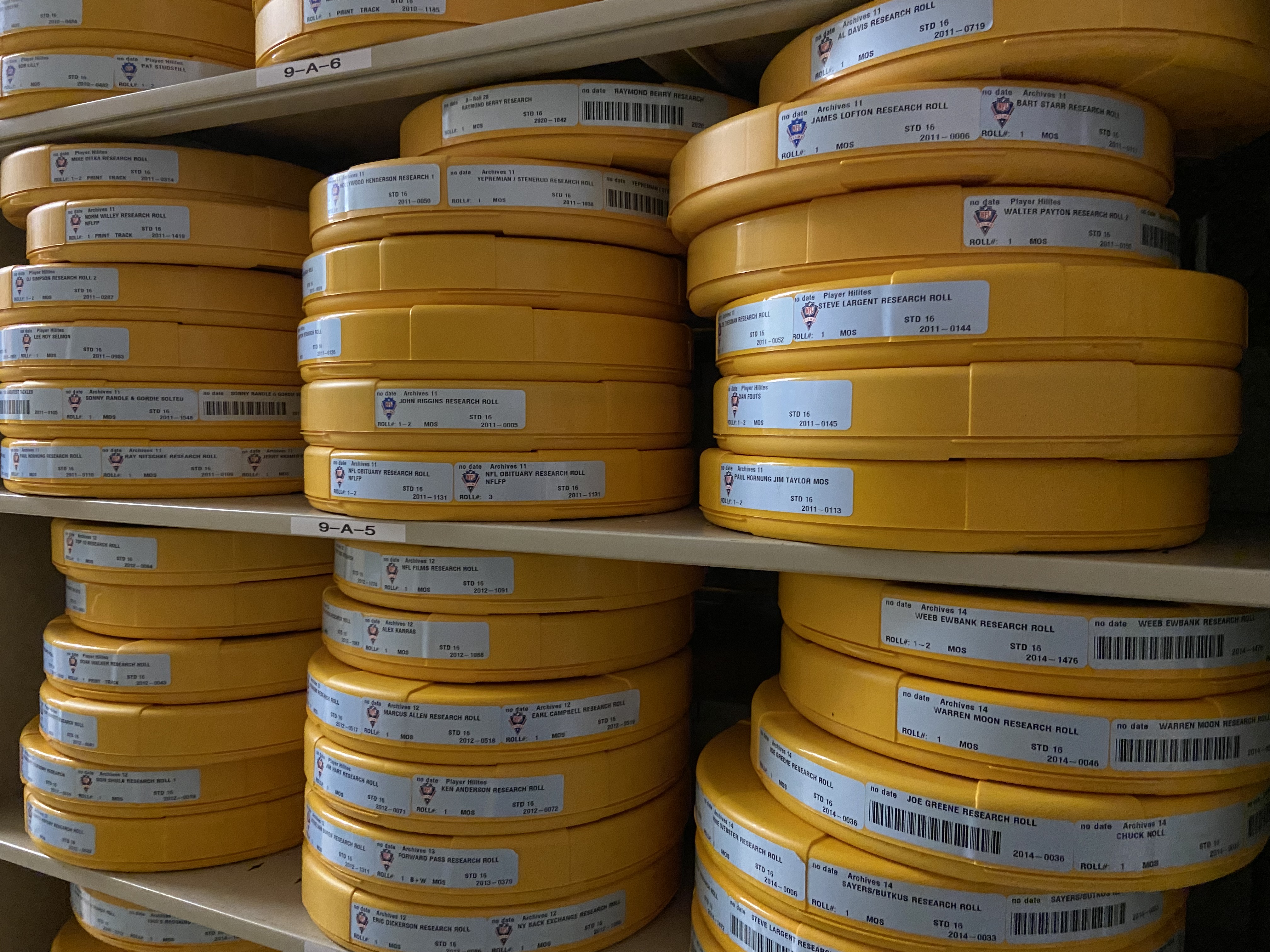
Millions of miles of NFL history are kept in a vast climate-controlled room at NFL Films.

By Bob Socci

For all but the past few months of my nine seasons as a New England Patriots broadcaster, I kept an admittedly peculiar ritual a secret between me and my playlist, positive that it was exclusively mine.

It’s one of my first acts settling into my seat on the bus before leaving the team hotel on the road or heading to the home radio booth at Gillette Stadium. I pull out my iPhone, insert ear pods and search the music library for one artist in particular.

One composer, actually. Seeking one song, specifically. 

Sam Spence, and The Raiders

Maybe you know his name. If you love football, surely you know his score. 

Probably, you’ve heard it as a drum-beating bed beneath poetry being read by a Philadelphia news legend with the ‘Voice of God.’ 

The Autumn Wind is a pirate

Blustering in from sea,

With a rollicking song, he sweeps along, 

Swaggering boisterously.

So goes the opening stanza of The Autumn Wind, which even to a childhood Raiders-hater, resonates from the lips of the late John Facenda and returns me to the mid-to-late seventies; again a kid dreaming of doing what I’d someday be lucky enough to do.

When I hear the song, I reflect. It’s a reminder as I ready for air that I occupy the seat of a dream fulfilled, in the role of all-time Patriots predecessors like Bob Starr, Curt Gowdy and Gil Santos.

Nerdy, I know. But, that’s me. 

Until early October, I couldn’t imagine anyone else observing a similar game-day rite. 

During the August week of Patriots-Eagles joint practices in Philadelphia, I toured nearby NFL Films.

Few colleagues calling NFL games locally or nationally on radio have done it longer than Kevin Harlan. First hired by the Chiefs in 1985, he’s about to broadcast his record 13th consecutive Super Bowl for Westwood One. 

When Kevin speaks, either thunderously and painstakingly describing a live play or as an interviewee humbly dispensing lessons from a career as full as his baritone pipes, I listen. 

Around the fifth week of this season, Harlan appeared as a podcast guest of the NFL Network’s Rich Eisen. As soon as the episode appeared, I pressed ‘play.’ Halfway through, I discovered I had company. 

Harlan shared some anecdotes about people who’ve influenced his career. One was Steve Sabol, who with his father, Ed, co-founded NFL Films in 1962. Another was Facenda.

“The first real voice that captured my imagination,” Harlan said, while reaching for and fiddling with his phone. He looked down, trying to access something he listens to before every football assignment — on Sundays for CBS and Mondays for Westwood One. 

Then he hit play.

The Autumn Wind is a pirate

Blustering in from sea,

With a rollicking song, he sweeps…

“I won’t get too emotional here,” Harlan gushed, his face aglow as he paused the recording of Facenda reciting words written by Steve Sabol to a song composed by Sam Spence. “When I hear that it just, it just puts me in the frame of mind of doing the NFL…we all feel so lucky and privileged to be a part of this great thing.”

Don’t you know, he was speaking for me.

Facenda’s voice, Kevin explained, was his “first football memory.” Much like the music of Spence was the soundtrack to mine. Lyrical and lyric-less, both take us back in time. We are men living dreams of children.

For me, those dreams flourished first in the finished basement of a duplex in Auburn, N.Y., a small city smack dab in the middle of the state. We lived a half-block from a large park, the Y-Field, where kids convened daily to play the main sport in season. When done for the day, I retreated inside to our downstairs TV to watch the athletes we had just imitated.

On fall Saturdays, following mornings of two-hand touch, I made sure to be back for afternoon college football offerings on ABC. Bill Flemming or Chris Schenkel, then Keith Jackson handled play-by-play. Dave Diles came on with the Prudential College Football Scoreboard. Once he dropped in a Slippery Rock update, we were off to church for 7:15 mass.

Sunday worship started with Notre Dame highlights, hosted by Lindsey Nelson, before moving along to further action with “This is the NFL” and “NFL Game of the Week.”  The latter opened with locker-room scenes, including players speaking the last line of the Protestant version of the Lord’s Prayer. Over the next half hour of slow-motion replays, orchestral strains and gospel according to Harry Kalas, I found my religion.

Network pregame shows set the table for our weekly family macaroni dinner coinciding with the one o’clock kickoffs. Unfortunately, the menu of early games via Syracuse affiliates — usually involving the then inept Bills, Jets or Giants — were often hard to stomach. 

Highlights for me as a viewer were, well, the highlights.   

It’s why I pleaded with my mom to let me stay up late on Mondays, to hear Howard Cosell’s halftime rundown, and so appreciated Friday invites to my pal Mike Murphy’s house. Unlike us, his family had HBO and, hence, Inside the NFL

Long before 24-hour sports networks, the internet and on-demand, I couldn’t get enough. Decades passed, and as I moved on from describing games in my mind as a kid growing up to calling them for real all over the country, I collected NFL Films originals on VHS tapes, DVD’s and, eventually, digital downloads.

They helped pass time on lengthy bus rides through baseball’s minor leagues and filled the background as I prepped for Navy football broadcasts. Years before marriage led me to Boston, I wore out early editions of 3 Games to Glory, the series chronicling each of the Pats’ championship journeys. I loved them as much for Gil and Gino as Tom and Bill. 

Then in 2008, my fiancé and I left Annapolis for Quincy. We got married, she started a new job and I began a search for same.  Still voice of the Midshipmen, I took Friday a.m. flights to BWI, returned to Logan late on Saturday nights and listened live on Sundays to the Patriots radio legends.

During the week, I knocked on doors. One opened a year later at 98.5 The Sports Hub, the fledgling all-sports home of the Bruins and Pats. I introduced myself to the program director and his assistant and handed them an audition CD on my way out.

Meantime, I continued canvassing for openings or, at least, critiques. An out-of-market radio producer thought my play-by-play had a ‘college sound.’ An agent who turned me down suggested voice lessons. 

I listened more closely, with real purpose, to the NFL Films radio cuts. What does an ‘NFL sound’ sound like? And how can I capture it? I paid a local opera singer moonlighting as a voice coach in hopes of losing my nasality. It was either that or pay a more harmful price by pairing cigarettes with scotch.

Real or imagined, I noticed a difference during Navy’s 2012 season. That December, three years after calling on 98.5, I heard back. With Gil retiring, they wanted samples of my recent work. I sent some, was granted an interview and got the job.

My first season began in Buffalo, only a couple of hours west of Auburn. Tom Brady led a fourth-quarter comeback that Stephen Gostkowski completed with his last-second, game-winning field goal. 

It felt awesome, yet didn’t feel real. 

Searching for validation, I turned on Inside the NFL two days later and waited for Pats-Bills highlights. Hearing myself, I cringed. Wow, I can do better. Then I smiled. Whoa, it’s really me! 

Now nine years in, little’s changed. I still listen critically, and the experience of hearing anything I say on NFL Films is still a stamp of authentication. It could be a regular-season call on a weekly show or turning point on postseason commemoratives like America’s Game and Do Your Job. And 3 Games to Glory

In my role, I’ve gotten to know the filmmaker who oversaw production of all that Patriots content, Ken Rodgers. He’s a protege of Steve Sabol, whose vision for the company endures more than nine years after losing an 18-month battle with brain cancer in September 2012.

Sabol saw himself as a storyteller and NFL Films as myth makers. Mixing the arts of cinematography, provocative writing, muscular musical scores and the raw reactions of mic’d up coaches and players, as author Rich Cohen once wrote in The Atlantic, they “taught America how to watch football.” (1) 

Sixty years have gone by since NFL Films grew out of a small company Ed Sabol started with a 16-millimeter Bell & Howell camera focused mainly on family events, including Steve’s high school games. Thousands of programs and features earning hundreds of Emmy Awards have had as much to do with pro football’s enormous popularity as the men and moments they’ve mythologized.  

Much of football’s history is archived inside rows of canisters at NFL Films headquarters.

The Immaculate Reception. The Holy Roller. The Catch. The Tuck Rule.

Mention of any one immediately conjures up the way they were captured among the millions of miles of film saved today inside endless rows of canisters stored at NFL Films headquarters. Built a decade ago at a cost of $45 million in Mount Laurel, N.J., about 20 miles east of Philadelphia, it sits on a 26-acre campus.

“Hollywood on the Delaware (River),” Steve Sabol called it in the Philadelphia Business Journal. (2)

Development of the sprawling campus was overseen by The Staubach Co. Yes, that Staubach, Roger, the Heisman Trophy-winning quarterback at Navy who went into commercial real estate when he retired from the Cowboys.

While in Annapolis, Staubach was a hero to a young Bill Belichick, who grew up to become the subject of numerous NFL Films documentaries, before becoming an Emmy-winning co-host of the 100 Greatest series. 

In August, with the Pats in Philly for preseason practices against the Eagles, Belichick and his team crossed the Delaware to Mount Laurel, where Rodgers led them on a tour of NFL Films. The next morning, Rodgers did the same for a second group from New England. Thankfully, I was included.

Back in the summer of 2019, the Patriots paid a similar visit, stopping in Canton, Ohio on the way to joint practices near Detroit. The entire traveling party entered the Pro Football Hall of Fame. I studied the exhibits and stood in awe of its bronze busts, taking photos of many, including Staubach’s. And Ed Sabol’s. 

A statue of Steve Sabol and bust of his father Ed (middle right) at NFL Films, in addition to Pro Football Hall of Fame sculptures of Roger Staubach (upper right) and the older Sabol.

I snapped another upon entering the NFL Films lobby, where a similar sculpture of the older Sabol greets visitors. Winding in wonderment into and out of creative suites and recording studios, past photos and artifacts, we eventually ended our several-hour stay where the gears of the younger Sabol’s creative motor constantly turned. 

It is kept as it was. Boxes of index cards marked with Steve’s musings sit atop a credenza. Post-its featuring messages both banal and poignant, from phone extensions to life philosophies, stay pinned to cork boards. Though chairs around a conference table and at Sabol’s desk are empty, his spirit fills the room. 

You hear it in Rodgers’ voice and see it on his face as he talks about his mentor and runs his fingers along those index cards. And feel it, perusing what’s written and displayed on the surrounding walls. The same spirit has gone into every tight shot of a spiral or close-up of a cloudy breath since the early sixties, dramatizing a game to make it much more than it is. 

George Halas referred to NFL Films as “keepers of the flame.” In my life, they helped ignite a spark. Years later I still sense it in their work. 

Stumbling on Hank Stram calling for “65 Toss Power Trap” on an NFL Network special. Straying down the YouTube rabbit hole to find Billy “White Shoes” Johnson dancing in the end zone. Scrolling through football historian Kevin Gallagher’s Twitter content and coming across the 1971 Pro Bowl.

And when starting my game days with a song synonymous with the ‘Voice of God.’

Because like the voice of the Super Bowl, I’m so lucky and privileged to be a part of this thing.

Since Steve Sabol passed away from brain cancer in September 2012, his office has been kept as it was.

  1. – “They Taught America How to Watch Football” by Rich Cohen, The Atlantic, Sept. 18, 2012.
  2. – “NFL Films kicks off new digs” by John George, Philadelphia Business Journal, Oct. 7, 2002.