Experiencing the Madness First Hand

By Bob Socci

In years past, this was always someone else’s game to call.  For weeks I rode along with the Patriot League’s basketball season, as it unfolded from mid-January through early March.  Until it was time to hop off after the semifinals, vacating my courtside seat for another voice from another network.

Bucknell's Sojka Pavilion.

Back to being a fan, the only way I could see the conference’s championship was to make it appointment viewing.  If time allowed, I typically enjoyed those telecasts, especially if what I was watching was accompanied by the sound of a personal favorite like Dave O’Brien or Jon Sciambi.

At the end — sometimes sooner, if the score was one-sided — of every final, happiness for one team was balanced by the disappointment for the other.  In a one-bid league like the Patriot, there’s no at-large consolation from the NCAA Tournament selection committee for those who come up short of a championship.  Personally invested in such a conference, trying to tell the stories of the programs and players throughout the season-long pursuit of their 15 shining minutes of fame on college basketball’s grandest stage, it’s impossible to avoid such mixed emotions.

Tonight, when Bucknell hosts Lehigh at the Sojka Pavilion, will be no different.  One will celebrate a dream attained; the other will lament a dream denied.  The difference, though, for me is where I’ll experience and how I’ll express those feelings for both.

Because the CBS Sports Network is televising the Patriot League Championship for the first time, I’m still along for the ride.  Vince Curran, a former Penn player and assistant coach, and I get to enjoy the privilege of crossing the finish line with the Bison and Mountain Hawks.

I’ve long relished the rewards of my association with a conference comprised of impeccable students whose interests extend to other areas of life, yet whose passion for the sport runs as deep as any of their Division I counterparts.  At any time, in every Patriot League contest, there are engaging personalities, whose histories are worth telling, on the floor.

For instance, the first player off the Bucknell bench figures to be junior guard Bryson Johnson, one of the most dangerous three-point shooters in the conference.  Growing up on the northern tip of the Canadian Maritime of Nova Scotia, he was first coached by his mother.  A year ago, he was voted to the All-Tournament team, after averaging 14.3 points per game during the Bison’s postseason trek to the Patriot title.  Johnson, an economics major, also is an Academic All-District selection; practically earning straight A’s to go with his high-arcing threes.

Perhaps no one’s past is more compelling than Lehigh reserve B.J. Bailey.  With his father absent from his life, his mother passed away when Bailey was a high school freshman.  Four years later and six games into his career at Boston University, he suffered a concussion.  The lingering effects, he says, led him on a path toward depression, mourning the loss of his mom and facing extreme homesickness.  Hailing from New Jersey, Bailey transferred to Lehigh in January 2010 and was soon diagnosed with Post-concussion Syndrome.

Six months later, in the early evening of June 24, Bailey and his friend Chris Popper got off work and went body surfing off the coast of Margate City, N.J.  Bailey and Popper got caught in a rip current.  Struggling to swim back to shore, only to be carried farther away, Bailey’s body was fatigued and cramping.

“After about two minutes I looked up and I was maybe 50 yards from the shore,” he told reporter Tom Hinkel of Easton, Pa.’s The Express-Times. “The rip current was pushing my legs back and my head forward.  I started to panic. Chris tried to help me but he couldn’t.  I told him to go ahead and try to save himself.  I basically gave up.”

Bailey lives to tell about it only because of three others, who risked their own lives by diving into the turbulent water to rescue him and Popper.  Traumatized, he decided to concentrate solely on studies.  Paying his own way to Lehigh, Bailey gave up basketball.

“It was a wake-up call,” he said of the experience, following practice on the eve of the Hawks’ semifinal rout of American.  “I wanted to focus on my priorities.”

Still, there was an emotional attachment to the Lehigh program.  Would-be teammates remained friends.  Shortly after workouts commenced, Coach Brett Reed realized the need for another body, mainly to give him 15 players with whom to conduct practice drills.  Reed summoned Bailey to his office and asked him to reconsider his plans for 2011-12.  He did.

“I didn’t want to look back in 10 years and realize that I didn’t give basketball a try,” Bailey says.

He has since gone from non-member to practice player to an integral part of Lehigh’s school-record, 25-win success.  In the first two rounds of this year’s tournament, he averaged 9.0 points and 3.5 rebounds in 19.5 minutes.  And as, if not more important, the kid who once suffered from PCS is a constant source of “energy plays,” liable to spill across the court to corral a loose ball.

How can you not root for someone like that?

These Patriot League finalists don’t just have great individual stories.  They’ve got game too, having split the last two titles.  Between them, the Bison and Mountain Hawks own 49 victories.  Their best players, Mike Muscala and C.J. McCollum, are clearly the conference’s best as well.  In fact, they’re among the most talented in the mid-major game, if not all of college basketball.

Both are juniors included among the nominees for the 2012 Lou Henson National Player of the Year award.  Each has been a Patriot Player of the Year.  McCollum earned the honor as a rookie in 2010 and again in 2012.  Muscala won it last season.  And both are pro prospects, attracting looks from NBA evaluators.  McCollum is a 6-foot-3 guard ranked in the top five nationally in scoring (21.7) and steals (3.5).  Muscala stands a legitimate 6-11 and owns a skillset marked by mobility (183 career blocks), versatility (16.3 ppg, 8.8 rpg and 39 percent from three-point range) and dexterity (he’s lethal with left or right hand).

Best of all, McCollum and Muscala rise to the standards of this series.  After the latter combined 20 points and 12 rebounds in a 68-61 triumph January at Lehigh, the former rebutted with a three-point dagger, off a killer cross-over dribble, in the final second of a 56-53 victory last month at Bucknell.  McCollum’s game-winner gave the Bison their first league loss in 21 games.

A year ago, Bucknell survived at home in the semifinals, edging the Hawks, 66-64, before defeating Lafayette with relative ease, 72-57.  The margin no matter, BU’s students, known as the “Sojka Psychos” went on a lunatic fringe, leading to an orange crush at centre court.

Somewhere around 9 p.m. tonight, either that scene will be repeated or the small cluster of brown-clad fans behind Lehigh’s bench will have license to go crazy.

Most exciting for me, the view will be up close and the experience far more personal.

Recap of Lehigh vs. American in Patriot League Semifinals

On Wednesday, March 7 at 7 p.m., Vince Curran and I will call the 2012 Patriot League Championship game for CBS Sports Network, featuring a showdown of the top two seeds, host Bucknell and Lehigh. The Mountain Hawks beat the Bison last month, 56-53, on C.J. McCollum’s three-pointer with :00.8 remaining. Lehigh advanced to the final after routing American, 85-66, en route to a school-record 25th victory on Saturday, March 3. Following is a link to our CBS Sports Network recap:

From The Heart (And Stomach)

By Bob Socci

Eating chips while watching the Super Bowl was always part of the weekend plans.  I just figured I’d be pulling them from a Green Mountain Gringo bag — preferably blue corn tortillas — and dipping them in salsa.  Instead, I was scooping ice chips from a styrofoam cup.

And so much for sitting on the cushions of our living-room couch to see New York and New England in all their high-definition splendor on our new 46-inch LED screen.  What I wound up watching were miniature Giants and Patriots on an old wall-mounted Zenith from a hospital bed just south of Boston.

I got there after going out for a run early the previous afternoon.  It was a rare weekend off for me in the middle of the college basketball season.  My wife had taken our two small children, a toddler and his infant sister, to spend the afternoon at her mother’s house.  Free time has been a rare commodity since our daughter was born in late December.  So I sought to use mine on this day in the healthiest way I know how.

Several miles into my jog — at a pace described as leisurely or laborious, depending on your fitness level — I was halted by a stabbing pain in my lower right abdomen.  Having already made the turn for home, I proceeded in a run, walk, run, walk staccato.  A few hours later, I lay on an emergency room bed.

Spending a Saturday night in an ER is about as much fun as a trip to the motor vehicle registry, a day in a dentist’s chair and a rush-hour lap around Washington’s Capital Beltway all rolled into one.  Overhearing medical staffers discuss their cases, I realized I was one of the few non chain-smoking, alcohol-abusing adults visiting for the evening.

I did for a moment, when the attending physician ordered a dose of Toradol to ease my pain, actually feel a certain connection to the G-Men and Pats.  As HBO’s Real Sports recently reported, Toradol is the drug du jour every Sunday in the NFL.  Bur for the most part, I waited and wondered, sipping a thirst-ruining concoction intended to lend contrast to a pending CT scan.

Initial suspicions centered on possible appendicitis or kidney stones.  As I braced myself for either, my thoughts shifted to selfish concerns.  If I needed an appendectomy, leaving me to watch the Super Bowl outside the comfort of our living room, so be it.  But I really wanted to know if I’d be well enough to travel to my next scheduled game.

Too much of my life, my life has been all about the next game, the next broadcast, the next season.  Even in recent years, after being blessed with a beautiful wife and kids, and approaching a better balance, the call of the game was always more than a professional calling.

When I was single, as much as I tried to maintain proper perspective, my “work” was my love.  Moments I wasn’t obsessed by the smaller picture of preparing for and calling each contest, I was consumed by concerns over the bigger picture of my career.  After meeting and marrying my best friend, a lot changed.  But much remained the same.  Someone became the most important thing in my life.  Yet something I try to do for a living was still close behind.  If you’re passionate about your own profession, you likely understand.

Less than two years ago, our son was born.  Then, this past December, our daughter arrived.  The addition of each, as any parent understands, continued to sharpen my focus on what matters most.  I always wanted to be the best father and husband I can be, and the best broadcaster I can be.  Definitely in that particular order.

Still, somewhat ashamedly I admit, there have been far too many times when that next game distracted me from the moment.  Like taking a peek at my Blackberry when my son deserved undivided attention during story time.  Or holding our baby girl late at night, hoping she’d fall asleep so I could cram a little more prep into my day.

And so, on the eve of Super Bowl Sunday, I lay in an emergency room thinking about Thursday.  Would I, could I be okay to get to Washington for the next broadcast?  True, a freelancer in business for himself has to think this way to a certain extent.  Each game represents another paycheck.  Diapers, much less college educations for two, are pretty expensive.  But as much as I thought in those terms, I also looked at it in this way: it’s simply what I’m supposed to do.  If you’re in the lineup, you play.  When you’re on a game, you make the call.

Until someone else, especially someone with a medical degree and your CT scan results, intervenes.  It turns out, neither appendicitis nor kidney stones were my problem.  Sparing most other details, suffice to say I wound up being diagnosed with an infection that challenged my large intestinal fortitude like nothing else I’ve ever experienced: diverticulitis with perforation and an abscess.  My wife, who’s in the medical field, assured me it was fairly serious.

Serious enough to re-think Thursday, along with a lot of other things in life.  Now, never for a moment, then or now, did or do I lose sight of the fact that what I was experiencing was still relatively minor compared to what so many endure.  I could have been in much, much, much worse shape.  It’s a blessing I’m still tabulating, among the otherwise countless others I’ve been given.  But considering the only other time I was a hospital patient was the week I was born, it was pretty startling.

Much of the next few nights, I was confined to a reclining bed and infused with a steady flow of various antibiotics.  I wasn’t going anywhere.  It was as good a time as any to let my mind wander.  Unashamedly I admit, it was a period of soul-searching and prayer.  I’ll keep most of those thoughts to myself.  Regarding the others I can share, you probably know them already.  Even I did.  Mostly, they boil down to this: work is work and games are games.  And neither is remotely as important as health and happiness for you and your family.

By midweek I was feeling much better.  My diet was expanded from ice chips to unfrozen water, to full liquids (chicken broth never looked so good!) to, finally, a “regular” meal.  It, in fact, represented a big test.  Following CT scans and x-rays, after being hooked up to an IV and probed for vital signs for several days, the real measure of my progress would be my body’s response to a Wednesday lunch.  And what did I get for my first real food since Saturday afternoon?  Hospital lasagna, served with chocolate cake.  As if I didn’t have enough stomach issues already!

Thankfully, I survived lunch, then dinner (turkey with mashed potatoes and gravy), too.  By Wednesday night, I was on my way back home.  I mean this when I write this: my wife never looked so beautiful, my children never seemed so lovable.  This was a night I was originally scheduled to spend in D.C., preparing in a hotel room for the next evening’s telecast.  I was more than happy to be in Milton, holding and soothing our baby girl.

On Thursday morning, knowing that I wasn’t getting to the next game, I had to think about the next game — two, actually — after that.  In just two days, I was scheduled to be in West Point, NY for a women’s-and-men’s basketball doubleheader.  All along, I planned on being there.  Wait and see, doctors said.  If your symptoms don’t recur, they assured me, traveling shouldn’t be a problem.  And yet, everything I’d been thinking about in the hospital, as well as the very real possibility of my condition suddenly worsening, gave me some pause.  What if something goes wrong on my 4 1/2-hour drive?  Where do I turn in an emergency, traveling to the remoteness of Bear Mountain and the west bank of the Hudson River?  Just two of the many questions I asked myself and posed to my wife.

We decided it was best to get to those next games.  Physically, I was up to it.  Plus, we concluded, I was more likely to have rest assured in a quiet hotel room than the noisy home of a toddler, infant and our two rambunctious cats.  Early Friday afternoon, I said a Hail Mary, backed out of our driveway and started west, with the steering wheel in the grip of white knuckles.

This afternoon, a week after my last run, I took my seat inside Christl Arena for the CBS Sports Network.  Wouldn’t you know it, the second half of the twin bill reached two overtimes.  We eventually signed off, after about five hours on the air.  Here in the hotel, I’m about to turn in for the night.

I’ll be on the road again in the morning.  I’m leaving the last game and heading home, until it’s time to take off for the next game.  It’s a lot like the old routine.  And yet, given the last seven days, I can’t help but think it’s the start of a brand new journey.

Bob is currently calling Patriot League basketball for the CBS Sports Network.  He recently completed his 15th year as radio play-by-play broadcaster for Navy football.  

A Look Back At The First Army-Navy Game Played After 9/11

By Bob Socci

Originally published in the Army vs. Navy Program (Dec. 10, 2011). 

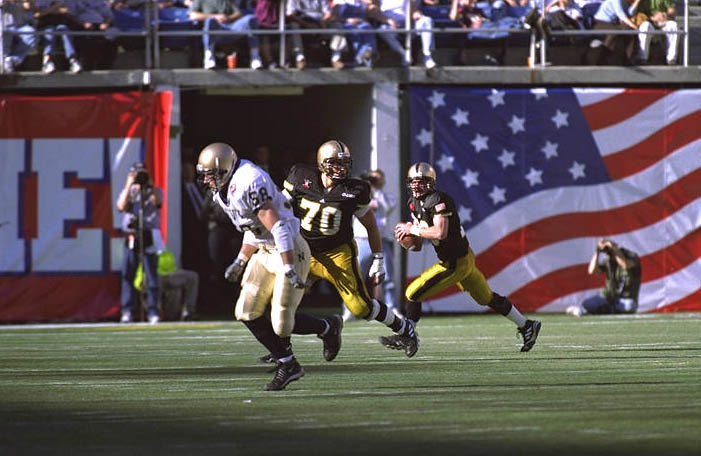
They first looked one another in the eye as team captains summoned to the center of a field surrounded by tens of thousands, and in full view of millions more.  There, Ed Malinowski stood beside Pres. George W. Bush and, on the cue from his Commander-In-Chief, called the opening coin toss of the 102nd Army-Navy game.

Pres. George W. Bush with Army co-captain Clint Dodson prior to the 102nd Army-Navy Game.

“Heads, Sir!” he said, clutching a gold helmet against his white jersey; each resplendent on the remarkably warm and sunny South Philadelphia morning of Dec. 1, 2001.  Brian Zickefoose too cradled a gold helmet in his left arm; only his bore the single black stripe of a West Point Cadet.

In that moment, three months after and yet, in many ways, not a day removed from 9/11, they were one and the same.  The president had ordered troops into Afghanistan eight weeks earlier.  So like every other classmate and counterpart, they fully understood their own call to combat was no longer an ‘if’; but rather a ‘when’.

That reality was palpable in the buildup to kickoff.

Gen. Norman Schwarzkopf, the West Point graduate who commanded coalition forces in the Gulf War of 1991, addressed the Cadets.  Similarly, Naval Academy alum Sen. John McCain, spoke passionately to the Midshipmen.

President Bush also visited both locker rooms, minutes before emerging for the coin toss.  For the record, he even took a handoff from Malinowski; receiving a ball autographed by Navy players.  In 15 months, he would give the go-ahead to bomb Baghdad.

For the players, that phase in their lives in which every fiber was invested in beating the other, in the sport they loved more than any other, would soon end.  Theirs was a common cause; one they were willing to sacrifice anything for.

But first, of course, they had one more score to settle.

*****

Malinowski and Zickefoose were future officers — the former in the Marine Corps, the latter as an Army Ranger — and maximum achievers, a pair of 5-foot-somethings defying typical parameters of their sport.  They were, in other words, quintessential characters in this American classic.

A backup quarterback for most of his career, Malinowski was accorded a cameo start in his career finale.  Throughout a tumultuous season, he tried everything within his reach to hold the Midshipmen together, even volunteering for special teams.

Alas, through nine prior tries and a late-autumn coaching change, victory remained elusive.  Still, Malinowski — quite literally — soldiered on.

In the stands, his mother caressed a dime in her fingers, hoping good fortune would rub off on her Ed, who wore No. 10.  Hers was a ritual that would continue well beyond this game, into subsequent years on Malinowski’s missions to Fallujah and Haditha, Iraq.  At Chartiers-Houston High School on the outskirts of Pittsburgh, faculty did their part for the son of a fellow educator.  Whenever a loose dime was spotted, it was promptly handed over to Marilyn Malinowski.

Meanwhile, Zickefoose was guided less by good luck than good words to live by.

Navy co-captain Ed Malinowski started at quarterback after winning the opening coin toss by calling, "Heads, sir!"

To the men in his life back home in Bridgeport, W. Va., service to country was a family obligation.  Older brother Greg flew for the Air Force; following the lead of their father, Gary, a Lt. Colonel in the Army Reserve.  Both grandfathers fought in World War II.  Grandpa Zickefoose was active in the Army for close to four decades, while Grandpa ‘Hank’ retired from the Navy Reserve.

It was the latter, a.k.a. Franklin Ellis, who became baseball coach at West Virginia Wesleyan for 36 years and penned advice that endures to this day.

“If the sun comes up tomorrow,” Ellis wrote to his grandson, “it’s a good day.”

The tiny postcard on which that simple sentence was written went everywhere Zickefoose did.  As a Cadet, he tucked it into his daily planner.  In years to come, he kept it in his action pack.  It served him well; in hard times as a Cadet, and lean times as a Black Knight.  Like the autumn of ’01, when Army won just two of its first 10 games.

In combat, Zickefoose would gain greater appreciation of its meaning in a place called Sadr City.

“You don’t realize it at the time, how (war) affects your entire persona,” Zickefoose said a decade later, as a husband and father of two young girls.  “You understand the value of small things in life.”

*****

As Army’s tight end and a fellow co-captain in 2001, Clint Dodson considers Zickefoose “the toughest dude I’ll ever know.”  Little more than 200 pounds, Zickefoose was a former halfback and safety moved to linebacker.

Against Navy he seemed to be everywhere at once.  In the final Army-Navy game in the history of — appropriately enough — Veterans Stadium, he helped to ensure that a 26-9 lead prove insurmountable.

Big plays had put the Black Knights in this position.  In the 1st quarter, a 60-yard run by Ardell Daniels and a 42-yard pass from Chad Jenkins to Brian Bruenton produced the first two touchdowns.  Then in the final 13 seconds of the 2nd quarter, Army converted a blocked a punt into a field goal, before Omari Thompson returned the opening kickoff of the 3rd quarter 96 yards.

Meanwhile, the Zickefoose-led defense was holding Navy below 100 yards rushing.  Much of that effort was invisible to Dodson, who was busy with in-game adjustments on the bench.  But what his eyes couldn’t tell him, his ears did.

“I swear I heard his name every series,” he said 10 years later, the echoes of ‘Zick-e-foose’ still reverberating all the way to Hawaii, where Dodson now works in finance.

It would be called one more time, on the Mids’ second-to-last possession.

Malinowski had started that drive with three passes for 36 yards, before unleashing the last throw of his football career.  The result was a last hurrah — or, as one says on the post at West Point, Hoorah! — for Zickefoose.

He intercepted it, fell to the 17-yard line with 2:19 to play and rose to celebrate.  The snapshot of what transpired next stays with him, through a tour of Iraq and more recent 14-month stint overseeing construction projects in Afghanistan.

“In Iraq, or wherever, you remember the guys you played with,” Zickefoose recently said from his home in Lancaster, Pa., vividly recalling a scene shared with Dodson and Jenkins.  “I remember the interception that sealed the deal for us.  I remember coming off and giving Clint and Chad a hug.  There was a feeling of relief to have done what I was supposed to do.  I was happy to bring a smile to the faces of my friends.”

Ardell Daniels gave Army an early lead.

Officially, the game wasn’t over until Navy regained possession, scored to make it, 26-17, and failed to recover an on-sides kick; leaving Jenkins to savor the next 23 seconds.

Aligned in victory formation, Jenkins, who was playing despite a torn knee ligament, handled one final snap before letting go of football.

“We spent five years waiting for that moment, to be on top, to share that moment together,” said Jenkins, alluding to bonds first formed in prep school, later tested and tightened in Beast Barracks and cemented upon commissioning.

*****

The closeness as competitors, carrying over as combatants, as much as anything, makes Army-Navy unique.

“You fight wars for your country; you fight battles for the man next to you,” Zickefoose explains.  “You play games for your school; you play the down for the man next to you.”

Cadets and Midshipmen wage those battles side-by-side.

“It is a game played against your brothers-in-arms,” assures Jenkins, who befriended Malinowski as rival quarterbacks.  “As meaningful and special and wonderful an experience as (beating Navy) is, it’s (all) the guys over there who will be fighting for our future.”

Of course, the true calling of Midshipmen and Cadets was crystallized on the morning of Sept. 11.

Two hijacked planes flown into the World Trade Center filled New York with smoke and ashes visible well up the Hudson River, from the high ground of West Point.

In Washington, an American Airlines flight sliced into The Pentagon.  Its pilot, Chic Burlingame, was a USNA grad frequently in attendance at Navy home games.  The carnage it caused didn’t discriminate between any of the branches of armed forces.

As in Manhattan and later a Pennsylvania field, it was an attack on of all of us.  Some of whom, in places like West Point and Annapolis, suddenly prepared to fight back.

“It’s crazy how naive I was at the time I got to the Naval Academy, all the way into my senior year,” Malinowski reflected last month from his home in Cranberry Township, Pa.  “There really wasn’t much going on (around the world) for three years.  I was worried about passing (my) Weapons and Systems Engineering class, worried about football, worried about my girlfriend.  Then it was like, ‘Wow!  I just became a grown-up.’”

“I don’t think (9/11) changed everything but it brought everything to the forefront,” says Dodson, who was sent into Afghanistan three years later.  “It’s a one-day-at-a-time environment (at West Point).  You’ve got to get through the next day, then the next day, then the next day.  Well, now (after 9/11) it was like, ‘You’re gonna go off to war.’”

Malinowski (10) and Navy teammates stand alongside Black Knights for singing of alma maters.

While Dodson was about to take his place in the Long Gray Line, as part of the first post-9/11 graduating class, 200 miles to the south, Shalimar Brazier had yet to sign his 2-for-7 papers.

Brazier, a sophomore cornerback, had time to reconsider committing to his final two years of schooling and at least five years of active duty.  If so desired, he could transfer without any obligation to the Navy.

“Most people said, ‘I’m going to do my part,’” Brazier states, before reciting the questions one asked of himself.  “‘Am I ready for this?‘  That thought has to run through your mind.  You have to make an educated decision.   Am I going to give the best I have?”

His answer was affirmative, times two.  If anything, the aftermath of 9/11 revealed “a sense of The (Navy) Brotherhood, and not just with the football team.”

Resoluteness was mutual.  Players from both academies were eager to step into the so-called boots on the ground; however treacherous the terrain.

Ryan Hamilton, a linebacker for the ’01 Midshipmen who reached the rank of Captain as a Marine, remembers how “the numbers jumped” among teammates service selecting the Corps.  A similar trend was evident at West Point.

“More guys on the team wanted to go infantry than previous years,” says Dodson, who opted for Airborne, Infantry and Ranger schools; paralleling the paths of Zickefoose and Jenkins.  “That itself said, resoundingly, where our hearts and minds were at the time.”

In Jenkins’s case, it’s also where his soul had been since the summer after his sophomore year, when a visit to Air Assault School exposed him to a true sense of purpose.  Ever since, he dreamt of joining the 75th Ranger Regiment.

“They’re the type of individuals, when things go bad, you want to be surrounded by them,” says Jenkins, who calls the young men he eventually commanded in the 2nd Ranger Battalion — many no older than academy underclassmen — “my heroes.”

Leaving them was difficult, despite the disruptions of deployment; like when plans to propose to then girlfriend Emily were put on hold, because a scheduled 30-day leave was shortened to a week.

Jenkins eventually popped the question, and Emily’s answer (yes, of course) subsequently led him to seek the stability of civilian life in raising his two children.  Still, other kids of his remain close to heart.

“Those are the kids I think of first and foremost, like the 18-year-old Ranger who’s the first going into a house and doesn’t know what’s on the other side of the door,” says Jenkins, who now works for the FBI’s counter-terrorism unit.  “I love those guys so much.”

He was remarkably fortunate in his four deployments to never lose a soldier under his command.  Which isn’t to imply that Jenkins doesn’t know loss.  They all do; these Cadets and Midshipmen from the Class of ’02.

Most recently, Jenkins dealt with the death of Kristoffer Domeij, a Ranger special operator killed on, incredibly, his 14th deployment.  Others were rocked by fatalities among former teammates.

Zickefoose can tell you about the lunch he shared in 2005 at Camp Rustamiyah with James Gurbisz, an ex-Army football player turned rugby standout.  About a week later, Zickefoose “heard a boom.”  It was an improvised explosive device (IED) detonating.  One of two soldiers killed was Capt. James Gurbisz, age 25.

Army's Chad Jenkins on the roll-out.

For Hamilton, “there isn’t a day that goes by” without remembering fallen heroes of the Navy Brotherhood.

“I get so emotional on that one,” he recently said, voice quivering as he steadied the wheel on a drive through Western Maryland.

Among them is Lt. Ron Winchester, Class of ’01.  His last appearance as an offensive tackle was in the 2000 Army-Navy game.  So typical of this rivalry, his lifelong best buddy was on the other side of scrimmage, Cadet nose guard Doug Larson.

As a so-called Firstie, he mentored Brazier, then a Plebe.  And if ever there was a Midshipman to model yourself after, it was the soft-spoken Long Islander who carried a big heart.

In Sept. 2004, on the eighth day of his second deployment, the 25-year-old Winchester was killed by a roadside bomb in Al Anbar Province.

That November, during a firefight in Fallujah, roughly 4-5 blocks from Malinowski, a sniper’s bullet pierced the left shoulder of Lt. J.P. Blecksmith.  Dead within seconds; he too was just 25.

Less than a week later, Malinowski was re-supplying as a logistics officer, amid the first of his tours of Iraq, when he asked someone about casualties within Blecksmith’s regiment.  Until then, he had no idea.

“It’s one of those times in life that just smash you in the face,” Malinowski says.  “You want to sit down, but you still have 30 Marines to care for.  There’s no time to grieve.  Later, you pause to reflect.”

*****

A decade after 9/11, Army-Navy remains unlike any other rivalry.

Our world became a different place a decade ago.  Especially for the young men competing on that first Saturday of Dec. 2001.

“None of us in our professional military careers know anything but war,” Zickefoose explains.  “For our generation, that’s all we know.”

Yet, the essence of Army-Navy was unchanged.  And remains so years later.  Mutual respect is inherent because of the shared experiences and greater mission of Cadets and Midshipmen.

“Especially after 9/11, you go through something so different that no one else can relate to,” Dodson says.  “They have a good understanding of what we’re going through.”

Those who competed in his day answered their call to duty.  Many still do.  Whether in the Reserve, like Dodson or Zickefoose.

Or on active duty, like Capt. Bryce McDonald, USMC; a fullback whose left leg was severely wounded by an IED while on patrol in Haditha, Iraq in 2006.  McDonald remains part of Navy’s program in his role as liaison officer.

Others stay close, as they always have; even from afar.

Internet, television and round-trip tickets get them to the games they want to see.  And this is one they wouldn’t dare miss.

Because as much as they’ve given to America, they’re grateful for what Army and Navy have given them.

“What football did for me is incredible,” says Jenkins, recipient of the last snap in 2001 and the last word 10 years later.  “I can honestly say that no other academy class, extra-curricular activity or summer training prepared me (like football) for taking over an infantry platoon and taking that platoon to combat.

“It prepared me to lead our most prized possessions into harm’s way.  No other event up to that point in my life prepared me to do that.  That’s what it means to be an Army football player and a Navy football player.”

A View From The Booth: Idle Time For Some Random Thoughts

By Bob Socci

Originally published on www.navysports.com on Dec. 1, 2011.

Here I sit at the keyboard, two weeks after Navy’s last game at San Jose State and roughly a week before the Midshipmen play their next against Army.

Leaves have been collected from the backyard and stuffed into lawn bags.  Rooms have been switched and furniture re-arranged, as my wife and I try to get organized before a chaotic Holiday season and the expected arrival of our second child.

So I must admit, as much as I miss the excitement of a football game day and love my Saturdays in the Navy radio booth, all this idle time of late has led to some semblance of order to life.  Temporary as it no doubt is.

Heck, there’s even time today to attack the stacks of bills (yikes!), magazines (no matter that by now their pages are filled with old news) and junk mail (seriously, how can the postal service be in such trouble?) rising on and around my desk since a late-September bye-week.

And yet, because I’m far better at procrastinating than prognosticating (put it this way, there’s a reason I’ve never gambled), I think I’ll hold off on them for now.  After all, there’s bound to be a free day or two sometime before the 2012 season opens in Dublin, right?

Besides, I’d much rather use the time to share some items that recently crossed my mind or were written into my notebook.

But like so many other things around here, at least until the last few days, there’s little organization to what I’m about to write; less a stream of consciousness than a handful of random thoughts.

*****

During Paul Johnson’s six-year tenure as Navy’s head coach, the question of whether an option offense could succeed in the NFL arose periodically.  As with most topics, Paul didn’t mince words.  His answer was a resounding “yes,” presuming the “right personnel” was in place.

With Tim Tebow, the Broncos are running an option offense, doing in the pros...

“Can you imagine Michael Vick running it?,” Johnson once said of the then Atlanta Falcon during a commercial break in his radio show, scoffing at the conventional thinkers who’ve long considered the option unfit for the pros.

Well, years later, with Johnson now in Atlanta at Georgia Tech, the ex-coach of the Midshipmen certainly looks like he knew what he was talking about.  Not that you’d ever expect otherwise, given his option expertise.

While Vick is injured on an underachieving Philadelphia team, the Denver Broncos ride a four-game winning streak on the shoulders of a terrific defense and, yes, an option offense.

As anyone not “too busy keeping up with the Kardashians” (more on that in a moment) knows, the Broncos and, specifically, quarterback Tim Tebow are part of the conversation on every frequency from 24-hour sports-talk radio stations to NPR’s All Things Considered.

...what the Navy Midshipmen have done in college football since 2002.

Of course, much of the chatter concerns either the magnetism or, to many, the polarization associated with Tebow.  But what fascinates me is how the Broncos have gone from 1-4 to 5-1 since bucking NFL stereotypes by doing to pro defenses what the Mids have done in the college ranks since Johnson came to Annapolis in 2002.

True, Denver runs the read-option; more along the lines of what Tebow operated at the University of Florida.  Still, basic principles of that offense are the same as Navy’s triple-option.

In 2008 the Miami Dolphins confused opponents by essentially resurrecting the Single Wing with the Wildcat formation.  Rival coaches were left to explain how the unfamiliarity of it in the modern NFL was cause for great consternation.

Suddenly, we’re hearing similar things about preparing for the Broncos.  Much the same way opposing coaches have spoken about the Midshipmen throughout the last decade.

*****

Speaking of the offense Johnson reinstituted after the one-time Navy offensive coordinator was hired as head coach in ’02, I was in Dallas the night the Mids debuted under his direction with a 38-7 rout of SMU.

Joining me on the radio, just he’d done the previous year at Toledo and would do on a couple of other occasions, was Ron Wolf.  A former executive for the Raiders, Buccaneers and Packers, Ron had retired to Annapolis and filled-in as a color commentator on our broadcasts.

Former Packers GM Ron Wolf, alongside his most famous acquisition.

Last Sunday — as noted by Sports Illustrated’s Peter King — marked the 20th anniversary of his hiring as Green Bay’s general manager.  Wolf went on to trade for Brett Favre; hire Mike Holmgren; convince Reggie White to sign as a free agent; and develop a scouting and drafting system that led to two Super Bowl titles, on his watch in 1997 and under protege Ted Thompson last season.

Ron recently made the list of 26 semifinalists for the Pro Football Hall of Fame as a “contributor” to the game.  In early January the nominees will be pared to the 15 names included on this year’s ballot for enshrinement in Canton.

Though no longer seen driving around Annapolis in his red convertible — Ron and his wife moved back to Wisconsin — surely everyone he associated with at the Academy is pulling for him to have a HOF bust next summer.

Wolf is a brilliant evaluator of football talent; shrewd enough to select Mark Brunell and Matt Hasselbeck withfifth- and sixth-round draft picks, respectively.  He’s also a historian of the sport and big fan of service academies, in particular.

While in Annapolis, he owned season tickets and regularly borrowed old films of Navy greats from video coordinator John McGuire; always in a genuinely appreciative and unassuming manner.

*****

A no-doubt future Hall of Famer with far-reaching Academy ties, Bill Belichick, said something this week that, I believe, has great relevance to the Army-Navy Game.

The three-time Super Bowl champion head coach of the Patriots and son of the late longtime Navy assistant, Steve Belichick, discussed first-place New England’s upcoming meeting with the winless Indianapolis Colts:

“(Our players) heard me talk about it every week, saying we don’t care about the record, and we don’t,’’ Belichick was quoted in The Boston Globe.  “What difference does it make?  Look, how somebody played two weeks ago against somebody else, who cares?  Us or anybody else.  It doesn’t matter.  The only thing that matters is how we and the Colts perform against each other on Sunday.  That’s all that matters.  Who cares who won three weeks ago in some other game against some other players?  It doesn’t matter.

“We talk about it every . . . It doesn’t matter. There’s 16 games on our schedule, they’re all the same.  It’s our team against that team that week and we look at, try to learn about our opponent and scout them and pick up tendencies, strengths, and weaknesses, and all that, but how we match up against that team that day is all that matters.

“The rest of it is just a bunch of garbage.  You guys can write about it all you want, it doesn’t matter.  I mean, really.  The winner of this game will be decided by which team plays better on Sunday, not what happened four weeks ago.  It’s like that every week.  Every week.’’

So what, you ask, does that have to do with the Mids and Black Knights?  Navy has won their last nine encounters, all by margins of 12 points or more.  In fact, overall in the Commander-In-Chief’s series, Army has lost 21 of its last 23 games.

Belichick, you and I all know that despite recent history, what matters is how the Mids match up with the Cadets next Saturday.  Still, it doesn’t hurt to be reminded; even if by a coach speaking in the context of Patriots-Colts.

*****

Finally, you might have heard halftime commentary by Bob Costas during NBC’s telecast of the Steelers vs. Chiefs last Sunday evening.  If not, perhaps you at least heard or read about it (check it out here).

Costas linked debased popular culture — opening with a reference to the infatuation many Americans have with the likes of the Kardashians — to an increasing affront to good taste and true class across the sporting landscape; specifically each week on fields around the NFL.
Don't expect to see end zone antics like this...
...when Alexander Teich of Navy meets Steve Erzinger of Army in the 112th encounter of Midshipmen and Cadets.

Maybe you agree with those critics who labeled Costas smug and self-righteous.  I — to the surprise of absolutely nobody who knows me — think differently.  To my ears, Costas’s soliloquy sounded like the best 2 minutes, 20 seconds I’ve heard on network TV in a long, long while.

His words and the video to support them remind me of one of the great rewards in covering the Midshipmen.  And give all of us further reason to look forward to what we won’t see when we watch Army-Navy next weekend.

Join Bob on Saturday, Dec. 10, when he calls his 15th Army-Navy Game, working alongside Omar Nelson, on the Navy Radio Network.

Making A Difference: The Story of Calvin Huey and Emerson Carr

By Bob Socci

Originally posted on navysports.com on October 31, 2011.

Last winter when the Navy Midshipmen were polled by their coaches to name a new pair of captains, the easy choice for the defense was Jabaree Tuani.

“The perfect defensive captain,” his once and again teammate, in high school and at the Naval Academy, Mason Graham declared.

Not that it mattered as they cast their votes, nonetheless his fellow Mids paid Tuani the same level of respect he earned in his prior life as a student attending at a small, private school near Nashville, Tenn. There, at Brentwood Academy, the popular Tuani was elected the school’s first African-American class president.

“I was at a predominantly white high school, but it didn’t bother me at all,” Tuani says. “I got to know everybody on a personal level.”

They, including Graham, did the same; ignoring the meaningless obvious for the only thing that matters when judging another. It was no different four years later.

And no surprise. The Midshipmen were here in the first place because of the content of their character. From the shades of their skin to the syllables forming their family names, they’re representative of an increasingly diverse Academy.

Descendants of the Far East, Latin America, the Pacific Islands and numerous other latitudes and longitudes, they consider themselves a Brotherhood. As teammates, race and ethnicity are irrelevant.

They serve under a Commander-In-Chief, Barack Obama, who is our first African-American president. Often they train inside a state-of-the-art facility named in honor of the Academy’s first black graduate, Wesley Brown.

More than any other player, save for fellow captain Alexander Teich, Tuani speaks for them. His is the voice that resonates from their locker room to Bancroft Hall to the ears of those outside Academy walls. He is their team leader in a 21st Century Annapolis.

But less than a half century ago, this was a very different place and Navy football had a very different look, because the Mids all looked the same.

While Brown graduated in the Class of ’49, it wasn’t until 1964 — 17 years after Jackie Robinson debuted with baseball’s Brooklyn Dodgers – that a player of color played for the Blue and Gold.

Recently, Tuani was quizzed about that football predecessor, a son of the South, who blazed a trail to Annapolis. An inquiring mind wanted to know if he’d ever heard of Calvin Huey. Tuani had not.

In fairness — and full disclosure — neither had the individual who posed the question; at least not until the most recent week or two of a 15-year tenure covering the Midshipmen. Nor had his broadcast partner from the Navy Radio Network, Omar Nelson, a ’97 grad and former USNA instructor particularly close to many players of the last decade.

The same was true in May 2008, when Frank Simmons returned to his alma mater for the dedication of the Wesley Brown Field House. Recognizing a prominent member of the Mids, Simmons pulled the young man aside and asked: Do you know who Calvin Huey is?

As with Tuani, Nelson and this writer; if Huey’s name rang a bell, the significance of the man and his accomplishments didn’t quite reverberate. That’s when Simmons made it his mission to educate the rest of us about Huey, as well as Emerson Carr; two individuals as important as any in Navy football history.

Simmons was commissioned with the Class of ’68. When he entered the Academy, blacks within the Brigade included three seniors, no juniors and two sophomores. He was one of seven minority plebes, among the four to graduate.

Working as a program manager for SAIC, the Fortune 500 defense and security contractor headquartered in McLean, Va., Simmons recently found time to act in the names of Huey and Carr.

“One day at work, a couple of months ago, I thought, ‘This is the day I’m going to do it,’” Simmons said. “Today I’m going to send an email to (Chet) Gladchuk.’”

His message to the Academy’s athletic director led to the words that follow, about two men whose college choices are watersheds in the 131-year history of Navy football.

Calvin Windell Huey grew up in Pascagoula, Miss. He was 19 years old when U.S. Marshals were ordered to his home state to enforce a federal court order allowing black student James Meredith to enroll at the University of Mississippi.

Influenced by uncles who schooled him in math, and a mother who enrolled him in summer programs at Historically Black Colleges, Huey was a gifted student. He was especially interested in science, specifically chemistry.

“My hope after high school was to go the University of Chicago, Ohio State or Wisconsin,” Huey recently said from his Annapolis home, before laughing. “Unfortunately, I didn’t know you needed money to go to those schools.”

He attended Tuskegee briefly, but left to join a friend at Oakland City College in California. Leaving the segregated South to go West, Huey was eventually lured East.

At Oakland, he was honorable mention junior college All-America as a quarterback. Recognizing Huey’s aptitude and athleticism, a friend suggested he pursue a service academy appointment.

Huey contacted Mississippi representatives. As you’d expect, he was immediately denied. One congressman, he remembers, reasoned that he didn’t want Huey “to be a stain on Mississippi.”

Undeterred, he instead got a California representative to nominate him; not as a football recruit, but solely on his own accord. In fact, Huey says he had no contact with Navy’s coaching staff before trying out for the team as a plebe.

Contrastingly, Emerson Frank Carr was being courted by all three academies, and numerous other programs, while enrolled at Central High in Minneapolis.

“I was the biggest guy on our team,” says the 6-foot-3 Carr, whose media guide bio listed him as a 235-pound defensive end entering his senior season with the Mids. “And I’m proud to say, also the fastest. I used to beat our receivers in wind sprints.”

West Point, which wouldn’t suit up its first African-American player until 1966, was the first to call on Carr. But yearning to fly, he was more interested in the Naval Academy.

A year after Huey reached Annapolis, Carr followed, becoming the first black Minnesotan to attend a service academy.

Hailing from the North Country, Carr makes light of his mostly pale surroundings in the Twin Cities.

“I went to what was considered a predominantly black school in Minneapolis, (but only) 20 percent of the students were black kids,” Carr says, before showing off his sense of humor. “You could also say the non-Scandinavians were the minorities. I thought the whole world was made up of Andersons and Johnsons.”

Regardless, Minnesota was very progressive. Unlike the city of Annapolis, where public schools remained segregated until 1966, more than a decade after Brown v. Board of Education. Carr found certain restaurants and movie theaters off limits.

On the other hand, Huey was accustomed to such racial demarcations. Sitting below the Mason-Dixon Line, Annapolis was, he remembers, “very much like Mississippi.”

Huey makes the comparison absent the slightest tinge of bitterness or resentment. Same goes for Carr.

Though outside the Academy, the Civil Rights Movement was gaining momentum. Inside, Huey and Carr were simply trying to succeed as midshipmen.

“The March on Washington took place during my plebe summer,” Huey recalls. “I didn’t know it occurred until a year after.”

That’s because he concerned himself only with what he needed to know to satisfy the demands of upperclassmen. If skin color subjected either to extra harassment, neither was aware of it.

Huey actually thinks he had it easier than most by trying out and making the basketball team, as well as the football squad. Sports enabled him to dine with teammates, instead of answering to older shipmates.

“I think I pretty much had a free ride by being an athlete,” he says. “I wasn’t dumped on as much as other midshipmen because I was playing sports. I had no trouble until the end of the year, because I ate at the training table for football and basketball. I joke that I had a two-week plebe year.”

More than likely, fellow mids simply reciprocated the way Huey conducted himself.

“It was important for me to be as respectful as possible,” he says, “and try to be an exemplary midshipman and person.”

“I don’t think I was treated differently than anyone else,” adds Carr, who was too busy making history to consider his place in it. “After the fact, one of the things you became aware of is being a trailblazer.

“The people who really pulled me through are my classmates. My classmates treated me like one of them.”

Coaches did too, namely three assistants. Carr remains thankful for the tutelage of Carl Schuette; the way Lee Corso “took (him) under his wing;” and the equal-opportunity demands of Steve Belichick.

To Belichick, the only time to see anything as black or white was on the practice field. Things were either done right or wrong; no in-between. But there was one problem that still causes Carr to chuckle: Belichick could be too indiscriminate. Sometimes, players couldn’t distinguish among themselves.

“Steve had the ability to look at the entire field and see everyone at the same time,” Carr explains. “He was the linebackers coach. He would be yelling at someone during practice, but we weren’t sure who he was yelling at. You couldn’t tell from his eyes. We’d turn to each other as players and ask, ‘Who’s he talking to? Was that you or me he was talking to?’”

There was little to nitpick about Carr. In Navy’s 1968 media guide, Schuette said Carr had “exceptional talent, speed and quickness…all the attributes to be one of the East’s leading defenders.” His words held true when Carr was invited to the East-West Shrine Game.

Meanwhile, Huey was singled out in his senior-year bio for “poise under fire,” as “an outstanding pass receiver and determined downfield blocker.” Though a quarterback at heart, he moved to receiver to become a catching complement to the passing of Roger Staubach.

In the autobiography Staubach: First Down, Lifetime to Go, the ’63 Heisman Trophy winner wrote: “Calvin Huey was just the kind of guy you liked. He had a great personality, worked hard in football and was an intelligent guy.”

Smart in the classroom, Huey was also savvy on the field.

Shrewd enough, at least, to improvise what for a fleeting moment or two had the makings of one of Staubach’s most memorable plays.

Facing a late deficit vs. Maryland in 1964, Huey subbed for one of Staubach’s favorite targets, Skip Orr. As the clock eclipsed the 3:00 mark, Huey caught a 10-yard touchdown pass for the lead.

“I actually called that play,” Huey says. “Roger would sprint out to the right and the Maryland defense would flow with him. I suggested he do a half roll, and throw back to me.”

Unfortunately, in the immediate aftermath, Ken Ambrusko’s 101-yard kickoff return lifted the Terrapins to a 27-22 victory.

“On the ensuing kickoff, my classmate Bob Havasy fell and hurt his knee,” Huey says of his good friend. “Whenever I see him, I joke that I would have been a hero if he hadn’t gotten hurt.”

Punchlines aside, Huey was already heroic. Not by making touchdowns, but by creating touchstones for future generations.

The following year, as a junior in his final season of eligibility, he became the first African-American to take the field at Georgia Tech. Though Navy fell, 37-16, Huey’s monumental afternoon in Atlanta was incident free. Interestingly, the only insults he remembers hearing in a game were hurled much farther to the North, at Penn State.

Likewise, there were times Carr stood apart from teammates and opponents alike.

“We played at a number of Southern schools,” he says. “Often I was the only black player on the field. It’s not something you think about while you’re playing.”

Only decades later. Like when Huey reflects on the game he cherishes most as a Midshipman.

“Army was the most incredible experience,” says Huey, despite the apparent emptiness of a loss and a tie in two varsity appearances opposite an arch rival. “It was the shortest game of my life. It goes so fast.

“I think the Army-Navy game is the thing I’m most proud of. You’re on the field and you know that countless eyes are looking at you.”

Imagine what it must have been like seeing Navy’s lonesome end in America’s game. Especially for people still denied basic rights

Less than a year earlier, states ratified the 24th Amendment to the Constitution, outlawing payment of poll or other taxes intended to marginalize blacks during federal elections. Just five months earlier, Pres. Lyndon B. Johnson signed into law the Civil Rights Act of 1964.

And fewer than four months earlier, the bodies of James Chaney, Andrew Goodman and Michael Schwerner were found buried together; weeks after they disappeared while protesting, as part of the Mississippi Freedom Summer.

“There was a lot going on in the 60s in the Civil Rights Movement,” says Carr, who originally was a year behind Huey but later spent another full year away. “I went to Annapolis before black people could vote in Mississippi.”

And now, if you will, picture the misguided congressman worried about Huey leaving a stain on the state of his birth. How might he react were he to learn what became of Huey? Or, for that matter, someone like Carr?

They are men of distinction less for what they did as football players than for what they’ve accomplished since.

Huey graduated in 1967, and was eventually assigned to the USS Perry in Mayport, Fla. Before long, he deployed on the first of his two tours of Vietnam. He then continued his education until earning a Ph.D. in Chemistry.

In 1973, he joined the faculty at the Naval Academy, combining classroom instruction with coaching what’s now known as ‘sprint football.’ Back in Huey’s day, it was ‘lightweight’ or ‘150’ ball. By any name, he thoroughly enjoyed it.

After his third year back, former teammate Tom Leiser persuaded Huey to join him at IBM. He remained with Big Blue until 1997, when health problems resulted in a kidney transplant. Fourteen years later, Huey’s nephew donated a kidney for a second transplant.

Carr also has endured health problems since transitioning seamlessly from military service to civilian success.

He fulfilled his lifelong goal to fly, piloting an A-6 Intruder and C-130 Hercules in the Marine Corps. Among his closest friends is ex-squadron mate Major General Charles Bolden, USMC. Bolden graduated from the Naval Academy in 1968, 41 years before becoming NASA Administrator.

An engineer, Carr retired as a Captain and joined General Motors in 1984. In year six, he was promoted to global operations manager for the company’s subsidiary AC Spark Plug, overseeing more than 4,000 employees in North America and Europe.

Much of Carr’s post-military life was spent in Michigan, though he briefly lived in England, where he also studied at Oxford. But by 2004, he moved to Silver Spring, Md. and was a partner in a consulting firm.

Back in the Detroit area on business, Carr was driving to an early-morning meeting when his vehicle was hit by a semi-trailer.

“It was,” he says, “as serious as it gets.”

For two months Carr was on a ventilator. His rehab continued for weeks thereafter, only to be set back significantly by a staph infection. He suffered multiple heart attacks, received a pacemaker and redoubled his rehabilitation program.

However grave his situation, Carr fought through it. At one point, his doctor at the Beaumont Trauma Center in Royal Oak, Mich. approached Carr’s wife, Anita, to detail her husband’s background. According to Carr, his medical team was astounded that he survived.

“‘He’s been trained to fight and survive,’” says Carr, repeating the doctor’s line upon learning of the Marine’s remarkable career. “‘That’s the reason he’s going to make it.’

“Going to the Naval Academy and being in the Marine Corps can have that impact. It impacts you in ways you don’t realize.”

One of the ways most obvious to both Huey and Carr is the ceaseless support each receives from classmates, as he wages his battle against health problems. For Carr, the fight includes a bout with lung cancer.

“The Naval Academy creates bonds that last for a lifetime,” says Carr.

They include ties to successors such as Tuani, who expresses a desire to learn more about the men who opened the door for African-American players in Annapolis.

“I definitely would like to find out more, knowing the adversity those guys had to face,” Tuani says. “They didn’t let it bother them…Nothing could have told those men to quit. I couldn’t imagine not being able to hang out with my friends in public places.”

Not so long ago, the idea of a black kid from Mississippi attending the Naval Academy was unimaginable too. Except to Calvin Huey.

“It makes me proud,” Huey says. “I don’t brag about, I cherish it. My wife (Deborah) brags about it.”

Chuckling, Huey describes how he is is still recognized in Pascagoula. There’s a Hall of Fame inside the technical school that replaced his old high school. He’s included, of course; a plaque there denotes his Academy achievement.

Both Huey and Carr came to Annapolis seeking a higher education, and willing to answer a higher calling to a country whose citizens stood on uneven ground.

By attaining the former and fulfilling the latter, they did their part to impact the Civil Rights Movement in ways they probably didn’t realize at the time. All these years later, it’s about time we all realize it.

“Every African-American my age was affected by Martin Luther King and the struggles of people who died, like four little girls in church on a Sunday morning,” says Carr, alluding to the Sept. ’63 bombing of a Birmingham church. “You have to be impacted (by that). I wasn’t riding the bus, but I was doing something other black people weren’t doing.”

“In a very small way, yeh,” Huey replied, his voice breaking up, after being asked if he made a difference for other African-Americans. ”It gave people hope they could do the same thing.”

Bob is in his 15th season calling radio play-by-play of Navy football.  He can be heard alongside partner Omar Nelson on Saturday, Nov. 12, when the Midshipmen visit SMU, on the Navy Radio Network and Sirius Satellite Radio.  For samples of his work, please visit. www.bobsocci.com.

John Dowd: Navy’s Old-School Lineman

By Bob Socci

Originally published in Navy vs. Southern Miss Gameday Program (October 8, 2011). 

The answer is self-deprecating, the words spoken over a steady track of his own laughter.

John Dowd was asked to assess his overall performance to date.  He is three games into his senior season, really just beginning his second year as starting right guard for the Naval Academy.

“I don’t do things very pretty,” Dowd says, a chuckle suggesting that he’s revealing a means to survival more than describing any style of play.  “I’m not very graceful but I get them done.”

To illustrate what he means, Dowd sets the scene from one of the late August afternoons leading up to the 2010 opener against Maryland.  Blocking to solidify his space on the Midshipmen’s offensive line, he engages a defensive counterpart.

Simultaneously, Dowd grapples with some suddenly non-adhesive athletic tape.  He is trying to keep his balance and use his leverage.  But the tape, once wrapped tightly to support his ankles and wrists, is unraveling right there on the practice field as Dowd does his best not to come undone.

He recreates the scene in his Staten Island English, which is its own sound, distinct from Brooklynese or any other dialect spoken in the five boroughs of New York City.  To finish his anecdote and complete his point, Dowd wants to share the line his position coach utters as the play — and all that tape — unfolds.

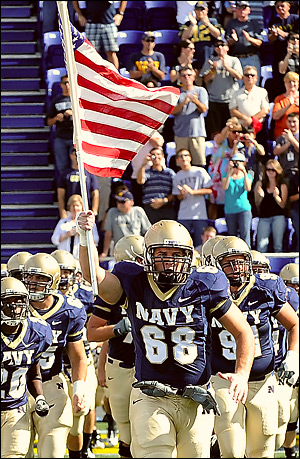
John Dowd (68) leads Navy out of its locker room on Sept. 11, 2010.

However, he’s smart enough to recognize his own limitations; few as they are, as you’ll soon discover.  It’s one thing for Dowd to simply repeat what Navy assistant Ashley Ingram has to say.  And quite another for someone raised between the Goethels and Verrazano-Narrows Bridges to try to replicate the native sound of Iron City, Ga.

“Coach Ingram has a strong accent,” Dowd prefaces, again with a laugh.  “I’m not going to try to do it.”

Then he delivers Ingram’s punch line — the coach’s words in his voice — to a play that ended with the 6-foot-4, 260-pound Dowd tripping.

“(Coach) was like, ‘That’s how you come off the ball!’’ Dowd says, his voice at least mimicking Ingram’s excitement.  “‘You stay low, you got stuff falling off you, and you plant him!  Then you go talk smack with your thick New York accent.’  I think that’s a pretty good way to describe how I play.”

Center Brady DeMell, who’s started every game alongside Dowd since the beginning of last fall, offers his own account of Dowd’s modus operandi.

“He’s an old school kind of player,” says DeMell, likening his pal’s on-field appearance to the grit captured on the grainy celluloid of NFL Films back in the 1960s.  “He’ll do whatever he can to get the job done.  Sometimes he makes a fantastic block, but sometimes he just puts his body in position to get the job done.”

Unlike Ingram’s summation, DeMell’s lacks any mention of extracurricular commentary.  If you believe Dowd, truth is most of the time he’s the one receiving rather than giving an earful.

“Probably every game we’re winning,” Dowd says of the frequency of trash talk crossing the neutral zone from defenders cut blocked down to size by the typically-smaller Midshipmen.  “You hear a lot of interesting stuff about that, like ‘Why don’t you block me like a man?’ or other things of that nature.

“But as long as we’re scoring touchdowns, that’s good enough for me.  I usually don’t say much on the field, and actually I didn’t say anything to that one.”

A good thing for his opponent, who was likely to be outwitted as well as outmuscled.

Dowd is easily one of the brightest players in college football, with the near-perfect grades to prove it.  Twice in his first three years in Annapolis, he was selected Academic All-America by the College Sports Information Directors of America.

After Second Team honors as a sophomore used mostly in reserve, Dowd was named to the First Team as a full-time starting junior.  The last Midshipman chosen First Team Academic All-America was Ted Dumbauld in 1980.

No course load is cake at the Academy; but what makes Dowd’s distinction especially impressive is that he’s earned a 3.92 grade-point average majoring in Mechanical Engineering.  This semester alone he carries 16 credits in classes ranging from (Nuclear) Reactor Physics to Introductory Economics.  Safe to say, Dowd is at low risk of contracting senioritis.

Still, one’s academic aptitude often remains independent of what coaches call a ‘Football IQ.’

“They are two totally different things,” Ingram explains.  “One, you sit and memorize and learn things.  (The other), people are moving in space.  A lot of guys can do it on paper, but when you put them in the situation (on field), maybe they freeze up or don’t transition soon enough, so things are happening too fast.”

That, Ingram makes clear, is a non issue with Dowd.  Whether wearing a pocket protector or protecting the pocket, his intelligence translates and his toughness transcends.

“Obviously, John understands concepts,” says Ingram.  “He’s definitely one who can transition from the classroom and film study onto the playing field.”

Ingram illustrates how Dowd processes what he sees to aid in-game adjustments.

“When things start happening in the game, you ask, ‘John, what’s happening here?’” Ingram offers.  “He’ll say, ‘Well coach, their linebacker’s playing downhill, so maybe I need to do this,’ or ‘Their linebacker’s playing over the top, so maybe I need to do this.’

“I love coaching him.  Obviously, he’s a very smart young man, (but) he’s as tough as they come.  If you could line up 11 John Dowds on the field all the time, you’d feel confident that (they’re) going to know what to do and going to play as hard as (they) can.  He’ll do everything in his power to get the job done every single play.”

Backing up his statement, Ingram rattles off a list of injuries hampering Dowd, if not his performance, during his career.  Ingram works his way around the anatomy, from knee to hip to the latest, his hand.

Dowd fractured his right thumb at South Carolina.  To remain active on the O-line, he was fitted for a boxing glove layered in tape, presumably sticky enough to last a complete game, at least.

“John’s obviously a smart football player who epitomizes who we are: just a bunch of guys who come to work,” says Navy head coach Ken Niumatalolo, who notes that Dowd smoothly converted from tackle to guard and is adept at all three disciplines of blocking in an option offense — scoop, pull and base.  “He adds great chemistry and great confidence to our offensive line.”

Being tight upfront is imperative on any football team; even more so with the Midshipmen.

“The type of offense we run, you rely on getting double teams,” Dowd says.  “So you’re working with somebody 80 percent of the time, or some crazy odd number, because we like to get two of our smaller guys on one of their bigger guys.

“We basically have to play as one team inside the team.  If somebody’s not getting it done, it affects us all.  So we do take pride in our cohesiveness and the fact that we’re so tight.”

To foster such unity, Navy’s offensive linemen regularly meet on Thursdays at the Drydock Restaurant inside Dahlgren Hall.  A small break from their every-other-weekday routine, it’s a chance to hang out as long as a couple of hours.  In season, they also congregate on Fridays at the team hotel to kibitz while surfing televised games.

Sometimes, on either night, what brings them closer is picking each other apart.  But in a good way.

“It’s all fun between us.  It keeps you sane at this place,” says DeMell, indicating that Dowd has the thick skin one expects of a New Yorker.  “We take shots at John, but he takes it well.  We all spend a lot of time together.  We know we can’t let each other down.”

Often, from both inside and outside his social circles, Dowd hears about the spots he and his parents appeared in the last two years for CBS Sports.  Produced as preludes to Army-Navy telecasts, they were moving portrayals of the young men who play at West Point and Annapolis.

Commonly referred to as “teases,” they are viewable on-line.  As you’ll discover should you take the time to Google the 2009 piece in particular, Dowd set the stage for Army-Navy with four words that, well, live in infamy:  Let’s get it on!

“I’ve gotten that quite a bit the last two years,” Dowd says of his line, scripted for him to conclude a vignette narrated by Harrison Ford.  “To put it lightly, I’ve had a lot of people ask me to do it.  I kind of cringe every time I hear it.”

Dowd is a two-time Academic All-American.

Yet, in the preceding three minutes, his mother, Kathy, emerges as a most memorably likable figure.  Joined by her husband, Thomas Dowd, she speaks poignantly of her son, his comrades and their counterparts.

“Remember their names, remember their faces,” Kathy Dowd says to America.  “Oh John Dowd, I am so proud of you!”

In quick-cutting clips, she animatedly — with hands and voice — describes the game’s pageantry.

“It’s enough to take your breath away,” Kathy proclaims.

And then she proceeds to do the same.  Two and a half minutes in, wearing John’s No. 68 Jersey and propped up on a railing, with Thomas in front and the Manhattan skyline behind her, Kathy pumps her arms chanting:  Fire up! Fire up!

Seconds later, Kathy Dowd, daughter of a Marine and a nurse who served four years in the Army, is seen doing textbook-form military push-ups.

“It was great,” John says.  “That’s just my mom being herself.  She’s always had that much energy and that much life to her, so I really can’t picture having a mom that’s any other way.

“My teammates will joke about the video sometimes, especially the corny stuff they sometimes make you say.  But I think on the whole everybody appreciates the fact that she’s willing to put herself out on national TV for us, and help us represent ourselves to the nation.”

His coaches certainly do.

“I don’t know (his parents) that well, but we all know his mom,” says Ingram.   “He doesn’t fall far from the tree.  It’s pretty obvious where he gets his toughness.  His dad was a career police officer in New York City and his mom, obviously, she’s a spark plug.  There’s no doubt about that.”

“What’s not to love about the Dowds?” Niumatalolo asks rhetorically.  “They’re great Americans.  They did a great job raising their son, with all the characteristics you look for in someone.  Seeing his mother do those push-ups, you see that energy translated into John.  He plays a thousand miles an hour.”

As Ingram mentioned, Dowd’s dad retired as one of New York’s Finest.  A number of relatives also serve among New York’s Bravest.  They, like so many other members of NYPD and FDNY, settled on Staten Island.

There were few communities in the country more personally impacted and heartbroken by the terrorist attacks of 9/11.  More than 270 Staten Island residents were killed on that Tuesday morning in 2001.

All of which made Thomas and Kathy Dowd’s child, and a son of Staten Island, the perfect choice of teammates to lead the Mids into last year’s matchup with Georgia Southern, on the ninth anniversary of 9/11.  He charged across the field, carrying an American flag once was raised over Ground Zero and flown over special operations bases in Afghanistan.

“To put it into a few words, would definitely not do it justice,” Dowd said.  “Obviously, the community I’m from was devastated.  But I was fortunate enough not to lose anybody in my immediate family.

“I’m very proud I can do those things, and maybe help some of my friends or people I know from back home who did lose somebody.  They’re the ones, ultimately, who suffered the most.  Anything I can do to help them heal, that’s really how I try to approach it.”

Only 11 years old in September 2001, Dowd was already contemplating his own call to service, influenced by both parents and his grandfather, Bill Marsh.

“I thought (military duty) would be part of growing up,” he says.  “I thought that since I was really young.  (9/11) didn’t change that, it just magnified how important doing that was.”

Years later, when college coaches began recruiting him out of St. Peter’s Boys High School, Dowd considered service academies his top choices.

“When I started getting letters from colleges in high school, I told my coach I want to send my (highlight) tape to the service academies,” says Dowd, who became valedictorian of his class.  “I wanted to make sure it got there first.”

Coincidentally — and fortunately for the Midshipmen — Dowd’s cousin was about to graduate from the Naval Academy the same spring he was set to leave St. Peter’s.  He visited Annapolis for a family-guided tour.

“I loved everything about the place,” Dowd says in retrospect.  “It was definitely a place where I could see myself flourishing and doing well.”

Dowd was clairvoyant.  Although saying he has flourished in his three-plus years here is an exercise in gross understatement.

He is poised to be Navy’s first two-time First Team Academic All-American and is officially a candidate to succeed the Mids’ own Ricky Dobbs as the Lowe’s Senior CLASS Award recipient.  Dowd downplays the former and, for now, ignores the latter.

Playing for a winning team, he believes, probably separated him from deserving Midshipmen during the 29 years the Academy went without a First Team Academic All-American from 1981-2009.  Anyway, Dowd’s preoccupied and unconcerned with end-of-the-year accolades.

“It’s really an honor to do that for an institution that’s given a lot to me, and helped me to grow up in a lot of ways,” Dowd says of his national recognition.  “(But) I really try not to think about that kind of stuff.  I’m really a ‘try to focus on the small things, and the big things will take care of themselves’ kind of guy.”

That’s exactly how Dowd views his work in the classroom and on the field.  He stays in the moment.  Of course, those moments add up.

“Even though I spent almost two hours with seven guys in Drydock last night, the three hours afterwards I was doing Heat Transfer and Design homework,” said Dowd, citing a recent sampling of the time he devotes to studies.  “I wouldn’t say it’s as simple as hard work, but it’s almost as simple.”

“I’m a history major and seeing what John does every day, I don’t know how he does it,” DeMell adds.  “I have to be in bed by eleven.  John’s up late most nights.  If you’re averaging a 3.0 (GPA) here, you’re doing a heck of a job.”

Dowd also attributes his near straight-A success to the accessibility of Academy faculty, both civilian and military, who view the role of a professor as that of a teacher.

“You also have to know when you’re in over your head,” he instructs.  “I think I’ve done well with that, knowing when to get help.  I’m not wasting my time, and time is, obviously, a very precious resource here.”

That time is winding down.  In little more than a month, Dowd will undergo his service selection interview.  He hopes it leads in the next year to a career as a submariner, an interest confirmed last summer during a brief pre-commission cruise on the California (SSN 781).

“I really liked that atmosphere, just how close-knit everybody was,” Dowd explained.  “It kind of felt like the team a bit, like with the guys I play O-line with.  Obviously, some of them were a little bit nerdier but I’m kind of a nerd myself.  I don’t think it will be too much of a stretch for me to fit in there.”

Surely it shouldn’t be for an individual who just might be the toughest guy on the block and the smartest guy in the room.

“He will get in scraps on the field,” Niumatalolo says of Dowd, “but he’s a gentleman and a scholar off it.”

Bob is in his 15th season calling radio play-by-play of Navy football.  He can be heard alongside partner Omar Nelson on Saturday, Oct. 22, when the Midshipmen entertain East Carolina, on the Navy Radio Network and Sirius Satellite Radio.  For samples of his work, please visit. www.bobsocci.com.
The Night The Game Went On

By Bob Socci

Originally published in Navy Gameday Program on September 3, 2011.

Backs to the Severn River, the young women were perfectly erect, their eyes fixed on the flag lowered to half mast. Facing them, about 80 yards away, rows of bleachers were filled with empty spaces.

In a more inviting time, which is to say until six days ago, the stands would have looked so different. Then, until six days ago, everything was different.

This was Monday, Sept. 17, 2001. They were about to play a soccer game.

It would be the first since the understanding of what they were doing at the Naval Academy was crystallized when terrorists attacked the United States on the morning of Tuesday the 11th.

Their opponent was George Washington. The Colonials were supposed to be in Annapolis over the weekend for Navy’s tournament. Like countless other events, from Major League Baseball to the NFL to the NCAA, it was never held.

Now, GW was finally here, but only after passing through Academy gates barricaded by sandbags and defended by armed Marine guards. Aside from the Colonials, no other non-Academy personnel were allowed in; not in this military state of THREATCON CHARLIE.

That’s why the head coach of the Midshipmen, Carin Gabarra, remembers just two people — literally, two people — sitting in the stands during warmups.

“It was kind of eerie, because in those years we usually packed the stands quite regularly,” Gabarra said recently, on the verge of her 19th season at Navy. “Having nobody there all of a sudden, with no one being able to drive on or off, it was a completely different atmosphere.”

Eventually, scores of midshipmen would show up in dress whites to support their soccer team. But first Gabarra stood alongside assistant Rob Blanck behind Navy’s players for the national anthem.

For a decade straight, Gabarra wore her country’s colors, earning more than 100 caps in international play. She’d been at attention for The Star-Spangled Banner as a World Cup champion and Olympic Gold Medalist, not to mention all the times in all her years coaching the Mids.

“One of the biggest parts of playing for your country is the national anthem before games. It’s something very special,” Gabarra explains. “It reminds you and those around you that you are playing for your country.

“The playing of the national anthem is something I’m sure every player will never forget. That’s what kind of brought our country together. We still looked at that flag, we were still all American…there was a huge significance in the fact that the stands were empty, but we played the national anthem, nonetheless.”

Megan Thomas, then a sophomore known by her maiden name, Megan Weller, sensed the same.

“From day one, we went out and were proud to be wearing Navy across our uniforms,” Thomas said. “That game, we were so much more proud. There was nothing else to do but think about why we were here, while listening to the national anthem. It meant so much more, almost (sending) shivers down your spine.”

Prior to 9/11, plebe Claire Henry could tell you why she was here; but she didn’t fully comprehend it.

“When I went to the Academy I had some idea of what it meant, that I was going to serve in the military afterwards,” Henry said. “But I just think as an 18-year-old freshman, you don’t really get what all that means. When (the attacks) happened, it really did change for everybody our understanding of why we were at the Academy.

“At the end of this (experience), that’s really what it means to go to the Naval Academy and what it means to pursue a career afterwards in the military.”

As a haze of shock and sadness hung over the country, Americans were clearly outraged and resolute. Whatever the country’s response, wherever it led, our citizen soldiers would be there. For the first time since Vietnam, really, classes of midshipmen were certain they were graduating to go off to war.

Like Thomas, Henry had yet to sign her “2 for 7” papers. At a service academy, one has two years before committing to two more years of schooling, and at least five years of active duty service.

Neither reconsidered. Years later, Gabarra couldn’t recall a single underclassmen on the ’01 Mids ever approaching her about leaving.

“Absolutely not,” she said.

“I made a commitment to go there, and I really did love everything about the Naval Academy. Of course, I’ve probably forgotten all the bad parts,” Henry chuckled. “It never really crossed my mind that, ‘Oh, maybe this is something I don’t want to do.’ It was kind of like, ‘Okay, this is really what it means, and this is something I want to do.’”

The former Erin Kelly, now Erin Timmons, was a senior bound for the Marine Corps. An Irish Catholic, she had plenty of relatives in the New York City fire department. Home was North Jersey, in the shadows of the Twin Towers.

“I just wanted to go out and do my job, and do it well,” said Timmons, who stood watch the night of 9/11. “I knew I would be one of the first ones (deployed).”

Ex-Navy soccer player Erin (Kelly) Timmons on deployment in Iraq.

One of GW’s coaches, an assistant who tried to recruit Timmons, knew too.

“She gave me a big hug, shook my hand and said, ‘There’s no one better for the job,’” Timmons recounts; it was the type of reaction she would continuously encounter. “During the national anthem, the other teams looked at us differently.

“We though of ourselves differently. We were proud of what we were doing. It was always a competition, but they had the utmost respect for us.”

Games they play have always given midshipmen an escape from the stress and strain of academics and military training. On this night and throughout the fall, soccer became cathartic for more than just those playing it.

“(The soccer field) is where we were happiest,” Timmons says. “We worked hard, but we were out there with our best friends. What makes us happy is what makes us more normal, being out on the soccer field.”

“One of the ways a lot of people have dealt with major tragedies is through the good times of sports and through meaningful experiences with sports,” Gabarra summarizes. “We tried to think of a way we, representing not just the Naval Academy but all who serve in our military, could support them and give them something else to think about.”

Gabarra left that greater purpose unsaid. She never addressed the backdrop to, or the emotions of the Mids’ return to the field.

“They all understood the significance and enormous scope of what was going on,” Gabarra explains. “I think everybody kind of handles that stuff in their own way. We all collectively knew that what we were going to do may be very important for our program, for all those that played before us and all those that may come after us. Of course, (that included) the military, the school and everyone else involved.”

Ten years later, the minutiae of that night is lost on its participants. For the record, Navy beat GW, 2-0. It was Henry’s long pass, nearly 33 minutes in, that set up Katie Eames for the game’s first goal.

What resonates are the feelings for those who shared the experience.

More important than freshman Kate Macfarlane recording her first shutout is her choice to join them in the first place. Halfway through her career at a civilian school in the Big East, Rutgers, she started over at the Academy. A rare transfer, Macfarlane went on to the Marine Corps infantry.

The fact that Stacy Finley scored the evening’s second goal, eventually to become the Mids’ all-time points leader, matters little; that she was taken from them far too soon, in March 2005, means everything. Not quite a year removed from graduation, Finley contracted viral encephalitis, which led to severe inflammation of the brain. She died less than a week later. She was 22.

Timmons isn’t one to forget; not Finley or her other fallen comrades.

She is now a captain in the reserves, raising two young children in a California community populated by military families. Husband, Marty, an Academy classmate, is again in harm’s way on one of the seven deployments the couple has combined to serve.

When she recently reflected on that mid-September night in 2001 and her life since, Timmons had just returned from visiting a veteran’s cemetery in San Diego.

“I’ve seen people I love go, and seen families torn up,” she said. “We go through it together.”

Timmons has been to Iraq and back twice. Each time on a nine-month tour.

“We were in a very rough area,” she says of her first deployment. “We lived in tents in small little bunkers. We were mortared every day. I would go to sleep with my boots on, my weapon next to me and my flak jacket over me to protect my vital organs from shrapnel.”

There were no showers for a month. Almost nothing about her new life resembled the one she left behind. One of the few constants was something she’d kicked around since childhood.

“A soccer ball over there will attract anybody and everybody,” says Timmons.

And so, in addition to passing out candy to children in her effort to win hearts and minds, Timmons helped generate an equipment drive. She collected cleats, jerseys and balls donated from contacts in the States, including Gabarra and Blanck.

“It got to a point where every time we got a new shipment of soccer gear,” Timmons says, “my (commanding officer) would ask, ‘What did you get?’”

One afternoon, on a dusty plot of land near Iskandariyah, Timmons reconnected with that first love in a pick-up game against locals. Instead of bleachers, the makeshift field was surrounded by armored vehicles. She was a long way from the manicured pitch of Navy’s Glenn Warner Soccer complex.

Her uniform was camouflage, protected by Kevlar. Timmons removed her helmet, and Iraqi men discovered a woman was in their midst playing soccer. For her, they were willing to suspend cultural mores.

Henry, who followed Timmons into the Corps and into Iraq, had similar experiences. She often played on base in Fallujuah against native interpreters and construction workers.

“It was interesting, because I was usually the only girl who would play,” Henry fondly remembers. “I would always ask, ‘Do your sister or other girls play?’ And they would always say, ‘No, no, no. That’s disgraceful. But you’re okay!’”

She also gathered up soccer gear, including jerseys sent by her mother from their home in Massachusetts.

“It was really cool because you could interact with people you wouldn’t otherwise,” Henry expounds. “When I went out on patrols, I’d give them to kids. They really liked it.”

“Those basic human interactions, I know (they) gave me a different idea of what people are like there. The culture is very, very different, obviously. But when you’re playing soccer, it’s very much the same.”

Unaware at the time, Henry was also learning to prepare for a future tour. As a 27-year-old captain in the spring of 2010, she deployed to the Helmund Province of Afghanistan to command 40 female soldiers. Part of the 1st Marine Expeditionary Force, their innovative mission was to interact in small units with Afghan women. Doing so, they learned villagers’ needs, while gleaning intelligence.

“I was really lucky to have that background, because it really helped me to steer what training we needed before we went there. It was still very new,” Henry said. “People are very much the same, but it was still very, very different in Afghanistan. The places that the Marines went were almost like Middle Ages or Biblical times with how people lived; in mud huts and with no contact outside of the home, especially for the women.”

Henry is now in Washington, D.C., an Olmstead Scholar preparing to study in Romania next year.

“The purpose is to build more well-rounded officers that not only appreciate other cultures, but truly try to understand them and see the world as that group of people sees the world,” says Henry, who will pursue a master’s in Liberal Arts.

Meanwhile, Thomas has returned to Annapolis, as a Navy lieutenant teaching in the Academy’s Oceanography department. Married to Capt. Russell Thomas, USMC, she is a couple of hours by car from her hometown of Richmond, Va.

Her parents used to make that drive all the time, to tailgate and watch their daughter play soccer. Except for the night the Midshipmen hosted George Washington 10 years ago.

“I haven’t thought about that game in a long time,” Thomas said this summer, a few minutes before picking-up her two daughters from daycare. “It’s come full circle, being here on 9/11 and being here when Osama bin Laden was killed.”

Thomas had once worked with Navy SEALs, providing weather intel to aid their training. Perhaps any one or some of those she assisted took part in the May raid on Abbottabad that killed the Al-Qaeda leader and 9/11 mastermind.

“It makes me proud to have that in my background,” says Thomas, equally proud of her current role. “It’s really unique where I am. A lot of senior officers get to come back, (but) I was at the Naval Academy not that long ago. I can relate to what (the midshipmen) are going through. I try to remind them about the bigger picture.”

If only she can reach them the way Thomas and every other soccer alum touch Gabarra.

“I don’t think they realize how much they inspire me, what they go on to do and the kind of people they are,” Gabarra says. “They’re so driven, they’re smart and they’re good athletes. They’re trying to give back to the country. It’s hard not to respect everything they do.

“It’s the fabric of what they’re made of. I talk about them all the time. I’m very proud of them, I’m proud of who they’ve become. They go on to do some incredible things.”

Bob is in his 15th season calling play-by-play of Navy football. He can be heard on Sirius Channel 134 at 7 p.m. Saturday, September 10, when the Midshipmen visit Western Kentucky. For samples of his work, please visit http://www.bobsocci.com.

‘As Tough As It Gets’

By Bob Socci

Originally posted on navysports.com August 26, 2011.

The jam session, as he calls it — one song actually, repeating itself, over and over — is underway. Music courses from the iPod in his left hand, his right hand extends and Alexander Teich begins his rounds.

With wrists wrapped in black tape, matching the streaks of grease across his cheekbones, Teich passes each stall and reaches out to as many teammates as possible. Here in this locker room at the brand new home of Jets and Giants, he renews a pre-game ritual.

Kickoff between Navy and Notre Dame is moments away and Teich wants fellow Midshipmen to understand how much they mean to him. There’s a whole lot of brotherly love to go around.

Of course, Teich has no idea how his gestures will be reciprocated in subsequent months, when teammates will elect him captain for 2011. Here’s what he does know in this hour on October 23, 2010: without many of them — specifically, his prep school classmates — he wouldn’t be here.

There’s something else Teich knows. He’s been convinced of it for days. And it’s being confirmed by the looks he now gets in return.

“I just had a feeling that week in practice,” Teich will say a year later. “I got in the locker room and saw the guys’ faces. You could just tell, everybody was ready to go.”

Circling the room and listening to a loop of Requiem for a Dream, he senses that the premonition he shared a short time ago is about to come true.

“It’s something I actually talked about with my mom before I got to the stadium,” Teich will confirm. “I said, ‘Today is going to be a great day. We’re going to make some history.’”

Alexander Teich prefers to be known by his given name, rather than Alex for short. It’s out of respect for parents Jacqueline and Patrick, who gave him much more than an identity.

They raised him in the small Southeast Texas town of Conroe, about 40 miles north of Houston, where they created an assisted living community on their 11 acres. It remains the family business.

The Teiches work around the clock tending to residents, many of whom are in hospice care. As kids, Alexander and his sisters each lent a hand. He also took to heart his youth surrounded by elders.

“I was always around, and it felt like I had 20 grandparents,” Alexander says. “Really, as a kid, I would just hang out there, and they would tell me stories and give me candy.”

His sweet tooth satisfied, Teich learned to savor something else.

“I saw how hard the work was,” he said. “To see my parents do that every day, that’s always driven me to try to do better in life, in school, on the field.”

He grew into a three-sport star at Caney Creek High School; as a shooting guard in basketball, a pro catching prospect in baseball and, especially, a running back in football.

Teich was county player of the year in 2006, leading the Panthers to the third round of the Class 4A football playoffs. On a single night opposite Bellaire, he accounted for 361 total yards, scored four touchdowns and was crowned Homecoming King.

But much to the dismay of his coach Glenn Hill, that wasn’t good enough for college recruiters. Whatever their reasoning — perhaps perceiving a lack of speed commensurate to Teich’s size — they mostly shied away.

Hill wasn’t about to let a stopwatch blind him from what he could see. A successful coach in San Antonio before moving to Caney Creek, he could judge for himself whether a kid had Division I goods.

Fortunately for Navy, assistant Danny O’Rourke listened to what Hill was saying. O’Rourke knew and respected Hill enough to include Caney Creek on his annual tour of roughly 120 Texas schools.

“(Coach Hill) told me that Teich is as good as he’s ever had,” O’Rourke recalls. “He said, ‘Danny, this kid’s not going to win a combine with his 40-yard dash time, but he’s the best I’ve ever coached.’ I thought, if Coach Hill thinks he’s that good, I better start recruiting him.”

“Coach O’Rourke was really one of the first coaches who contacted me,” Teich remembers. “He came out to spring practice at the end of my junior year. I always felt loyal to him.

“Once I got up here on my official visit, I fell in love with the place.”

But Teich almost didn’t return.

Back in Conroe, his baseball team had already qualified for its first-ever state tournament appearance when Teich was involved in a collision at home plate. He suffered a hematoma on his left leg, and soon developed a staph infection.

After surgery, the leg became infected again, and Teich went back to the operating room. He missed the playoffs and was confined to a wheelchair on graduation day. For a kid O’Rourke describes as “tough as nails,” it was hard to take.

Life didn’t get any easier in the coming months.

Teich rebuilt the strength in his legs and reported to the Naval Academy Prep School (NAPS) in Newport, R.I., presumably for the academic year. In the fourth quarter of his first football game, he tore ligaments in his right thumb.

Eighteen-hundred miles from home, he was injured again. Admittedly, his schoolwork suffered. Teich wanted out. He processed his paperwork, purchased a plane ticket and packed his bags. On the eve of Thanksgiving break, Teich planned on leaving; he wasn’t coming back.

“It kind of seemed like the whole world was against me,” he remembered.

Teich soon discovered, it was quite the opposite.

Byron McCoy, a former Navy player assigned to NAPS as a second lieutenant in the Marine Corps, penned an impassioned letter, imploring Teich to stay. Classmate Doug Furman remembers it being a dozen pages long.

Furman and other team leaders staged an intervention. Taps had sounded on what was going to be Teich’s last night there. Risking demerits or worse, they went door-to-door, rounding up others, rousing many of them from their bunks.

In all, 30-to-40 teammates, including a few in their boxers, converged on Teich’s room. All for one, they told him: You’re not going anywhere.

“I remember it like it was yesterday,” says Furman, now a senior receiver for the Mids. “We wanted to keep everybody together. You could see how guys bonded around Teich. Everybody loves the kid.”

Soon after, just before midnight, Teich picked up his phone.

“He called me at about 11:30 and said, ‘Coach, I think I made a mistake,” O’Rourke retells. “‘The guys won’t let me leave.’”

O’Rourke advised Teich to contact his commanding officer, express his feelings and seek another chance. He got it.

“My brothers pulled me up,” a grateful Teich says today.

It was a classic example of how midshipmen are expected to rally around a teammate they consider family. The resulting bonds are life-lasting, and life-changing.

“I see it today as that,” Furman said. “But three months into my military training, I had no idea what I was doing. Looking back, it was the kind of team building the military wants to incorporate. We just didn’t want to lose a good friend.”

A reinvigorated Teich rededicated himself. The only place he was going from that night forward was Annapolis. When he got here, though, a position change awaited. First thought to be a large slot back, Teich became a small fullback. Instead of the perimeter, he would run inside.

“Navy got spoiled with (Kyle) Eckel, (Adam) Ballard and (Eric) Kettani, the big, physical bruisers who all could run well,” fullbacks coach Mike Judge says of the three ex-Mids averaging 240 pounds. “(Teich) is a hybrid.”

Six-feet tall and 200 pounds as a plebe, Teich was quicker and faster than those past prototypes. He immediately took to his new role.

“I don’t like to run east and west. Fullback was more downhill,” he says, before joking, “I didn’t realize how much of a beating came with it. But it definitely fit my style a lot more.”

To refine that style, he attached himself to Kettani.

“My freshman year I was in his hip pocket everywhere he went on the field, trying to learn as much knowledge as I could about the game,” Teich said. “(Eric) taught me a lot more about the schemes and concepts, what defenses are trying to do. I learned a lot from him.

“And Coach Judge has been phenomenal. I had a lot of days in the offseason when I just met with him to look at plays and go over film. He wrote notes on the (video) screen so I could (learn from) them. He did a tremendous job of getting me ready when I was young.”

Teich appeared in 12 games in 2008, often deployed on kickoff returns. As a sophomore, he started at Ohio State, rushing for 61 yards. Two weeks later at Pittsburgh, Teich gained 80 yards. But in the season’s fifth game, he injured his ankle vs. Air Force.

Sidelined for two weeks, he watched junior Vince Murray seize his opportunity. Murray ended the fall by rushing for nearly 1,000 yards. Teich finished with 70 carries and 376 yards.

“It was definitely tough. It taught me a lot about growing up fast, and making the most of opportunities,” Teich says. “Vince did a great job. There’s nothing I can take away from him; I can’t be mad at him for that. All I can do is continue to prepare as if I was the starter, coming to work every day.

“I get a little upset when I hear guys complaining about their playing time. I didn’t want to go to Coach and ask, ‘Coach, why am I not playing?’ That’s not me, that’s not my character. Put your head down, work hard and earn what you get.”

Instead of sulking, Teich ignited a spark. No longer lead fullback, he reappeared on kickoffs and averaged 27.6 yards per return, including a 47-yarder vs. Missouri in the Texas Bowl. Teich showed who he was, and what he wasn’t.

“He’s as tough as it gets,” head coach Ken Niumatalolo insists. “I firmly believe that when we put him back on kickoff return, he completely changed our return game. The kickoff return guy — I don’t care how fast you are, I don’t care how elusive you are or how strong you are — you’ve got to be fearless. You’ve got to hit it, you’ve got to run and you can’t dance.

“You’ve got to, basically, see that hole and run through it and have the confidence that you can get through there before it closes. You can’t be scared.”

This too is no time to be scared, even though it seems like the ball is in the air forever.

Navy’s defense just denied Notre Dame on 4th-and-goal; Teich flipped the field with a 54-yard run; and it’s 3rd-and-5 at the Fighting Irish 31. Navy must convert to sustain the drive and maintain momentum.

When the Mids won at Notre Dame a year earlier, Murray was their brightest star. But, in a reversal of misfortune, he is now the injured fullback. Here in the Meadowlands, this is Teich’s moment to embrace.

He’s been ready for it all week, talked about it en route to the stadium, sensed it inside those locker room walls.

“When the role was flipped for Vince, the door was open and I had to make the most of my opportunity,” Teich will later reflect. “I think that preparing myself the season before, as if I was the starter, I understood the offense. I understood what (the coaches) were asking of me, so when it came my turn, I was ready to step in there and fill those shoes.”

“(Alexander’s) an absolute pleasure to coach. He really listens to what you’re trying to teach him,” Judge will say months later. “He competes against himself. He has the ability to drive himself to get better that separates him from others.

“His knowledge of the offense has grown remarkably. He puts himself in the right spot. He knows what offensive lineman is blocking for him.”

All of the above is evident in these few seconds that feel like an eternity, before the screen pass lobbed out of Ricky Dobbs’s right hand finds Teich’s right hand.

“It was a third down and I knew I had to get the first down, so when Ricky lofted that ball, I’m thinking to myself, ‘Oh my God, he threw this thing over my head,‘“ Teich will recreate. “After that great stop by our defense, I thought, ‘I can’t let this ball hit the ground, I have to catch it somehow.‘ So I reached up and luckily it just stuck in my hand.”

Leaning forward, Teich cannot reach any higher. Nor be left more vulnerable.

“I was expecting to get nailed as soon as I turned around, (but) I was hoping I would at least get a first down,” he will continue. “I looked up and saw some guys making great blocks; Josh Cabrall pancaked the outside linebacker. Then I saw some room and thought, ‘I might as well get into the end zone after that great catch.’”

Teich will laugh as he speaks those last two words. It was a great catch, only to be bested by the finish to the run that follows.

Left arm pressing the ball against his chest, Teich sprints to the Irish 3-yard line. Two defenders close — one from his right, one from his left, both aiming low. He plants his left foot and propels himself toward the end zone. He flips in mid-air and lands on a heavily-wrapped left shoulder; the same shoulder he injured two weeks ago at Wake Forest.

Fearless. Breathless. Those adjectives describe the most spectacular play of this sensational day.

“It was a lot of guys making plays in front of me that allowed me to be able to run and score that touchdown,” Teich will summarize, the following August.

The game is only 8 minutes, 55 seconds old, and the Mids have the lead for good. Already, Teich has caught a 31-yard pass and rushed three times for 59 yards.

Navy will win, 35-17. Teich will rush 23 more times, gaining 151 additional yards for a total of 210. In a series dating to 1927, no Midshipman has rushed for more. In an overall history dating to 1879, no Navy fullback — large or small — has rushed for more.

“The offensive line was on point all day, Ricky was doing a great job making reads, the A-Backs were blocking, the wide receivers were blocking and the defense was playing phenomenally,” Teich will conclude. “It was just a great day.”

More than a single catch-and-run, the overall body of Teich’s work gives Niumatalolo and his staff reason to rethink, if not recast the mold of Navy fullbacks.

“We’ve started to look at guys like Alexander now, the 220-pound guy who could be a one-back in a spread offense; big enough to block, athletic enough to catch a pass,” says Niumatalolo, after Teich rushed for 863 yards as a junior. “(He’s) a guy who’s very athletic and tough enough to run between the tackles. He’s obviously got the speed to run the ball on the edge and the strength and power to run inside.”

Niumatalolo calls Teich explosive and considers him “one of the strongest kids on the team, pound-for-pound,” the result of being “a weight-room freak.” Judge credits Teich with helping to evolve his position, observing that defenders “can’t get a lot of clean shots” at his now 217-pound frame.

Judge also helps explain why only a few years after prep school classmates showed Teich the way to Annapolis, they chose him to lead them in their final year together.

“He has unbelievable character,” Judge says. “One of the fiercest competitors I know.”

Teich may also be the most outwardly emotional and vocal Navy captain in recent memory.

“Everybody has their own style,” he says. “It’s who I am, it’s who I’ve been.”

“I think the guys understand that (Alexander) genuinely cares for his teammates,” says Niumatalolo. “The guys have really responded to his leadership.”

“When (he) tells you to do something,” adds Furman, “no one thinks twice about it.”

Teich isn’t just a talker, but a doer. And a listener.

He opened his ears at NAPS the night others poured out their hearts. He then opened his mind to a possibility he previously thought improbable.

For a time, Teich wanted to join special forces, until others persuaded him to reconsider. Too tough, they said, given the demands of your sport.

But last January a former player and longtime Navy SEAL spoke to the Midshipmen. That night, Teich’s earlier notion became his mission.

“I made up my mind, this is what I want to do,” said Teich, who worked out last summer with SEAL Team 4 in Little Creek, Va. “(The guest speaker) talked about the SEAL brotherhood and being part of the best. I feel like I’ve had a calling in life; a purpose not to be mediocre but to push myself to the limits and see how good I can be.”

So close to never finding out, he’s come awfully far in four years.

“Over the years, you understand why you’re here,” Teich says. “You grow with the bigger picture.

“I think you learn some of the best lessons to prepare yourself for the military on the football field. There are times you’re hurting and you have to keep pushing. Then there are guys you have to bring up when they’re down.”

Like in a dorm room in Newport. Or a locker room in New Jersey.

Bob is in his 15th season calling play-by-play of Navy football. He can be heard on Sirius Channel 134 at 7 p.m. Saturday, September 10, when the Midshipmen visit Western Kentucky. For samples of his work, please visit www.bobsocci.com.