Circle of Trust

By Bob Socci

Day 7 – Friday, May 11:  Norfolk Tides at Indianapolis Indians

They are coming at me in waves.  I am trying to navigate the maze connecting my hotel to its more luxurious neighbor on the same block of downtown Indianapolis.  I’m in khakis, a polo shirt and a sporty Nike pullover.  Though my face is stubbled, casting a shadow long before 5 o’clock, I represent a clean-cut exception to the masses I suddenly find myself in the midst of.

All I want is a cup of coffee before heading to the ballpark.  I left my room at The Courtyard a few minutes ago, figuring it was hardly out of my way to stop by the Starbucks next door at the JW Marriott.  A grande Pike Place, room for cream, that’s what I’m after.
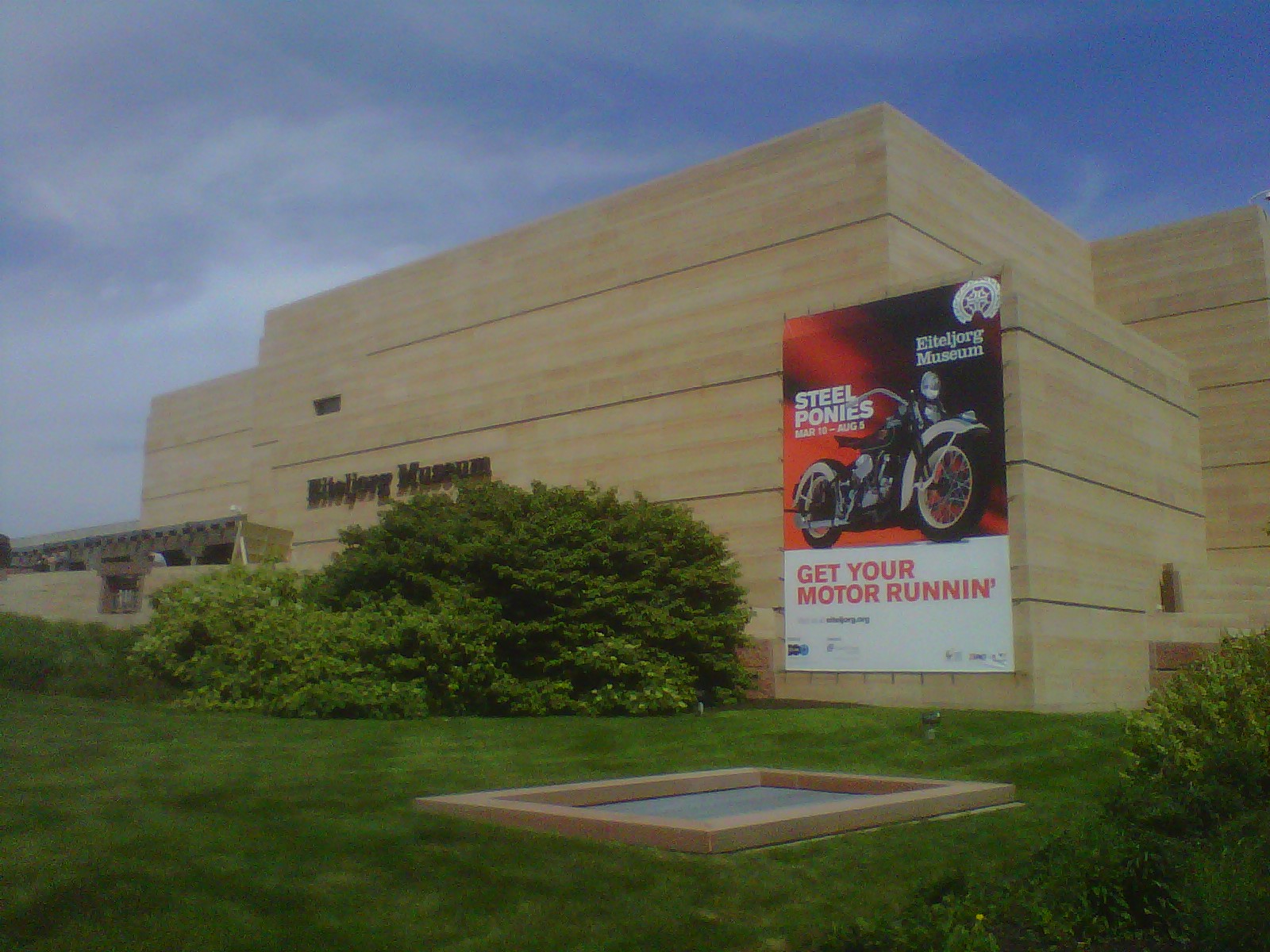
A timely exhibit, across the street from the 27th annual National Convention of Motorcyclists.

Rolling my briefcase in tow, I am wading against a current of rugged-looking individuals who walk not in groups, but in gangs.  To a man, their garb is essentially the same: steel-toe boots, well-worn jeans and black leather vests.  More than a couple wear their long beards in twists, stretching from chin to oversized belt buckle.  Just about all bare arms covered by tattoos.

It’s a strange juxtaposition — them and me — I think at first.  They roared into Indy, riding their Hogs and Steel Ponies to the 27th annual National Convention of Motorcyclists.  I came in the quiet of night, to paint pictures with words about something long ago described as a pastoral game.  But the more I see — and I see a lot — the more I realize we aren’t just sharing the swank surroundings of a 5-star hotel.  We — well, most of us — are bonded by the coffee bean.  Everywhere I look I see not-so-lonesome riders sipping from white and green cups wrapped in cardboard sleeves.  I even chuckle — only on the inside, of course — at the sight of one particularly-menacing figure indulging in what looks to be a Frappuccino.  Tough guy, enjoying a fufu drink.

I reach the counter, where I stand behind someone ordering a Cappuccino.  Waiting my turn, I check out the name of his posse, embossed on the back of his vest: “Bikers For Christ.”  Had I not known any better, I would’ve expected to read, “Hell’s Angels.”  Yet, I do know better.  Besides having a brother and sister-in-law who regularly hop on their Harley’s, my church back home in Massachusetts recently staged a mass blessing of motorcycles.  Not exactly in my element, I’m not entirely out of it either.  We’re not so different, them and me, after all.  We all get our kicks from caffeine.  And we’re all in Indianapolis this weekend because of something we love.

Across the street from where the motorcyclists convene, there’s a gathering of Triple-A baseball teams at Victory Field.  The Norfolk Tides are beginning pre-game preparations, as they re-pay a visit to the home-standing Indians.  Two weeks ago in Norfolk, the Tides rebounded from two Indians’ wins with two of their own, before leaving town.  They’ve since been to Durham and Louisville.  Day One in Indy is Day Seven of this trip.

Here as the team’s radio announcer, I’ve reached the point where I think less of the time we’ve been away than the time we have remaining.  A baseball fan since age 3, I first dreamed of broadcasting it not long thereafter.  I am still enamored by the those late-afternoon hours when a ballpark awakens, and still thrilled by the late-inning confrontations of pitcher and batter.  There aren’t many places I’d rather be than at a ballgame.  One of them, however, is anywhere my wife and children are.  On this trip, they are hundreds of miles away.

My wife texts pictures of the kids — a toddler boy and infant girl — daily, and tries to fill me in on everything each is up to.  With every photo or anecdote, I miss them more.  In this light, seven days out mean there are three more to go until I see — and hold — them again.

But I know I have it good, really good, even in comparison to coaches and players.  I’ve been on the road for a week.  They’ve been at it since spring training, grinding away some of February and all of March to get to games that truly count.  May is only the second of five months of a minor-league campaign.  And yet, I imagine, it’s already getting difficult for some to keep count of the days on the road.  The longer the season goes, the more challenging it becomes.

Whatever the day, and wherever it’s spent, the Tides have a skipper who prefers to start it a certain way.  It goes back to when Ron Johnson was managing the Pawtucket Red Sox, and regularly did something completely out of the ordinary in comparison to his counterparts.

The Tides form their Circle of Trust.

In my many years of shadowing pro ballclubs, I’d observed men whose managerial styles varied greatly.  Some seemed hardened; others laid back.  There were curmudgeons and cheerleaders, firebrands and far steadier hands.  Where one kept an open-door policy, another hid behind closed doors.  But Johnson was the one manager who consistently huddled all his players — pitchers included — on the field before batting practice, the way a high school or college coach might.

I remember times the Tides took batting practice, while Paw Sox players organized into a large oval.  Between the cracks of the bats and songs from the loudspeakers, you’d hear lots of laughter emanating from Pawtucket’s ring around RJ.  Their pre-game formation, I learned from a friend with the Sox, was known as the Circle of Trust.

Johnson now manages the Tides, and today in the Circle City, as Indianapolis has long been called, it’s the Tides who shape the Circle of Trust.  Indians hitters take swings at BP fastballs, while Norfolk players surround Johnson in foul territory, just past the first-base bag.  Stadium speakers are silent, so Johnson is heard revisiting details from last night’s victory at Louisville.  He praises infielder Blake Davis for his two triples.  I didn’t think you were going to make it, Johnson says with a laugh about the second, but good job.  Whatever’s said a minute later is inaudible outside the circle, but obviously funny.  There’s more laughter, from Tides players.  Johnson offers a parting statement, meant to be taken to heart.  If you play the game the right way, he tells them, you will be rewarded.  He repeats it for effect.  Whether or not it sinks in with the Tides, it registers with an eavesdropper.  If you play the game the right way, you will be rewarded.

Impressed, I decide I must get the back story to the Circle of Trust.  Before the weekend is done I inquire about its origins.  It all started, Johnson reveals, when he was managing the Red Sox Double-A affiliate in Portland, Me.

“You’re always looking for a way to get your day started, and through the course of a baseball (day) you have pitchers who go down (to the bullpen) and do their work, guys who get here early (and) do side work,” Johnson explains.  “They stretch, they throw.  There’s all these different programs.  But I really believe there needs to be a starting point for everybody daily, one time we can all be together in the same place.  Even if it’s for five minutes, (when) we can address in-house issues.”

Initially, the circle was mostly a means of keeping everybody in the loop.  What resulted reflected sheer geometry.  Twenty-four men standing in a circle are forced to keep an eye on each other.

“It really started just to eliminate the questions (like) ‘What are we doing tomorrow?’” Johnson continues.  “Everybody knows what’s going on.  And what happens is that peer pressure will lead guys.  You’ll hear somebody say, ‘Hey, what are you talking about?  We talked about that yesterday.’  It takes me out of the equation.”

Players police themselves.  Often with tongue — sharp as it can be — in cheek.

“It’s kind of evolved,” Johnson says.  “We have a little fun with it.  We get personal.  The guys can call each other out.  It’s that one time every day.”

Tonight’s game is a matter of trust for Tides starting pitcher Chris Tillman.  Drafted in the second round by Seattle, Tillman was traded to the Orioles and got to Triple-A before reaching the legal drinking age.  He broke spring training camp with the Tides in 2009 at age 20, a right-hander standing 6-foot-5, with an even taller upside.  Later that summer, after turning 21, Tillman was invited to both the Triple-A All-Star and Major League Futures games, before debuting with Baltimore.  The following spring, he returned to Norfolk and no-hit the Gwinnett Braves.

Ever since, Tillman has been up and down, in more ways than one.  As an Oriole a couple of years ago, he dominated Texas, only to get roughed up by Tampa Bay the very next outing.  The next start after that was in Triple-A.  But Tillman is still a youngster, his big-league ‘stuff’ still recognizable.  Before his last outing at Durham, Johnson wanted to see Tillman more aggressive against a predominantly left-handed lineup.  That he was, in a 4-2 victory.

In Indianapolis, he is even more assertive.  He throws his fastball with mid-90s velocity, and commands a wicked breaking ball.  Old-timers would tell you it’s the kind of curve that “falls off the table.”  Tillman shows faith in all his pitches, retiring 15 of the first 18 Indians.  He strikes out the side in the 4th inning.  And again in the 5th.  Six straight batters, not a ball in play.

The Tides, however, have scored only once off another imposingly tall right-hander who was once in the Oriole rotation, Daniel Cabrera.  Less impressive than Tillman this evening, Cabrera manages to minimize the scoring.  Finally, his teammates reach Tillman in the 6th inning.  They take a 2-1 lead, before loading the bases with one out.

Tillman is at a crossroads.  He is pitching to keep his team within a run.  And for his own sake, to prevent a single inning from ruining what had the makings of a brilliant performance.  Instead of buckling, Tillman bears down and gets the next two hitters.  Norfolk is still very much in the game.

The Tides, however, won’t score again this evening.  They will fall farther behind in the bottom of the 8th, when Indy pins two more runs on the bullpen, and drop a 4-1 decision.

Regardless, Chris Tillman should feel good about himself as walks back to the dugout for the final time.  On this first night in Indianapolis, he has every reason to believe in his ability.

And here on out, every reason to see the round mound of clay and dirt in the middle of the diamond as his very own circle of trust.

Possibility City

By Bob Socci

Days 4 thru 6 – Tuesday, May 8-Thursday, May 10: Norfolk Tides at Louisville Bats

Wind is wreaking havoc along Fourth Street.  Two city workers in bright yellow shirts, on a beautifully sunny but breezily cool afternoon, are wrestling with a vinyl banner.  It’s supposed to be hanging from the post of a streetlamp, but instead flutters uncontrollably.  Walking past the two men trying to get a grip on the sign, I read the greeting it bears: “Welcome to Louisville, City of Possibility.”

City of possibility.

That’s exactly why I’m here, and have been the last three days.  Later tonight I’ll be watching baseball’s Norfolk Tides and Louisville Bats engage for the eighth and final time in 2012, ending their second series in less than two weeks.  When last they met, each won twice.  But apart from playing one another, neither has fared very evenly overall with the rest of the International League.  The Tides are 13-18, five games from .500, a third-place club in their division.  The Bats stand fourth in theirs, due to a dozen more losses than wins.  Just yesterday they ended a five-game losing streak, rebounding after Norfolk started its stay here with back-to-back victories.

Collectively, there’s a possibility the Tides will prevail in this series, and thus the season set, or Louisville will once more manage a split.  Individually, however, there’s a much different possibility everyone is playing to make reality.  For some it’s actually more of a probability.  For a few it’s an inevitability.  It has little to do with the standings or head-to-head records of these two Triple-A teams.

On this level of the minor leagues, a roster allows for 24 active players.  In the case of every last one, there’s somewhere else he’d rather be.  Today for the Tides, that somewhere else is Baltimore, where the Orioles host the Texas Rangers.  As Norfolk’s parent club, the O’s are one of the spring’s biggest surprises.  Recent bottom dwellers in baseball’s toughest division, they currently sit atop the American League East.  Still, the Orioles are under stress, particularly their pitching staff.  Their week began with a victory in Boston.  Nonetheless, achieving it in 17 innings took a toll.  More taxing were the following two nights versus Texas, and the prospect of two more games yet to come against the Rangers.  Two-time defending pennant winner, Texas scored 14 runs Monday in Baltimore.  On Tuesday, Josh Hamilton staged a one-man slugfest by hitting four — four — home runs.  Under siege, the Orioles made several players moves the last 72 hours.

There’s a possibility of more to come.  And so for every Tide, particularly the pitchers, there’s a possibility the next call could be for you.  Already on this trip to Durham and now Louisville, big-league summons have been served to pitchers Jason Berken, Stu Pomeranz, Zach Phillips and Dana Eveland, as well as infielder Steve Tolleson.  Unfortunately for Berken, his stay was short.  Up by Monday, he is back down on Thursday.

Like any other Triple-A club, the Tides are an eclectic group.  They are American, Latino, Canadian and Australian.  They are pretty old — at least by pro baseball standards — and extremely young — by any measure.  Among them are seven-, even eight-figure earners, as well as those whose paychecks include fewer digits to the left of the decimal point.  Two nights ago Norfolk’s starting pitcher was Joel Pineiro, a veteran of 12 major league seasons, featuring more than a hundred wins.

Last season Joel Pineiro went 7-7 in the second year of a lucrative free agent contract with the Angels.

According to the website baseball-reference.com, he’s been paid in excess of $48 million for use of his right arm.  Last year alone Pineiro made a reported $8 million as an Angel, which computes to $1,142,857.14 for each of his seven victories.  In contrast, last night’s starter Steve Johnson is an eighth-year pro, a one-time 15th-round draft choice in his second organization.  He didn’t get to Double-A until his fifth season, Triple-A until his sixth.  In his first go-around in the International League, Johnson closed 2011 with a 2-7 record and 5.56 ERA.

And yet age, experience and income aside, they take the ball looking to seize the same opportunity.  They pitch for the same possibility.  Pineiro need only call upon his own past to know it’s so.  There’s a reason four big-league teams rewarded him with such riches, for so many seasons.  As for Johnson, the only example he needs is the man who raised him.

In 2012 Pineiro is trying to pitch his way back to the big leagues as a member of the Norfolk Tides.

David Wayne Johnson was, is a ‘Bawlmer’ guy.  Born in Charm City, he pitched professionally for the first time as a 22-year-old Pirates farmhand.  It took until his sixth season to reach Pittsburgh, for all of five games and little more than six innings.  Signed that winter by Houston, Johnson was traded to his hometown team on the last day of March, 1989.  Sometime in between, he helped make ends meet by working as a truck driver.  Those Orioles were the game’s laughingstock, a year removed from the infamy of an 0-21 start to a 107-loss finish.  But through the spring and into the summer of ’89, while Johnson toiled in Rochester, baseball in Baltimore went through a renaissance.  In August Johnson joined the Oriole upstarts, and beat the likes of Minnesota, Boston and Milwaukee.  Then, as a last-minute replacement for an injured Pete Harnisch, Johnson opposed Toronto in a final-weekend showdown for first place.  He left ahead, 3-1, in the 8th inning, only to see the Blue Jays rally to the divisional title.

As disappointing as the outcome was, Dave Johnson retains a warm spot in the hearts of longtime Oriole fans.  He also remains a presence, in their ears and before their eyes commentating on radio and television.  Meanwhile, his son Steve strives to become a second-generation Oriole, with the Tides in Louisville.

Dave Johnson remains a favorite son of Charm City.

The starts by Peneiro and Johnson, like their careers to date, unfold differently.  The 33-year-old Pineiro quickly gets into a groove.  In his second game since being released by Philadelphia out of spring training and signing with the O’s, he retires 18 of the first 21 Bats.  Entering the 7th inning, Norfolk has five runs; Louisville has two singles.  But with one out, five straight hits force Pineiro from the mound.  The Bats pare the difference to one, before the Tides rebut in the 8th with six runs of their own.  The final is 11-4, and the decision belongs to Peneiro.

Johnson, 24, follows to the mound with a mere 2.60 ERA, allowing a meager .206 opponents’ batting average.  With a 1-0 lead, trouble arrives in various forms.  First, a blast ties it.  Later, after a walk and hit batsman, Johnson’s own throwing error off a bunt puts him behind.  A sac fly makes it, 3-1, after two innings.  Another base on balls and another hit batter lead to another three-run inning, this time in the bottom of the 4th.  The key play involves a misjudged, wind-aided fly ball resulting in an RBI double.  But thereafter, Johnson silences Louisville’s bats.  He sets down the last 10 hitters he opposes.  Not enough to avoid a 6-5 loss, nevertheless Johnson has an outing to build on.  In five more days, he will return in his role, armed with the power of possibility.

Steve Johnson aims to become a second-generation Oriole.

The wind dies down as the Tides conclude their stay in Louisville.  Blowing off the Ohio River, from the North at eight miles per hour, it’s enough to cool the temperature to 71 degrees.  But not nearly enough to impact the game the way it affected earlier efforts to hang a welcome sign.  Norfolk pitcher Brad Bergesen bids goodbye to Possibility City by hanging zeros; five of them in a 54-pitch, 38-strike spot start.  He is backed by 10 hits, including five from lineup bookends Xavier Avery and Blake Davis.  Avery’s three hits as leadoff man include a two-run homer and a double.  Davis, batting ninth, triples twice.  Three relievers handle the final four innings.  The Tides take the series finale, 4-1, in 2 hours and 32 minutes.

It’s exactly as ordered on a get-away night; a fast-moving game sending Norfolk on its way.  Only, there’s a problem.  On this night, pitchers work at a much different pace than the bus driver chauffeuring the team to Indianapolis.  A 120-minute, late-night commute on a lightly traveled Interstate is taking much longer than two hours.  As Indy’s skyline comes into view, there are 20 rows or more of backseat drivers.  Quips start in the back of the bus, working their way to the front.

The culture of baseball rarely cuts anyone slack, and a good laugh is too hard to pass up.  One needs thick skin to survive in a clubhouse.  Ballplayers always have, and always will, give each other grief.  In a good-natured way, of course.  And generally, they’re no different when it comes to others on the team periphery.  Almost unfailingly, there’s one or two players whose wit is especially sharp.  Again, these Tides are like the rest.

Laughing in my seat, four rows behind him, I feel a bit for the driver too.  Thank God, I think, at least we’re not lost.  To his credit, the busie handles the colorful commentary as well he handles the wheel.  From where I sit he shows no signs of any weight piling on his shoulders.  Or enough, anyway, to force him to press a little harder on the pedal.

Safe and sound, we eventually pull up to our hotel in the early minutes of tomorrow morning.  Nineteen hours from now the Tides play the first game on the last leg of this baseball journey.

No longer in Louisville, Indianapolis is now their city of possibility.

Black, and White

By Bob Socci

Day Three – Monday, May 7: Norfolk Tides at Louisville Bats

As the Norfolk Tides complete their 2012 tour of baseball’s International League they will be welcomed to 13 different cities, as guests for more than 70 dates spread across a five-month span.  At every stop, the same handful of factors determine how much I enjoy, or whether I have to endure my stay.

In Louisville I definitely “Imbibe with Enthusiasm.”

Most important are those that shape the game-day experience.  How nice is the stadium?  Will there be big crowds?  Some are specific to my job (not that it’s exactly work I do).  What’s the press box like?  Am I going to enjoy the view from the booth?  Can I count on a strong internet signal?  And one is simply about sustenance.  Thumbs up or thumbs down on the press box buffet?

Of course, I also concern myself with accommodations.  Is the hotel nice?  Any good places to run in the area?  Are there ample eating choices nearby, and do they serve late at night?  I’m also interested in sights to see, basically boiling down to this: What else is there to do?  

A place really earns points if ballpark and hotel are within walking distance.  And, yours truly being the coffee snob that I am, it’s a major coup if I find a cool cafe to rest my laptop for awhile.

Here as a fill-in, this is my first trip actually traveling with the Tides this season.  I’ve lucked out.  The Durham leg of our journey met most of the critical criteria.  It would have been better had we stayed downtown, per usual in the past, at the Marriott.  But then, I’m in no position to complain about a Hilton.  So what if it was a bit farther away from the park.  Next up is Indianapolis.  There, no doubt, I’ll check all the boxes upon taking inventory of our surroundings.  It’s a major league home to a minor league ballclub.

Louisville literally, and metaphorically, sits in between.  We stay at the Galt House, an enormous old hotel whose wallpaper is somewhat tattered, carpet a bit worn and furniture dusty.  But, as the saying goes, real estate is about location, location, location.  And this property, comprised of two high-rising towers overlooking the Ohio River, is in close proximity to more good eats than I can possibly sample in four days.  Plus, Louisville Slugger Field is blocks away.  At a good pace, I can cover them in well under 10 minutes.

Our first day here is off to a good start.  I head up Fourth Street, computer satchel slung over my shoulder, in search of a coffee ‘house’ I recall from past visits.  It’s a corner cafe, across the street from a Starbucks inside the Sheraton.  As much as I like the big-name competitor born in Seattle, I trend toward local brew when I can.  Which is why I grab a stool at vint coffee, where you’re encouraged to Imbibe with Enthusiasm.  I boldly do, ordering a dark roast.  The staff is friendly yet laid back, and the Wi-Fi is strong and fast.  I’ll be here for awhile.

But not too long, not with a 6:35 start between the Tides and Bats, who are affiliated with the Cincinnati Reds.  I still have to grab lunch and try to get a little exercise, before heading to the park.  It’s a little past 2 o’clock when I leave the hotel and start down Main Street.  A block away, on my left, is the still-new KFC Yum! Center, home of the University of Louisville basketball teams.  It’s a shining centerpiece in an area undergoing much development.  Old warehouses which appeared vacant a few years ago are converted into restaurants.  There’s an actor’s theatre on the other side of Main.  This is the new Louisville.

I reach the far end of the arena and come to a stoplight at the corner of Main and Second.  Traffic barrels across a bridge from Indiana into downtown Louisville.  I am standing next to a young African-American woman.  We make eye contact waiting for the walk signal.  I say hello.  She asks how I’m doing.  The light changes and we step off the curb into the crosswalk.  We’re not walking together, just alongside one another.  We are separate but equal, stride-for-stride, a few feet apart.  Halfway to the other side of Second Street, I hear a voice from a car passing by on Main.  Hey!, someone shouts, Don’t you know she’s black?

The young lady and I each hesitates for a split-second, though it seems longer.  Again there is eye contact.  She wears a pained expression, clearly stung by words of the anonymous passer-by.  Flabbergasted, I can only shake my head and say to her:  Some people are just stupid.  I wish I had something more profound to offer.  It’s all I can come up with in the moment.  I continue on my way.  She does the same.  I will never see her again.  I also will never forget her, or the moment we’ve just shared in this city that proudly embraces Muhammed Ali as its own.

Minutes later I am still on Main Street, walking along the first-base side of Louisville Slugger Field.  I’m headed for an entrance near the visiting clubhouse.  The door is beyond the right-field corner.

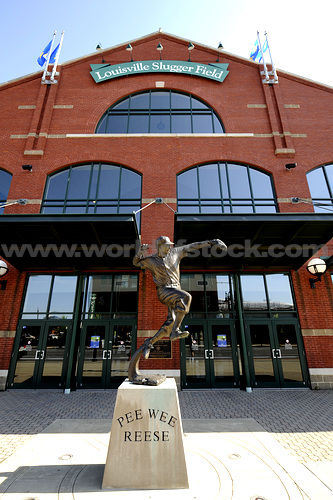
To get there, I must walk past another famous son of Louisville, Harold ‘Pee Wee’ Reese.  The Captain of the Brooklyn Dodgers is immortalized here in statuesque form, ostensibly leaping and throwing to complete a double play.  Staring at his statue, I see Reese in a more permanent pose.

Favorite son of Louisville “Pee Wee” Reese is immortalized on Main Street.

He is the shortstop of the Dodgers, and teammate of Jackie Robinson.  It’s the late 1940s, and time — without overstating it — for something seminal.  Robinson has broken baseball’s color barrier, but remains subjected to the taunts of racist hecklers in the stands.  One day, in full view of others, Reese has heard enough.  Eying Robinson, The Captain has seen enough.  Son of the South, Harold ‘Pee Wee’ Reese sidles up to Robinson and delivers a gesture that will long transcend the ballfield they stand on.  In fact, that very moment is memorialized by another statue found outside a stadium.  It’s in Brooklyn, where the Class A Cyclones play.  It shows Pee Wee, with his arm around Jackie.

Inside the park, journeyman lefty Dana Eveland is terrific for the Tides.  He limits the Bats to four singles in 5.0 innings and owns a 4-0 lead.  Surprisingly, Eveland is removed after only 63 pitches, 44 of them strikes.  Or, perhaps, not so surprisingly.  By the following day, reporters in Baltimore will speculate about a pending call-up for Eveland.  If promotion comes to fruition, the Orioles will be his seventh major league club.  Right fielder Jai Miller hits one of the highest and longest home runs I’ll ever see.  It orbits out to straight-away center field and lands high beyond the wall, between a black screen and a row of trees.  An announcement is made in the press box.  Miller’s longball traveled an estimated 440 feet.

In Brooklyn, Reese is remembered for a gesture transcending the game he played, and time in which he lived.

Miguel Gonzalez retires the six batters he faces in the final two innings.  Opponents are now an astounding 2-for-55 against the Norfolk right-hander, who wraps up a 4-2 win in a tidy 2 hours, 15 minutes.  The fast-moving contest has me thinking:  If I hustle, I can get to a TV before the Rangers and Capitals end Game 5 of their Stanley Cup series.  I’m out the door, race-walking toward a sports bar at the Marriott.

Leaving, I return to the episode that occurred while going to the park.  I am talking on the phone to my wife as I repeat the words of a drive-by bigot.  Her moral compass is unerring; she is open-minded and open-hearted.  And she is equally appalled by what I tell her.  I reach the lobby of the Marriott, say goodnight, and take a seat at the bar.

The Capitals are on the verge of taking a series lead.  The Rangers are in need of a miracle on ice.  They empty their net for an extra skater.  Then, with less than a half-minute left, they find themselves with two extra skaters.  Joel Ward inexcusably commits a double-minor penalty, with a high stick to the face of Carl Hagelin.  If there weren’t 22 seconds left, he’d get four minutes in the box.  Playing six against four, New York produces the improbable.  Brad Richards flicks a rebound into the goal with 6.6 seconds on the clock.  There’s bedlam in Gotham, as overtime awaits.  Not long  — 95 seconds, actually — after a brief intermission, Ward still sits idle when Mark Staal drives a dagger past Washington’s goalie Braden Holtby.  Madison Square Garden again erupts.  It’s the Rangers who own the series edge.

No more than two weeks ago Ward was on the spot to seal the first-round fate for defending champ Boston.  In overtime of Game 7, his game-winning goal advanced the Caps into the next round.  But as one of a handful of black players in the NHL, he was instantly vilified for his heroics and assaulted with epithets.  Not unlike a bigot shouting from a moving vehicle, there were those who exposed their ignorance despite the cowardice cover of Twitter and other internet messages.  Enough of them, anyway, for The Boston Globe to publish a front-page story on a wave of racial slurs aimed at Ward.

Tonight Ward is again under attack.  Soon there will be more reports about more senselessness — slander over the color of someone’s skin.  At the same time Ward will be praised.  Writers and commentators will recognize the class and grace he shows by waiting in the dressing room to answer every last question.  He takes full responsibility for a foolish penalty; full responsibility for a devastating loss.

Joel Ward handles his situation like a pro.  He handles it like the man that he is.

As the ballclub’s lead announcer from 2006-10, Bob is traveling with the Norfolk Tides on their current 10-day trip.  Tides broadcasts can be heard via www.norfolktides.com or www.espnradio941.com.  For highlights of Bob’s work calling baseball, football and basketball, please visit www.bobsocci.com.

Flashing Back, Moving Forward

By Bob Socci

Day Two – Sunday, May 6:  Norfolk Tides at Durham Bulls

The manager just about everybody in baseball knows as ‘R.J.’ sits at a desk inside a cramped office he shares with his coaching staff in the visitor’s clubhouse of the Durham Bulls Athletic Park.  He is discussing the night before, when his Norfolk Tides and Durham Bulls played 44 minutes of baseball between a pair of rain delays totaling 3 1/2 hours.

Some — perhaps most — in his position would harbor lingering bitterness over what they’d consider the fiasco of an entire afternoon and most of an evening devoted to less than 2 1/2 innings.  Not Ron Johnson.  True, the Tides have a 3-0 lead before he has to return to coach 3rd base in about an hour and a half.  That itself is surely reason to smile for someone with more than 1,200 managerial victories in the minor leagues.  But Johnson’s outlook is formed more by philosophy than the practicality of an early lead in a game soon to be resumed and resolved.

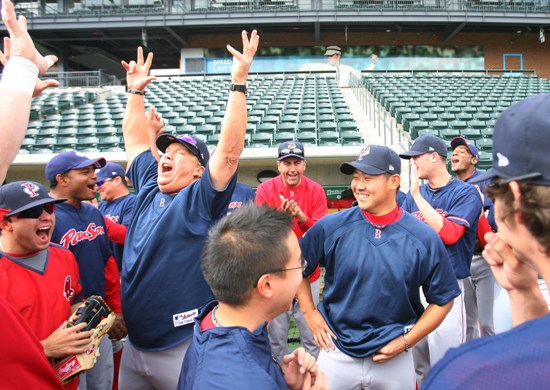
While Ron Johnson seemed to be shouting for joy as manager of the Pawtucket Red Sox…

“It was fine, you just sit around and wait,” Johnson says into a microphone recording words that will later be played back to a Virginia radio audience.  “An old-time coach told me a long time ago when I first started breaking in…I’ll never forget him — Joe Jones, he was a coordinator for Kansas City — he said, ‘Put the uniform on, sit down, wait (and) when they tell you to take it off, take it off.’”

There’s another reason Johnson isn’t angry over the uncontrollable.  It has to do with someone in a different uniform.  While R.J. was playing a Saturday-night waiting game, Chris Johnson was reaching a milestone in Houston with his first major-league grand slam.

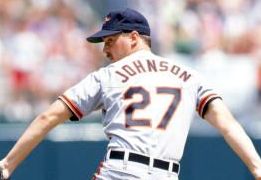
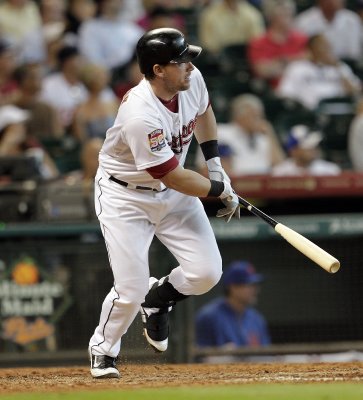
“He had a good week, two homers and six ribbies the other day and then he hit a granny yesterday,” R.J. beams with pride, and a chuckle.  “And for those people who don’t know, that’s my son who plays third base for the Astros, and I’m proud of him.”

Can anything Dad do — or did as, albeit briefly, an ex-Royal and Expo — in the game top that?

“No, no.  That’s the bottom line,” Johnson says, in all seriousness.  “It doesn’t even come close.”

…he was beaming with pride after Chris Johnson launched three homers in a week.

A year after joining his kid in the big leagues, as first base coach for the Red Sox, the elder Johnson is in the Orioles organization.  On this Sunday his Tides and the Bulls each will wind up with a win.  Norfolk’s three runs from the previous night prove the difference in a 5-2, 9-inning affair, before Durham triumphs, 2-1, in 7 innings.

Those of us witnessing the split do so with divided attention.  Because in Boston an epic involving Johnson’s former and current employers makes for compelling scoreboard watching.  Off to two of the spring’s most surprising starts — one for better, the other for worse — the O’s and Sox are entangled in a 6-6 tie deep into extra innings.

As they soldier into the 16th, Baltimore and Boston have utilized eight pitchers apiece.  In the last of the 16th, the Orioles opt to throw a last resort at the Red Sox lineup.  Chris Davis sheds his Designated Hitter label to take the mound.  Six years removed from his last pitching appearance, at a Texas junior college, Davis posts a zero to prolong the proceedings.  Boston counters in the top of the 17th by dispatching its DH, Darnell McDonald to the hill.  McDonald doesn’t fare as well, allowing a three-run homer to Adam Jones.  Davis completes another inning to end a 6-hour, 7-minute marathon.  He is the first position player to win an American League game as a pitcher since Rocky Colavito in 1968.

In Durham, my mind rewinds to June 9, 2006.  That’s when a backup catcher for the Bulls earned victory in relief.  The game started with a matchup of the late Jose Lima and Jason Hammel, a then Devil Ray prospect and a present-day Oriole.  And the first of eight Durham pitchers.  In need of a ninth, the Bulls called on Kevin Cash.  He completed a scoreless top of the 14th inning of a 5-5 tie, before Luis Rivas singled home Kevin Witt with the game-winner in the bottom half.  Also in the Durham lineup, none other than left fielder Darnell McDonald.

Looking ahead, I experience another flashback.  It’s one everybody who’s ever spent considerable time in the minors identifies with.  The Tides are leaving Durham tonight for Louisville.  By land, not air.  That’s more than 500 miles and roughly nine hours on a bus, from Sunday evening into Monday morning.  Not that any of us is worthy of sympathy, especially from others who’ve beaten the bush leagues.  The ride may be long, but the Tides still travel better than most, even Triple-A contemporaries.  Ours is nothing like the mode transporting fictional Durham Bulls Crash Davis and Ebby Calvin ‘Nuke’ LaLoosh, or many real-life clubs confined to the narrow seats of a single bus.

The real-life Tides left Durham in far more comfort than the fictional Nuke LaLoosh and the big-screen Bulls.

Traveling with the Tides, there’s a choice between two.  On this particular trip, you can elect to recline in a wide, comfortably-cushioned seat aboard an ‘executive’ bus.  Or you can choose to take a ‘sleeper’ bus outfitted with bunk beds, card tables, internet service and satellite television.  This night, for this tag-along, it’s the only way to go.

Within an hour of the final pitch of Game 2, clubhouse attendants load equipment into luggage bays and leave coolers of drinks and boxes of pizza on the buses.  Climbing onto the sleeper, I’m mildly surprised to see several players congregating in the front.  In the past, this space was occupied mainly by staff.  But my surprise is pleasant, because they’re here to watch a Stanley Cup playoff game on TV.  The interest in the Devils-Flyers is mutual.  I used to count on missing the best postseason in pro sports anytime a baseball trip conflicted with a hockey telecast.  Tidesvision, if you will, was generally tuned to West-coast baseball, Seinfeld reruns or re-airs of Caddy Shack.  All entertaining, no doubt.  Still, none as passionate as the quest for the Cup.

Thankfully — even if it costs me any extra space — this year’s group of Tides include the likes of Canadian Chris Robinson and Minnesotan Jamie Hoffman, a one-time draft pick of the Carolina Hurricanes.  One knows hockey as his national pastime.  The other nearly made it his profession.

I take a seat on a bench alongside pitching coach Mike Griffin.  Though he resides in New Jersey, ‘Grif’ is too busy to pay much attention to the Devils.  Studying charts filled with copious numbers and notes, he resembles a college professor reviewing mid-terms.  But in his case, Grif grades only two of the 144 tests Tides pitchers are scheduled to face in 2012.  All the information is painstakingly condensed into a computer report for Oriole brass in Baltimore.  He hits the send key and leans back.

The home-state Devils hold on for a Game 5 win, and the channel changes to Lakers-Nuggets.  The NHL postseason gives way to the NBA playoffs.  Must-see television late on a Sunday drive through the mountains of West Virginia.  Not exactly wild and wonderful, but our ride could be a lot worse.

We pause at a truck-stop convenience store and re-load to continue the journey.  Getting back on the bus, the TV gets turned off and lights go out.  I hop into a bunk, turn on an iPod Shuffle set to a mix of relaxing jazz and classical.  Smooth music for a bumpy ride.  Sleep is had in intervals.  At least it adds up to a decent amount by the time we roll into Louisville at about 7:30 a.m.

As father to a toddler and infant, and nighttime nemesis to family cats crowding the bed, uninterrupted sleep isn’t anything I’m used to anyway.  I’m ready to start a brand new day in a different city.

Two down, eight more to go on the Tides’ longest trip of the season.

As the ballclub’s lead announcer from 2006-10, Bob splits time on the road with the Norfolk Tides calling baseball and following hockey.  Tides broadcasts can be heard via www.norfolktides.com or www.espnradio941.com.  For highlights of Bob’s work calling baseball, football and basketball, please visit www.bobsocci.com.

On The Road Again…

By Bob Socci

Day One – Saturday, May 5: Norfolk Tides at Durham Bulls

The alarm goes off, and an annoying tone sounds from the cell phone left atop a nearby bureau.  I reach to silence it, still in denial.  Seriously, it can’t be time to get up so soon.  Literally, it seems, my head just hit the pillow.  Is it really 4:30?  Already?

I stay in bed briefly, needing an extra five minutes to face the day.  In another couple of hours, I’m supposed to travel from New England to North Carolina.

Barely awake enough to shower and dress, I whisper goodbye to my wife and our baby daughter, who sleeps peacefully and beautifully a few feet away in her bassinet.  I then cross the hallway for a peek at our son in his crib.  He too is sound asleep, surrounded by stuffed animals, as well as the blankets he routinely kicks off in his nightly state of unconsciousness.

Night one of the Norfolk Tides’ longest road trip of 2012 includes 3 hours, 26 minutes of delays before play in suspended.

“Love you buddy,” I say, turning away.  And then I walk out the door for the next week and a half.

Waiting on me is a taxi to Boston’s Logan Airport.  From there I will fly to Raleigh-Durham to join the Norfolk Tides baseball club on a three-city, 10-game trip.  Two days in Durham mark the first leg, followed by four in Louisville and four more in Indianapolis.  I’ll accompany the Tides on a long bus ride, then on a shorter drive; each taking me back to a childhood dream of broadcasting baseball.

The cabbie is familiar.  Actually, he’s unforgettable, in a good way.  I recognize him from a trip to the airport during last football season.  He’s been dispatched, I’m convinced, from South Boston central casting.  Right away he correctly pegs me as a sports fan, launching into a recap of the previous night’s playoff win for the Celtics.  He sounds like so many others I regularly hear on local sports-talk radio.  For instance, he tells me that Paul Pierce has taken the last shot of regulation at least 70 times and, disregarding the fact that Pierce is one of the team’s all-time best, probably made one of them.  Somehow a postseason victory is spun forward in a negative way.  Conversation shifts to the Red Sox, and the tone is far harsher.  Hair slicked back and seat reclined, the cabbie deftly steers the wheel of his mini-van with his left hand while sipping from the cup of Dunkin’ Donuts coffee in his right.  Undeterred, he continues expounding on the disappointing state of the Sox.  All while wearing a throwback Washington Redskins jersey, his three-quarter sleeves homage to Slingin’ Sammy Baugh.

Before I know it, we’re curbside at Logan’s Terminal C.  The cab pulls away, and I think of that driver as the kind of character who gives a place its character.  My ride was definitely entertaining and, in an odd way, enlightening.  I’m also struck again by how effectively sports serve as starters between people.  The success of the Celtics, the struggles of the Red Sox — each easily each sparks conversation.  I’m sure I’ll see that cabbie again, perhaps when my football weekends resume this fall.  No doubt we’ll pick up where we left off.  Unless the subject of the Patriots comes up first.

Once safely in Durham, I check the team’s itinerary.  There are generally two trips made from hotel to ballpark before each game.  The first bus is filled with pitchers reporting for early work and position players looking to log extra time in the batting cage, or simply anxious to get to the park.  The second bus always includes the starting pitcher and, early in the season, a few others.  When the schedule lengthens, more and more players will opt for the later departure.

There’s something else that’s almost always bound to happen: changes will be made.  The printed itinerary can be trusted only so much.  This is one of those days.  I hustle to the lobby for the 1 o’clock bus.  Several Tides are there as well.  Unbeknownst to us, the 1 o’clock bus is now scheduled to depart at 2:30.

There won’t be batting practice on the field at the Durham Bulls Athletic Park, so there’s no need to arrive too early.  Leaving later rather than sooner will turn out for the better.  We’re all about to spend far more time at the DBAP than anyone could possibly expect.  Game time is 5:05 p.m., but it too becomes subject to change.

Raindrops begin falling at about 4:30.  There are thunder storms close by, and it’s about to come down a whole lot harder.  It won’t stop for several hours.  The infield remains under cover at 5 o’clock.  An hour later, the scene is unchanged.  Roughly 6,000 tickets were sold for today’s game.  Even now, most who turned out hours earlier remain.  They eat, drink, talk and laugh.  And they watch the left-field video board, as the Mets beat the Diamondbacks, before I’ll Have Another runs to the roses at Churchill Downs.

But they’re here expecting to see the Bulls and Tides.  As another half hour passes, many decide they’ve waited long enough.  The P.A. announcer tells the departing fans that even if a game is eventually played, the club will honor their tickets on a future date.  I’m not sure how rare such a gesture is, I just know it’s a classy and smart move by the Bulls.  And evidence of why they remain remarkably successful, more than a quarter-century after Kevin Costner and Susan Sarandon put the franchise on the national map.

Finally in the next half hour, between 7:30 and 8:00, the rain relents and the grounds crew goes to work.  A cadre of stadium staffers and groundskeepers pull the tarp from the infield, roll it up and return it to the third-base sidewall.  Players emerge in full uniform, the Tides and Bulls trickling out to left and right field, respectively.

Among them is Durham starter Matt Torra, a 27-year old righthander who joined the Tampa Bay Rays organization last July.  He was the 31st player drafted overall by the Arizona Diamondbacks in 2005, after leading the nation with a 1.14 ERA for the University of Massachusetts.  But after only five pro outings, Torra’s career was jeopardized by shoulder surgery.  He progressed as far as Triple-A Reno of the Pacific Coast League, before the D-Backs dealt him to the Rays for “cash considerations.”

Two weeks ago Torra’s earned run average was a bloated 8.22.  However, his last two appearances — a tough-luck loss at Norfolk and a masterpiece vs. Indianapolis — lowered the mark to 5.04.  Torra hasn’t allowed a run in his last 10.0 innings pitched.  In fact, against the Indians five days ago, he didn’t surrendered a hit until there was one out in the 8th inning.  Torra won that start by a 1-0 final.  It was Durham’s first victory in 14 games.

While Torra warms in his bullpen, Norfolk’s Jason Berken does the same across the outfield grass, along the line in left.  Also a righty, Berken is off to a much better beginning to 2012, though his won-loss record doesn’t reflect it.  Actually, he has neither a win nor a loss to his name this spring, as mainly a victim of non-support from the Tides’ offense, bullpen or both.  Berken owns a 1.35 ERA, yielding just three earned runs (five total) in his first 20.0 innings.

For three days in late April, as he had done the previous three seasons, Berken joined the Orioles.  But he was unused out of Baltimore’s pen, and returned to the Tides.  Tonight’s start can be viewed one of two ways: it’s either his second assignment since coming back to Triple-A or his second opportunity to prove he belongs back in the big leagues.

At 8:01 — 2 hours, 56 minutes after he was scheduled to deliver his first pitch — Torra starts Xavier Avery with strike one.  Avery is a promising young outfielder in his first Triple-A season.  He chose to sign with the Orioles out of high school, bypassing an opportunity to play football at his home-state University of Georgia.  As you’d expect of an SEC recruit, Avery combines strength with speed.  He unveils the former on Torra’s next offering, pulling a hard line drive into the empty blue seats beyond the right-field wall.  Two pitches in, Norfolk leads, 1-0.

Trouble continues for Torra by the time Bill Hall comes up.  A single and walk have set the table for Hall, who represents the customary contrast of a Triple-A roster.  On this level of pro ball players are either stepping forward (like Avery) or stepping back (like Hall).  One is a 22-year old moving up in an organization, perhaps within a hot streak of getting to the big leagues for the first time.  The other was 22 when he broke into the majors with the Milwaukee Brewers — a decade ago.   Hall is trying to make Baltimore his sixth different MLB club.

As a Mariner, Red Sox, Astro and Giant since the Brewers traded him in the summer of 2009, Hall went to spring training with the New York Yankees.  Unable to make the major league club, he became a free agent and signed with the O’s on April 25.  Now he is in Durham, N.C., having waited more than three hours for this first at-bat of the night.  On the third pitch, he doubles to left-center to give the Tides a 3-0 lead.

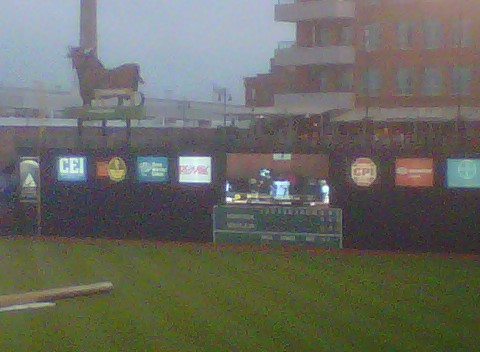
The iconic Bull is left standing in the rain atop Durham’s “Blue Monster,” while fans watch baseball and the Kentucky Derby on the stadium’s video board.

It will be Norfolk’s last hit until the 8th inning, which means it will be the last hit until late the following afternoon.  Before Hall’s next turn in the top of the 3rd, the game is again held up in the midst (and mist) of wet conditions.  Only this delay is man made.

Groundskeepers had set the field’s sprinkler system on a timer, assuming the scheduled contest would be over by 8:30 p.m.  Someone, however, forgot to hit the reset button when the game time got pushed back.  Sure enough, four sprinkler heads begin spraying water around the infield, forcing batter and fielders alike to briefly scatter.  The fact that this is happening here is entirely too convenient.  In Norfolk a radio listener instantly pictures the Bull Durham scene in which Costner’s character, Crash Davis, leads teammates on a clandestine, overnight mission to flood the field (You want a rainout, I can get you a rainout).  The listener calls the studio, repeating the Costner line: What we have here is a freakin’ natural disaster.

What we’re really about to have, in the words of Norfolk manager Ron Johnson, is something bordering on the super natural.  Hall is back at the plate.  Torra delivers a 1-2 pitch for a called third strike by umpire Travis Carlson.  The sky opens up.  Slightly obscured through the sheet of rain, Hall argues with Carlson.  Meanwhile, first-base ump David Rackley waves the teams off the field.  Everyone else is sprinting for cover, but Hall and Carlson remain in the downpour long enough to have their say about strike three.

Unlike the previous hold-up, this one will take awhile.  This is the work of Mother Nature, and she isn’t in the mood for a ballgame tonight.  Thankfully, the umpires understand.  Not a second after waiting the requisite 30 minutes, they suspend play.  It’s 3-0 Norfolk with two down in the 3rd inning.  The third out will have to wait until tomorrow.

It’s nearly 10 p.m. when players start boarding the first bus to the hotel.  Many, if not all, are anxious to get moving.  They want to get where they’re going — and now! — so they can catch the Mayweather-Cotto boxing match somewhere on pay per view.

Not me.  I’m in a hurry, alright.  But I just want to get to bed.

And no, I won’t be setting my alarm.

Bob was the Tides’ lead announcer from 2006-10, before opting to become the Manny Mota of Triple-A broadcasters as a pinch-hitter.  Broadcasts can be heard via www.norfolktides.com or www.espnradio941.com.  For highlights of Bob’s work calling baseball, football and basketball, please visit www.bobsocci.com.

Home Away From Home

The Yankees Triple-A affiliate recently continued its 2012 road show by “hosting” the Norfolk Tides in Batavia, N.Y.

By Bob Socci

The baseball was about to land just a few feet behind them when the couple came face-to-face with the Yankees catcher.  She wore a midnight blue Derek Jeter t-shirt.  He was in a similar top, only his bore a “13” beneath the surname of Alex Rodriguez arcing between his shoulder blades.

Shortstop Ramiro Pena turns a double play for the Empire State Yankees vs. the Norfolk Tides in Batavia, N.Y.

Sitting slightly to the third-base side of home plate, they were suddenly separated by inches from Francisco Cervelli.  The only thing between them and Cervelli, who’d been seen the last two years catching in more than 130 games for New York, was the thin netting tied to the backstop.

A year or two ago getting this close to Cervelli pursuing a foul pop-up in pinstripes would have cost upwards of 1,400 bucks.  On this recent Friday it took a mere $18.  This wasn’t the Bronx, and the iconic facade of the house that replaced the house that replaced “The House That Ruth Built” was nowhere in sight.  Nor were any of the other 29 ballparks home to major league clubs.  No matter that the big leagues were just a phone call away.

Cervelli was here, at this moment, in this spot, because his prior role as backup to Russell Martin is now being occupied in New York by Chris Stewart.  Two days before the start of the season Cervelli was sent to Triple-A.  At any point from 2007 to 2011 such a demotion would have prompted a move to Moosic, Pa., where the Scranton-Wilkes Barre Yankees made PNC Field their home.

But for the next five months of 2012, the Triple-A Yankees are without a stadium of their own.  PNC Field is undergoing $40 million and a year’s worth of renovations, and the team formerly known as Scranton-Wilkes Barre has been re-branded the “Empire State” Yankees.

Although that’s a misnomer for 12 of the 72 home-away-from-home games they are scheduled to play this season.  Those dozen contests will be staged in Pawtucket, R.I. and Allentown, Pa.  Where the name fits is in the three other International League cities housing the Yankees: Buffalo, Syracuse and Rochester.  The latter hosts the most, staging 37 dates at Frontier Field.  Oddly enough, in eight of those games the real home club, Rochester’s Red Wings, is relegated to the role of “visitor.”

Strange as that seems, at least there’s a familiarity, breeding more comfort than contempt for Yankee players, coaches and even opponents.  Otherwise home to IL North Division rivals, those stadiums are up to Triple-A standards.  And though much will appear out of place — starting with the Yankees wearing pinstripes and “hosting” the Paw Sox in Red Sox Nation — enough will be the same (i.e., playing surfaces, clubhouses and stadium amenities).  Still in Triple-A surroundings, it will remain the next best thing to being in the big leagues.

There is a sixth place where the nomadic Yankees are hanging their batting helmets this spring and summer: the tiny town of Batavia, N.Y.  That’s where Francisco Cervelli had his close encounter with Ms. Jeter and Mr. A-Rod.  They were among the roughly 1,300 watching Cervelli and his band of baseball gypsies play the Norfolk Tides on a late-April Friday.

Officially, it was the seventh night of a 10-game so-called home stand — a “home stand” that began with two games in Syracuse, continued with four in Rochester and was set to conclude with four in Batavia.

South of the New York State Thruway, east of Buffalo and west of Rochester, Batavia is a burgh of roughly 15,000.  While its Western New York neighbors have large stadiums set in the center of their cities, its cozy park, Dwyer Stadium, is tucked into a mostly residential area.  And while Buffalo and Rochester field teams — Bisons and Red Wings, respectively — who compete at the top level of the minor leagues, Batavia’s club — unmistakably the Muckdogs — is closer to the bottom.

In fact, the Muckdogs season doesn’t open until June, shortly after baseball’s amateur draft.  Affiliated with the St. Louis Cardinals, the Muckdogs are members of the New York-Penn League.  Many, if not the majority, of players passing through Batavia this summer will be selected in this year’s draft.  Mostly college kids, few will advance as far as Triple-A, much less reach the majors.

And yet those who do will join an impressive list of NY-P alumni.  Many are enshrined across the state in Cooperstown.  Some, no doubt, will soon be.  Still others are Hall-of-Fame caliber, whether inducted or not.  These notables include Tony Perez and Pete Rose, teenage teammates on the 1960 Geneva (N.Y.) Redlegs.  Jim Rice debuted at 18 with the Williamsport (Pa.) Red Sox in 1971, five years before Wade Boggs was a pro rookie at the same age for the Elmira (N.Y.) Pioneers.  Randy Johnson, Bernie Williams and Robin Yount also played in small Upstate New York cities like Jamestown, Oneonta and Newark.

Sadly, several of those towns have only their baseball past to preserve.  There is no NY-P present for them; their mom-and-pop franchises lost to greater metropolitan areas, as the minors became big business by the start of the 21st century.  The Yankees, for example, uprooted from Oneonta in favor of Staten Island.  Their chief rival is the Mets affiliate, once located in a place called Little Falls and now situated on Brooklyn’s Coney Island.

Batavia, however, remains one of the last bastions of a mostly bygone era.  Barely.

The Muckdogs are community owned and operated, but reportedly have been for sale since Aug. 2010.  They stay anachronistic instead of becoming defunct due only to current ownership’s desire to find a buyer who won’t move the club, as well as a partnership with the nearby Red Wings.  Rochester’s franchise, also community owned, has managed the Muckdogs since 2008.  According to The Democrat and Chronicle, the Wings have lost $600,000 under the arrangement.

Besides lacking amenities universally found in newer ballparks, Batavia’s Dwyer Stadium, re-built for $3 million in 1995, seats just 2,500.  And even that small number seems larger than necessary.  In 2011 the Muckdogs drew a league-low 37,029 to 35 home games, or a mere 1,058 per date.  Meanwhile, NY-P leader Brooklyn averaged 7,002 (totaling 245,087) for the same number of contests.

This summer may very well prove the winter of discontent for Batavians who recall Manny Sanguillen catching Gene Garber as young Bucs; eventual Super Bowl hero John Elway homering for the Oneonta Yankees; and Chase Utley preceding Ryan Howard by a year as future Phillies.

Whatever the future holds, whether or not these are indeed Batavia’s final playing days, pro baseball plays on at Dwyer Stadium.  With no less than the Triple-A Yankees facing Norfolk in April, Pawtucket in May and Louisville in June.  In all, seven games were originally scheduled in Batavia because other IL parks were unavailable due to conflicts with their own clubs.

It’s the rare chance for Yankee fans in these parts — which is to say most fans around here — to get a first-hand glimpse at someone like Cervelli, whom they’ve regularly watched on the YES Network the last few years.  True, he came through the NY-P with Staten Island in 2006.  But those Yankees never made it to Batavia.

Against the Tides, top farm club of the Baltimore Orioles, Cervelli’s battery mate is 39-year-old Ramon Ortiz.  A decade ago, he won 15 regular season games for the Anaheim Angels, before beating the San Francisco Giants in Game 3 of the 2002 World Series.

Ortiz has fallen from the game’s pinnacle.  He is in Batavia trying to make the New York Yankees his eighth major league team in a 17-year pro career.  A sinewy 5-foot-11, Ortiz still appears to be “Little Pedro,” a nickname earned long ago because of his resemblance to Pedro Martinez.  Yes, they still look alike; though in stature on the mound more than stuff to the plate.

Behind him at shortstop is Ramiro Pena, who spent much of the last two seasons spelling either Jeter or Rodriguez on the left side of New York’s infield.  Back in Triple-A, he has just 8 hits in his first 41 at-bats.  At the same time, he fights bad hops off an uneven infield in Batavia.

Backing Ortiz in the outfield is DeWayne Wise, whose crowning moment as a major leaguer occurred the afternoon of July 23, 2009.  Wise had been inserted as a 9th-inning defensive replacement for the Chicago White Sox against the Tampa Bay Rays.  It just so happened that pitcher Mark Buerhle was three outs from a perfect game.

It also figured that the first batter after Wise entered would test him like never before.  Gabe Kapler drilled a 2-2 pitch into deep left-center field.  Wise sprinted across the alley, leaped at the wall, raised his glove above the fence and made a juggling catch as he tumbled to the ground.  Under the circumstances, it was unquestionably one of the greatest plays of all-time, preserving perfection.

Now Wise is off to a very good start to the new year, hitting .485 with three home runs and 8 RBI entering the Norfolk series.  Still, he is in Batavia, where beautiful weather — 76 degrees at game time of the series opener — will soon give way to a constant and chilling rain.  The following day, there will be no game at Dwyer Stadium.  DeWayne Wise will have use this Saturday for neither glove nor bat.  Meanwhile, in Seattle, another White Sox pitcher, Phil Humber, will pitch a perfecto.  In the process, there will be no need for a defensive sub or a spectacular play.

By the time this first game between the Yankees and Tides is decided, Ortiz is no longer a factor.  He pitches 7.0 innings and leaves in a 4-3 deficit.  But Wise leads off the 8th inning with a walk and scores the first of three runs to lift Empire State to a 6-4 advantage.  Although Cervelli is the lone Yankee not to bat in the bottom of the 8th, he remains behind the plate when Juan Cedeno escapes a 9th-inning jam thanks to a sensational game-ending double play.

Soon the rain begins to fall.  It continues through Saturday and into Sunday.  The Yankees and Tides reconvene early Sunday morning, expecting to play a doubleheader.  However, less than two hours before the scheduled first pitch, there is a change of plans.

Both managers, Dave Miley and Ron Johnson, are concerned about conditions.  A bumpy outfield terrain was already treacherous enough on Friday.  All the rain the last 24-plus hours has made it all but unplayable.  Each should know of what he speaks.

Miley is in his seventh season as the Yankees’ Triple-A skipper, after briefly managing the Cincinnati Reds.  His clubs have amassed more than 1,600 victories in the minors, including the 2008 IL title for Scranton-Wilkes Barre.

Johnson is less than a month into his first year with the Orioles.  Most recently, he was 1st base coach for the Boston Red Sox, after managing the team’s Triple-A affiliate in Pawtucket.  In an earlier baseball life guiding the Omaha Royals, Johnson had the unenviable task of taking his team on a three-week road trip in the middle of the season.  At the time, the Royals affiliate shared Rosenblatt Stadium with the College World Series.  Part of an annual rite of summer, the team skipped town before and during the CWS.

Perhaps that experience informs his perspective.  Johnson is constantly upbeat, despite already less than ideal circumstances.  He remains that way when IL president Randy Mobley directs the Yankees and Tides to hold a single nine-inning game rather than the expected doubleheader.

It is a cold, damp Sunday.  The temperature is 39 degrees, with a windchill of 34, when Dellin Batances deals his first pitch to Xavier Avery.  Betances is a 6-8, 260-pound prospect struggling in the season’s opening month.  He has walked 11 batters in his first 13.0 innings of 2012 and owns a 10.38 ERA.  Betances begins this day with, what else, a walk to Avery.  Two batters later, he issues another.

And so it will go, for both teams, the better part of the next three-plus hours.  Understandably, fewer people have taken the three left turns off the Thruway at Exit 48 to get to Dwyer Stadium today.  Those who did get here, by any route, will witness a pace slowed by a combined 18 walks by nine different pitchers.  Betances is not only charged with six bases on balls, but uncorks a wild pitch, commits a balk and unleashes a run-scoring throwing error.

Like Friday, Norfolk grabs an early lead.  Today the Tides get two extra-base hits by their newest member, catcher Luis Exposito, in the first five innings.  His two-run double puts them ahead, 5-2, in the top of the 5th.  This is just Exposito’s second game, acquired by the O’s when he was claimed off waivers from the Red Sox.  He is well reputed as a solid defender and a strong game manager.  Johnson knows him well.  Picking up Exposito is a smart move by Baltimore.

It comes at a price, however.  His arrival means someone must depart.  That someone is John Hester.  Almost exactly a year ago, Hester joined the Orioles as part of a multi-player trade with the Arizona Diamondbacks.  Educated at Stanford, he played for the D-Backs for small fractions of 2009 and 2010.   Only last weekend Hester’s 14th-inning homer ended a Norfolk win over Charlotte.

He came to Batavia with his teammates for the second leg of an early season road swing.  It was a wasted trip.  Before the series began Hester was released.  Late Friday afternoon he sat on a curb outside the Clarion Hotel in Batavia, flanked by a Diamondbacks suitcase and Orioles duffle bag, waiting for a ride to the airport.  In Triple-A environs or around the bend from a Wal-Mart in a place for the game’s beginners, baseball is a harsh business when a player reaches the end of a road.

Fortunately for Hester, another opportunity will almost immediate present itself.  In a few days, he will sign with the Angels and report to the Salt Lake Bees of the Triple-A Pacific Coast League.

As for the team Hester left behind in Western N.Y., it suffers another late-inning lapse on Sunday.  This time the Yankees rally in the last of the 7th inning.  Both Wise and Jack Cust — he of more than 200 lifetime minor-league home runs — produce RBI doubles.  Empire State, slash Scranton-Wilkes Barre, entrusts a 6-5 lead with closer Kevin Whelan.  He ends his save by inducing a pop-up to Pena, some 3 hours and 12 minutes after Betances offered ball one to Avery.

Before leaving the park on Sunday, everyone is certain they won’t be returning the following day for the scheduled series finale.  The forecast calls for far worse than the weather they’ve just played through on a field deemed unfit for a twin bill.

Their assumption proves correct.  A heavy snowfall starts overnight, wiping out Monday’s afternoon game by early morning.  The Tides collect their belongings, head to the airport in Buffalo and return to Norfolk.  The Yankees meet in Rochester, before busing to Pawtucket.

Two of the seven contests the Yankees are supposed to hold at Dwyer Stadium are in the books.  And two others are casualties of the weather, as if it’s winter in Batavia.

Bob Socci began calling Norfolk Tides baseball in 2006, long after his first job behind a pro baseball mike as the P.A. announcer for the Auburn Astros of the New York-Penn League.  For more recent samples of his work, please visit www.bobsocci.com.

In The Wee Small Hours…

By Bob Socci

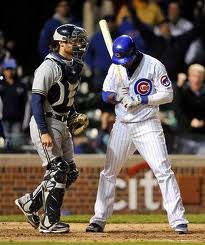
A few batters earlier an error by third baseman Aramis Ramirez helped his former team transform a threat into a rally.  Immediately after the ex-Cub mishandled Marlon Byrd’s grounder, pinch-hitter Steve Clevenger singled in a run and Darwin Barney walked.  Chicago loaded the bases.  Milwaukee was barely holding on to a 7-5 lead.

While life now includes daily episodes of Sesame Street...

Fortunately for the Brewers, the game’s 10th pitcher — their sixth — had means of maneuvering out of jams like this.  Generally, John Axford did it with a mid-80’s slider and a fastball in the upper 90‘s.

Seventy times the last two years he saved a win for Milwaukee.  Given his first opportunity of this new season, Axford was within a strike of doing it again.  Sixty feet away, Starlin Castro was in the right-handed box.  He stood in a hole created by two hard breaking balls, swinging at the first, taking the next.

With long brown hair flowing from his blue cap and reaching down to his gray jersey, Axford set himself upright.  Then he uncoiled from the stretch and unleashed a 96-mile per hour delivery.  He placed it precisely on the outside edge of the strike zone.  Castro was frozen in the moment.

...I still found time, albeit at an ungodly hour, to see the Cubs' Starlin Castro take a game-ending third strike.

As were most of the hearty souls hanging around Wrigley.  Or so it appeared on ESPN.  Thankfully for them, they had long since thawed out by the time I was seeing that game-ending sequence.  Axford had actually vanquished Castro and the Cubs hours earlier on a Monday night.  But I didn’t bear witness to it until sometime after 4, yet not quite 5 o’clock, the following morning.

Though exciting, even when viewed through a haze of half-consciousness, such 9th-inning drama had nothing to do with why I was captive on our coach in Tuesday’s wee small hours.  Framing it in baseball terms, I was up at that ungodly hour because it was time for the 7th-inning stretch.

At least that’s how I’ve come to think of that stage of the night when our 3-month-old daughter cries out from her Nanny Caddy, demanding to loosen her legs and fill her tummy.  This particular Tuesday, Mom was due for a long, hard day at the office.  So Dad was in the bullpen, awaiting the call from Baby M to warm up a bottle.

It came by way of a tap on my shoulder.  “The baby is stirring,” my wife said, signaling for the right-hander and returning her head to the pillow.  Into the darkness we went, my girl and I, descending the stairs to our main living area.

We were bound for the kitchen, though I stopped briefly in the family room to turn on the television, knowing full well that once feeding begins the parent is left without a free hand to change channels.   A minute or two later, we returned.

All things considered, this wasn’t so bad.  Our baby was happy and I was getting into the game.  So what if it involved the Cubs.  After all, a week or two earlier I was sitting in this same spot, probably at this same time, enduring an Orioles-Pirates spring training replay on the MLB Network.

(By the way, the overnight slots always seemed to be filled by either the O’s or Bucs.  Or, come to think of it, the Padres.  No surprise, I suppose, that while the Yankees and Red Sox get prime time — even in the Grapefruit League — the game’s perennial dregs go up against infomercials.)

In years past, whether single or married before children, the baseball I viewed was live.  Not tape delayed.  From April through August, my vantage point was mostly in a ballpark press box.  If I caught a telecast or radio broadcast, chances are I had just called, or was about to call a game.  Even last year, after the birth of our first child, a son, led me to cut back my work as a broadcaster, I was with the Triple-A Norfolk Tides for their opening two weeks.

But here in 2012 my season-opening homestand extends into late April.  Instead of preparing for the next game, I prep sippy cups and formula bottles.  About the time I used to describe the bottom of 2nd innings,  I now read to my boy from a rocking chair.  Ball Four has been replaced by Cleo’s Counting Book.

Before our first was born, friends who are parents promised: Your life will never be the same.  This I understood.  Of course, it made perfect sense.  What I didn’t (what I couldn’t possibly!) know is just how many ways and how much life differs when kids enter the picture.

For one thing, I’m much less hip to pop culture.  Okay, not that I was very hip to begin with, but spending time around ballparks gave me a pretty good sense of contemporary tastes, like which music topped the charts.  For two hours of every afternoon batting practice is set to Top 40 hits blaring from stadium speakers.  More than once, I used to leave the field trying to empty my mind of the latest Nickleback release.

Today, instead, there’s no escaping the themes to my Buddy’s favorite Sprout and PBS Kids shows:

They’re two, they’re four, they’re six, they’re eight; Shunting trucks and hauling freight…

Sunny days sweeping those clouds away; On my way to where the air is sweet…

Who’s got the power, the power to read?  Who answers the call from friends in need?

Oh, there’s more where those lines came from.  What’s more, those tunes strike at every hour, during any activity.  If I weren’t a fan myself (the Super Why jingle is especially catchy), I’d find them haunting.

Who's got the power to read? Why, of course, it's Super Why!

Since I mentioned the “t” word, my wife and I still have best intentions of trying to limit our children’s TV intake.  That, however, doesn’t mean I get to watch what I want, when I want.  Case in point, consider last Sunday.

Bubba Watson and Louie Oosthuizen had just left the tee box, looking to rescue themselves from their drives on the second playoff hole of The Masters.  I’m no golf guy.  But I do appreciate drama in competition, and was anxious to see the conclusion.  Just then our Little Guy returned from Tubby Time.  He was sipping warm milk from a cup in one hand, holding his sports-themed Lovie Bear with the other.  The Pajanimals were about to begin.

We never did see Bubba don the green jacket.  In his place, Apollo, Squacky, Sweetpea Sue and Cowbella set off for the Land of Hush.  Make no mistake, in our house The Pajanimals are a tradition unlike any other!

Regardless of such sacrifice (I write with tongue in cheek) and save for sleep deprivation (this I mean!), life’s vast changes are for the better.  You gain a great sense of accomplishment from a solid broadcast.  But it’s nothing compared to the pride you sense from seeing your toddler point to the number eight on your cue.

Sure I’ve missed the ballpark, especially on Opening Day.  You can find yourself in Rockford, Ill. or Moosic, Pa., as I have.  It doesn’t matter.  The season opener is special.  Starters are introduced along the baselines.  Ballparks are dressed with red, white and blue bunting.  The first pitch is as symbolic as it is ceremonial.

But this year I experienced a first on the real first day of spring.  With rare control of the remote, I switched back-and-forth between the Red Sox in Detroit and Mets at home against the Braves.  My son, who will soon be 2, joined me.  I was about a year older when I first fell in love with baseball and the not-exactly Amazin’s.  This fact my boy will someday learn should he ever ask why I routinely serenaded him with Take Me Out to the Ballgame and Meet The Mets— before he emerged from his mother’s womb.

Frank Francisco saved an Opening Day win for the Mets, giving father and son reason to celebrate.

Much to my satisfaction, New York held a 1-0 lead and Atlanta was down to its last out.  Still, the combination of Frank Francisco pitching and Jason Heyward batting left the outcome very much in doubt.  But Francisco, who’d been velocity-challenged in spring training, mustered enough of a fastball to tie up Heyward with a 3-2 pitch above the belt.  Swing and a miss!

In Flushing Meadows, the Mets celebrated their 33rd opening-day victory in the last 43 years.  About 220 miles away, just south of Boston, this dad asked his kid for a high five.  Excitedly, my Buddy obliged.  Now that, thought the Old Man, is Amazin’!

With Big Bro apparently hooked on our Household Pastime, who knows whether his Little Sister will likewise contract — as it was said when dad was a kid — Baseball Fever.  I certainly don’t intend to force-feed her the game, 24/7.  Nevertheless, as long as Daddy’s Little Girl needs to eat, 24/7, there’s always a chance she’ll get hooked too.

It just so happens the Yankees are playing the Twins this Monday on ESPN.  Re-air of the game is scheduled for Tuesday.  At 3 a.m.

Bob has called baseball on the radio for the  Norfolk Tides since 2006.  He is also the radio play-by-play voice of Navy football and broadcasts college basketball for CBS Sports Network.  For samples of his work, please visit www.bobsocci.com.

I Once Played in Peoria

Thanks so much to Kevin Capie of the Peoria Journal Star for taking time to remember the kid who once hoped (and, well, still does!) to someday embody the old Vaudeville line: If it can play in Peoria, it can play anywhere.  Kevin was kind enough to recently catch up to me and publish excerpts from our conversation in the Monday, March 26 edition of the Journal-Star.

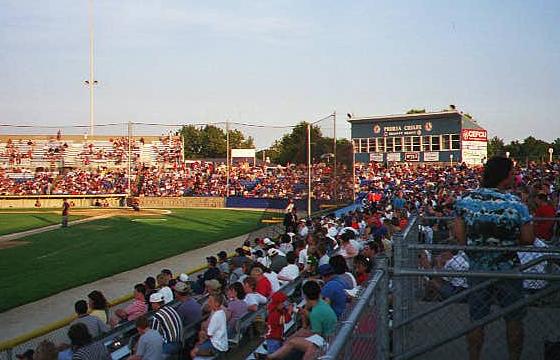
I still relish the view I enjoyed at Pete Vonachen Stadium, in my first full-time broadcasting job with baseball's Peoria Chiefs from 1993-95.

It’s wonderful not to be forgotten.  But what’s far more enjoyable is reliving memories of the many great people I met during my first experience as a full-time play-by-play broadcaster for baseball’s Peoria Chiefs of the mid-199os.  A handful are mentioned in Kevin’s piece.  Unfortunately, too many are not, including Scott Krusinski, the general manager who hired me in the winter of 1993; Grandma, the devoted Chiefs fan who often dropped off batches of cookies in the booth; Peter and Marian Korn, the native New Yorkers who showed me the real Heart of Illinois; and Reid and Kathy Ottesen, who demonstrated true Midwestern Hospitality.

I witnessed a lot in those three seasons, from Alex Rodriguez as an Appleton Fox to striking major leaguer Jim Thome striking batting practice balls into neighboring area codes.  And I was lucky enough to share time on the air with legends like Jack BrickhouseHarry Caray and Jimmy Piersall (yes, that Jimmy Piersall).  Mostly, though, I was blessed with an opportunity to grow in ways I’m only now beginning to realize.

Where Are They Now? David Robinson

By Bob Socci

Originally published in 2012 NCAA Men’s Basketball Championship program.

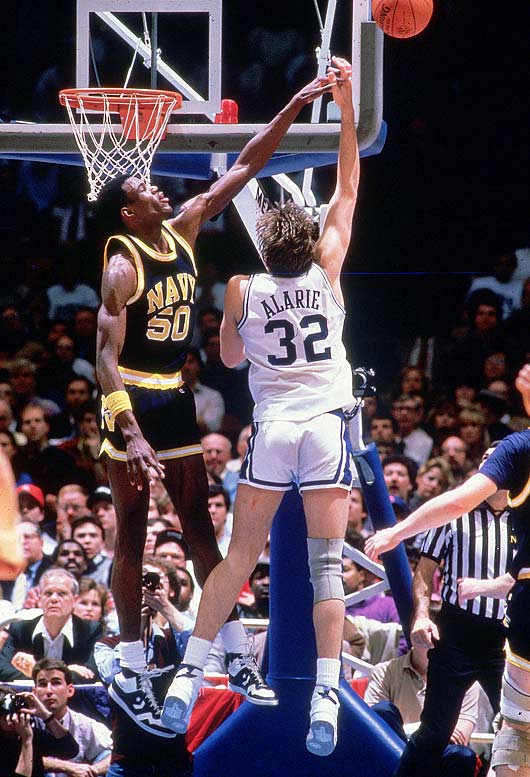
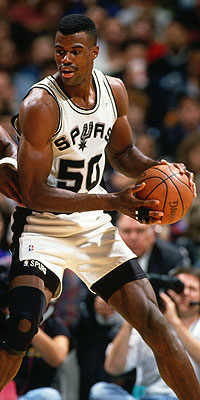
David Robinson rejects a shot by Duke's Mark Alarie in the 1986 East Regional final in East Rutherford, NJ.

Several years ago, as a guest of an Annapolis, Md. radio show, former Navy basketball coach Paul Evans cracked a smile and recalled the night he paid a recruiting visit to the Northern Virginia home of Ambrose and Freda Robinson.

The Robinsons’ oldest child, David, was a teenager with an ear for Beethoven and an insatiable intellectual curiosity.  His talents in math and science far exceeded any of the athletic skills yet to emerge during his brief high school career.  He was mainly interested in becoming an engineer.

“What David was most excited about,” Evans chuckled at the memory of their meeting, “was showing me the television set he built.”

“I was a bit of an egghead as a kid,” Robinson joked, laughing as Evans’s line was recently repeated to him.  “It was a big project.  My dad and I were supposed to do it together, but he was away in the service.  I felt pretty good that the thing actually worked.”

Robinson manufactured the large projection unit with parts of a kit mail-ordered from the Heath Company, whose customers included a young visionary named Steve Jobs.  It showed that Robinson looked at life and saw a much bigger picture than the small world framed inside a basketball court.

That Evans was building a successful program at a service academy, one of the nation’s best engineering schools, didn’t escape Robinson’s view.  Nor did the fact that Ambrose had what his son calls “a great experience” as a career Navy man.

But far more serendipitous than anything leading Robinson to Annapolis is what took place once he got there.  He entered at 6-foot-6 and immediately underwent a growth spurt of seemingly mythological proportions.

The self-described ‘egghead’ became a legend known as ‘The Admiral,’ outstretching his 7-foot-1 frame to project a larger-than-life image.  He led the Naval Academy on one of the most improbable and captivating journeys in NCAA Tournament history, before developing into one of the greatest pros of any generation with the San Antonio Spurs.

Along the way, Robinson, who was gifted with such good fortune, began to give back.  Basketball may have ultimately made a career choice for him, but it didn’t stop Robinson from becoming an engineer.

He eventually went from assembling electronics to envisioning ways of educating children and connecting the components to lives lived more fully.  The kid who once built a television decided to help others avoid the vast wasteland of missed opportunities.

*****

Vernon Butler initially encountered Robinson during the winter of 1982-83.  As a Naval Academy freshman, Butler was a linchpin of Evans’s efforts to make the Midshipmen consistent winners.  Robinson was a skinny high school senior, playing his lone basketball season at Osbourn Park in Manassas, Va.

By the time they saw one another again, a year later, a remarkable transformation was underway.

“I first met David at a hospitality room we had set up for recruits after a game,” Butler remembers.  “He was pushing 6-6 or 6-7.  At one point, I looked him in the eye.  The next time I saw him, I was looking up to him.”

Tall as he was, Robinson remained a long way from reaching his athletic ceiling, which was raised exponentially with every inch added to his height.  He didn’t start a single game in 1983-84, but offered occasional glimpses of what he’d become.  One occurred during a loose-ball flurry under the basket at Richmond.

“(David) grabbed the ball off the floor and rose for a vicious dunk,” Butler recently said from his office, as a vice president of defense contractor Booz Allen Hamlton.  “I was standing next to him, and realized he was something special.”

Robinson’s skills continued catching up to genetics.

“He would work on a different move four or five times and have it down,” Butler explained.  “His coordination and ability to adapt quickly were unparalleled.  Another thing he had was impeccable timing.”

All of which enabled Robinson to glide across the court, combining the finesse of a soft left-handed touch with the power to rebound and reject shots with either hand, from any angle.  Each performance was increasingly well-rounded.  Much like the person himself.

“I thought he was a really fun-loving guy,” says classmate Doug Wojcik, who remembers Robinson’s engaging personality and easy laugh transcending the daily rigidity of Academy existence.  “I describe David as a person with a great sense of humor and a lot of interests.”

“He had an ability to maintain balance with everything going on around him,” adds Butler.  “David wasn’t one-dimensional, basketball wasn’t his life.  He was a well-rounded person.”

As the country they had all sworn to serve was about to discover.

Robinson and Butler were perfect complements, as an inside scoring tandem on offense and anchors of a ‘2-3’ zone defense.  Wojcik, who was promoted from Navy’s junior varsity to be its starting point guard in 1984-85, joined a deeply talented supporting cast.

And together they totaled 26 victories, won the ECAC South and marked Navy’s first NCAA Tournament   appearance in a quarter century with a 78-55 rout of fourth-seeded LSU.  But the Mids, seeded 13th, couldn’t maintain a late lead and narrowly lost to Maryland in the second round.

That summer, between his sophomore and junior years, Robinson could have left Annapolis without obligation to the Navy.  Conventional wisdom suggested he transfer to eschew tours of duty and ensure the NBA riches he was likely to command.

Of course, Robinson didn’t see it the same way.  As early as January 1985, he shared his insight with Sports Illustrated’s Jim Kaplan.  Robinson spelled out the guarantee of a job upon graduation and the security of a possible military pension.

“I like the saying that’s in our home-game program: ‘Some college students learn what to do from 9 to 5,’” said Robinson, who would wind up as one of the game’s highest-paid players.  “‘Midshipmen learn what to do from 22 to 47.’”

When Robinson joined the other four returning starters for 1985-86, Navy captured another conference title and rode a 13-game winning streak into the NCAA tourney.

The seventh-seeded Mids blew past the Golden Hurricane of Tulsa to set up a second-round rematch with Syracuse on the Orangemen’s home floor.  In early December, Navy was beaten soundly inside the Carrier Dome, 89-67.

But with a berth in March’s Sweet 16 at stake, the Mids orchestrated a 34-point swing.  Robinson thoroughly dominated counterpart Rony Seikaly, producing 35 points, 11 rebounds and seven blocks in a 97-85 win.

Fellow upstart Cleveland State awaited in The Meadowlands, where Robinson grabbed 14 rebounds and rejected a startling nine shots.  But it took the last two of his 22 points, delivered in the final six seconds, to lift Navy to a 71-70 victory.

One game and one team, Duke, separated the Mids from the Final Four.  The tightly-knit group of young gentlemen soon to be officers were adopted as America’s Team.

None attracted more attention than the erudite seven-footer in his service dress blues.  And yet no one seemed less affected.  Robinson wasn’t thinking about making basketball history.  Something more important was on his mind.

“It was another momentous step for me in becoming a man and making my own space in the world,”Robinson says 26 years later from San Antonio, where he and wife Valerie raise their family.  “Having three sons, I know my boys want to get out of my shadow and create their own space.  I just wanted to live up to what my dad had done.”

He certainly did that; no matter that the Blue Devils, not the Midshipmen, advanced by virtue of a 21-point win.  Navy finished 30-5 and Robinson was voted All-America.  He averaged 22.7 points and 13.0 rebounds per game, while blocking a Division I-record 207 shots.

Individual acclaim continued the following season, as the Navy team confronted a grueling national schedule.  What seemed a farewell tour for Robinson included a visit to No. 1 UNLV and a matchup with Kentucky on Super Bowl Sunday.

As consensus player of the year, Robinson and the Mids secured a No. 8 seed and were paired with Michigan in the NCAA’s first round.  It was Robinson’s final collegiate appearance.  Memories of his grand exit — highlighted by 50 points and 13 rebounds — easily outlast any other details of a 97-82 decision.

More than 2,600 points, 1,300 rebounds and 500 blocks after after entering Annapolis, he was drafted first overall by the Spurs.  But before ever playing a pro game, Ensign David Robinson reported for duty at a submarine base in Kings Bay, Ga.

Two years later, in 1989, he was allowed to join the Spurs.  And two decades later, he was inducted into the Naismith Basketball Hall of Fame.  An All-Star in 10 of his 14 seasons, Robinson celebrated two NBA championships.  He was also a three-time Olympian, helping the U.S. to a 23-1 record, two gold medals and a bronze.

For anyone else, it would truly be an amazing legacy.  For Robinson, it’s anything but.  Understanding his true legacy requires one to consider the overarching lesson of his time in Annapolis.

“The Academy taught me about service, and what service means,” he says.  “The idea of laying your life down for your country, and how great this country can be.”

*****

Robinson made what he calls his “first foray into education” in 1991, at the urging of his mother, Freda.

“My mom pushed me to consider this community, especially giving to children in San Antonio,” Robinson said.  “She helped me to focus.”

Inspired by New York philanthropist Eugene M. Lang and his “I Have A Dream” Foundation, Robinson made a pledge to 94 fifth-graders at San Antonio’s Gates Elementary school.  Anyone finishing high school would earn a $2,000 college scholarship.  On David.  In 1998, when 50 of those students received their diplomas, David was on hand.

About the time Robinson delivered his promise to the kids at Gates, he decided to deepen his spirituality with a well-chronicled religious re-birth.  Guided by faith, and mindful of helping hands who touched his life, he sought more ways of reaching out.

“People helped me along the way,” says Robinson, who has since entered the ministry.  “I just want to fulfill whatever God’s calling is for me on earth.  It’s being spelled out step-by-step.”

In 2001 he founded The Carver Academy, an independent elementary school named for George Washington Carver.  Originally accommodating a culturally-diverse body of 60 students, enrollment today exceeds 100.  Virtually everyone is on scholarship, requiring Robinson to raise more than $44 million since its inception.

“Watching the school grow, and watching children grow is one of the great joys of my life,” he says.

Robinson is more than a benefactor.  Many of his own loves — of foreign languages and classical music, for example — are incorporated into the curriculum.  A big man with a broad outlook wants students to realize just how small the world is, after all.

“It’s not just being exposed to languages, but other cultures; the world is smaller than you think it is” says Robinson, who’s also a self-taught musician.  “It’s been proven that music helps you learn in other areas.  I know how it makes me feel when I play.”

He’s trying to instill in the children of Carver what his parents gave him, and his Annapolis experience reinforced.

“I want to produce the next great generation of leaders,” he says.  “There’s a foundation of values that isn’t going to change.  The world may change around you, but you’re always going to be able to come back to (those values)…They keep you grounded.

“It’s great to see what it’s meant to the kids.  Not just the education part, but the relationship part.  Kids represent our deepest hope.  There’s so much there; the whole world awaits.”

Coinciding with Carver’s success, Robinson co-founded The Admiral Capital Group and The Admiral Center.  The former is intended to create social impact via private investment.  The latter partners with large corporations and celebrities, ranging from actors to athletes, to do what Robinson has done with Carver: sustain a project to benefit a community.

It’s no surprise for those who knew the Admiral when he considered himself an egghead to see Robinson involving so much of himself to help so many others.

“Every time someone mentions David’s name, they say what a great person and what a great role model he is,” Butler said.  “He’s still seen as a gentleman’s gentleman.”

“David didn’t expect to be a superstar,” says Wojcik, the former head basketball coach at Tulsa.  “It doesn’t surprise me that he turned (fame) around to help others, especially children.  He’s somebody I’m proud to consider a friend.”

He’s also somebody who’s just getting started.

“(The future) is unlimited,” Robinson says in a rich baritone.  “I’ve been given ridiculous favor.  When you’re in a position of influence, with access, you can be a voice.  I like to say, ‘If you have a strong voice, don’t whisper.’”

As longtime radio voice of Navy football, Bob recently called the Patriot League men’s and women’s basketball championships for CBS Sports Network.  For samples of his broadcasting work, please visit www.bobsocci.com.

Patriot League’s Best At Their Best

By Bob Socci

Inside the final half minute of Wednesday’s Patriot League basketball championship, a pair of missed free throws by Lehigh’s Mackey McKnight accorded Bucknell a 12th opportunity to take its first lead of the evening.  And perhaps, the only lead it would need to return to the NCAA Tournament for the second straight year.

But the Bison were out of timeouts, after spending their final two in the minuscule span of four seconds; during which guard Bryson Johnson bracketed a Mountain Hawk foul with his back-to-back three-pointers.  His remarkable sequence reduced a 78-71 differential to the narrowest of margins.

Twice in a matchup of the conference’s top two seeds, who entered the evening with a combined 49 wins, the game had been tied.  First, at 15-all.  Next, after Lehigh led by as many as 11 late in the first half, when the score was 50-50.

With a predominantly orange-clad crowd of 4,267 crammed inside the Sojka Pavilion poised to spill onto Bucknell’s home court, possession and the latest chance to forge in front belonged to Bison sophomore Cameron Ayers.  As a Second-Team All-Patriot League guard, Ayers was part of the talented supporting casts surrounding the conference’s two premier players.

Bucknell’s Mike Muscala had doubled as the league’s Player of the Year and its tournament MVP in 2011.  Lehigh’s C.J. McCollum, who in 2010 became the first freshman to win the Patriot’s Player-of-the-Year award, had earned the honor again in 2012.  Between them, Muscala and McCollum were bound for a 59-point night.

With the shot clock dark and no other options presenting themselves, as time slipped away, Ayers drove along the baseline from right-to-left.  Elevating under the basket, he attempted a reverse layup, only to have his shot blocked with eight seconds to go by the Hawks’ Gabe Knutson.  Despite playing with four fouls, Knutson made the defensive play to preserve the lead.

Four free throws later, two by McCollum and the final pair by senior Jordan Hamilton, Lehigh celebrated an 82-77 victory (its school-record 26th overall) and a second trip to the NCAA Tournament in three years.    McCollum, who finished with 29 points, five assists, three steals and two blocks, was deemed the tourney’s most valuable player.

Meanwhile, Knutson was its most invaluable.  A second-team all-conference pick, he started by making his first six shots.  Then, following misses on five of his next seven tries, Knutson drilled a three-pointer for a 67-62 lead, just past the five-minute mark.  Overall, he scored a season-high 23 points and grabbed a team-leading seven rebounds.  Five of those boards were offensive, helping the Hawks outscore the Bison, 10-4, on second-chance points.

As a kid, Knutson lived for three years in Australia, where his father worked on the financial side of John Deere.  By the time they returned to the United States, eventually to settle in Iowa, Knutson was a seventh-grader.  He also was probably the most well-informed middle-schooler in middle America about the sports of water polo, rugby and Australian Rules Football.

March Madness, on the other hand, was a mystery.  On Wednesday morning, shortly before Lehigh’s shoot-around, Knutson recounted the time he found his dad filling out an NCAA Tournament bracket.  What was he doing, Gabe wondered?  Of course, he’s since found out.  Two years ago, Knutson was a freshman when the 16th-seeded Mountain Hawks hung with Kansas, before the Jayhawks pulled away midway through the second half of a 90-74 victory.  Next week Knutson gets to rediscover the true meaning of the madness.  Admittedly short on his knowledge of basketball history, Knutson sure has been living a lot of it lately.

Bucknell, denied a dozen times in its bid to overtake Lehigh, takes its 24 wins into the NIT, guaranteed a postseason berth by virtue of its regular-season title.  In 2005, the last time the Patriot League had two teams play beyond its tournament, the Bison shocked Kansas in the NCAA and Holy Cross eliminated Notre Dame from the NIT.  With McCollum and Muscala carrying the Patriot League banner, while leading their respective schools to their respective tourneys, a similar showing is a very real possibility.

But regardless of what they do and where they go from here, theirs was quite a send-off.  Even if only one  left the Sojka smiling on Wednesday, the performance of both are worth celebrating.

Following is a link to our recap for www.cbssports.com, after Vince Curran and I enjoyed the privilege of calling Lehigh’s 82-77 win for the CBS Sports Network: