From afar, an up-close look at how America’s Game has gone global

I’ve been awed by tens of thousands at NFL games in Mexico and Europe, but learning about some of the faces in those crowds moved me in a very personal way.

Prior to the New England Patriots vs. Jacksonville Jaguars at London’s Wembley Stadium in 2024.

More than 3,000 miles and an ocean away from Foxborough, on a North Atlantic island a wee west of Scotland’s mainland, one doesn’t expect to find much interest in the NFL draft outside of a chance encounter with a fellow American tourist.

But here on Islay, the 240-square-mile isle of roughly 3,000 year-round residents famous for its peated whiskeys, Caroline Ogden’s eyes light up from behind the cafe counter at the Laphroaig distillery, where she manages the visitor center.

“The draft begins tonight!” she excitedly says to me on this Thursday afternoon.

Caroline is all Scot, all smiles and all-in for Joe Burrow and the Cincinnati Bengals. Her husband, however, roots for a different team and, right now, she wishes he were here to meet this New Englander and perhaps talk about who that team, the Patriots, might choose with this evening’s fourth overall pick.

It’s the second time in as many days of a trip split between a London family vacation, a Scottish celebration of a good friend’s milestone and middle-of-the-night draft-watching that I’ve forged a transatlantic relationship over America’s Game. The first involved a father and his teenage son who live a few hours by ferry and car east of Islay, in a small town this side of Glasgow.

Craig Flynn started Mini Tours Scotland in 2004, operating out of his home in Greenock and crisscrossing the United Kingdom and Ireland, cracking jokes and creating an appreciation of the local history and culture for his clients to take back home. In recent years, he’s also made time for personal travel, taking his boy Gregor to places as far away as New York and as near as not-so-far-away London.

“You might not believe why we go to London,” Craig said to me as I listened from the other front seat, the one on the left, as he drove us out of Edinburgh the day before. “We go there to see American football.”

In fact, Craig told me, unknowing of what I do or where I do it for a living, they were there last October to watch Gregor’s favorite team compete against the Jacksonville Jaguars at Wembley Stadium.

“That one started well,” I laughed, thinking back to the Patriots’ short-lived 10–0 lead in an eventual 32–16 loss, “before it took a wrong turn.”

Thankfully, Craig made all the right turns — odd as they were for me, from the left lane — and for the next few hours riding across Edinburgh’s cobblestones toward Argyll and Bute’s country roads, away from one castle en route to another, our conversation veered between Scottish, English and Gaelic history and American football.

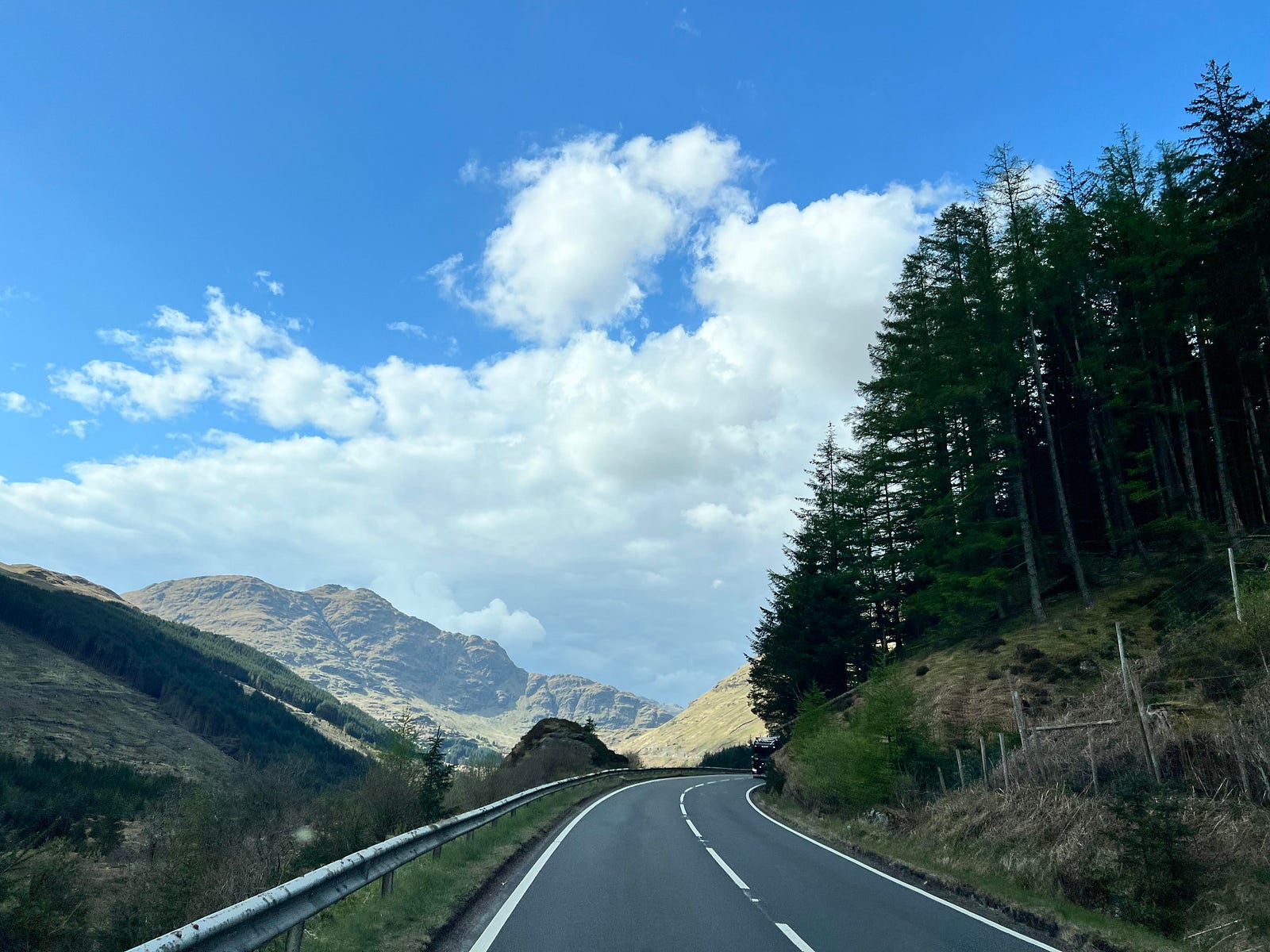
From the passenger’s seat, the one on the left, while driving toward Loch Restil in Scotland.

Gregor, his dad was proud to say, played two kinds of football, neither being the one preferred by most kids in the U.K. The young lad quarterbacks the Scottish national flag football team and is a tight end and QB for the East Kilbride Tigers in tackle football.

Over lunch along our way, Craig shared some photos from Wembley, by then well aware that I was there too. Seated in an end zone section, Gregor stood out in a nautical blue jersey, the Flying Elvis on his sleeves and №10 on his front and back. It had been a Mac Jones replica shirt, until a strip of tape and magic marker turned it into a Drake Maye model.

This wasn’t a kid, I thought to myself, who learned the sport by watching NFL Europe’s Scottish Claymores. Their last game was in 2004, well before he was born. Nor, based on the positions he plays and his souvenir jersey of choice, was he drawn to the game in hopes of being another in the NFL’s line of Scottish kickers and punters, the next Graham Gano or Jamie Gillen.

I’ve seen broad examples of the payoff from the NFL’s 21st Century investment in international markets while calling Patriots games in Mexico City, Frankfurt and London. And I’ve heard them in the chants of “Bra-dy! Bra-dy!” at Estadio Azteca and cheers for Sebastian Vollmer at Deutsche Bank Park.

But here in Scotland, learning about a face in those crowds helped to put a face on a reminder that the appeal of the Patriots and the sport they play reaches well beyond the Maine and Cape Cod coastlines. Sometimes in deep, personal ways.

No, the Pats will never even remotely approach the level of interest Scots have in Rangers F.C., Celtic F.C. or, in another sport, their national rugby squad. Still, to quote Will Campbell, the player they chose with the aforementioned fourth pick of the draft, their “logo speaks for itself.” And, as I’ve recently heard, in more than one accent or dialect.

Same for the NFL shield. Once a sport that we Americans mostly owned to ourselves, it is increasingly a global game.

During his Super Bowl week press conference in February commissioner Roger Goodell kept alive the notion that a franchise could someday be located in an international market, adding that it wouldn’t surprise him if a Super Bowl were to follow.

Annually, new sites are being added to the league’s regular season world tour. São Paulo last year. Dublin and Madrid this year. Melbourne next year. Paris, perhaps, the year after next.

And new global markets are continually being assigned to individual teams. In March, the league granted marketing rights to four teams for Greece and the United Arab Emirates.

Within the last decade in Scotland, the 67,000-seat rugby stadium at Murrayfield in Edinburgh and 52,000-seat Hampden Park in Glasgow were considered possible sites to host NFL games. But such talk has quieted in recent years as the league has expanded outside of the U.K. Nevertheless, a pair of Sots made history in the Highlands over the weekend.

On the third day of the draft, the 162nd choice overall, selected in the fifth round by the New York Jets, became the NFL’s first pick announced live from Scotland. Brothers and professional strongmen Luke and Tom Stoltman donned tartan kilts matching their green Jets jerseys and in their Highland lilt read the name of University of Miami linebacker Francisco Mauigoa, an American Samoan, while standing before Aldourie Castle at Loch Ness.

All to feed a monster whose appetite may never be satisfied. The league says there are tens of millions of NFL fans beyond our shores, and tens of millions more of potential converts who will buy its merch and pay for tickets if and when a game is held in or near their neck of the woods.

Just like the Ogdens and Flynns in a land marked by silver birch and Scottish pines.

Sunday morning I received a text from Craig, who was off on another father-and-son football journey. This was a relatively short one to Inverness for an Under-19 matchup of East Kilbride and the Highland Wildcats.

Craig included another photo. In this one, Gregor is wearing his own jersey. He’s in the Pirates’ red and black, standing in the grass, his helmet in hands and teammates in the background, and could pass for any of a million other kids his age across this country on any autumn weekend.

The picture came with an update. Gregor, Craig wrote, replaced the injured starter at quarterback and led the Pirates to a 35–24 win.

I read it with a smile, before moving on to reports about the Patriots’ post-draft class of college free agents. One of whom is a defensive lineman from Virginia Tech.

His name is Wilfried Pene. His hometown is Tours, France.

This article was originally published to www.985thesportshub.com on May 1, 2025. I’ve called play-by-play for the Patriots Radio Network on 98.5 The Sport Hub since 2013. Please join me on Bluesky and Instagram.

My seasons on the air and on the road with John Feinstein

Like most of Notre Dame’s other victories during its four-decade winning streak over Navy, the game they played on Nov. 14, 1998 was over long before it concluded. 

Through three quarters, the Fighting Irish led 27-0, leaving this voice of the Midshipmen little reason to sound excited on the radio and every reason to long for a running clock. But those final 15 minutes, featuring only a Notre Dame field goal, dragged on interminably, challenging my partner John Feinstein and me to hold any remaining listeners’ interest.

Fortunate for me, nobody filled time like John. 

He could do it with a 60-second parting shot, sitting alongside ESPN’s Dick Schaap early on a Sunday, or in just over three minutes, chatting with NPR’s Bob Edwards on a weekday Morning Edition. During other day parts, usually after headlines, John could deliver a quarter hour of radio gold: bold opinions informed by a savant’s knowledge of the four major sports, plus golf and tennis majors, spoken with utter and unsparing conviction, while never reaching for the easy pickings of low-hanging hot takes.  

A sports media star of that time, earning credibility over years of groundbreaking reporting and prolific writing as a bestselling author, John was in a rarefied position to speak his mind. He could say whatever he wanted because he was so successful. And he was so successful, in part, because he said whatever he wanted. It didn’t matter whether he was in sports-talk drive time or garbage time of a lopsided game.

On this Saturday afternoon, in a place then known as Raljon, Md. at a year-old stadium briefly named after its builder and owner of Washington’s football team, Jack Kent Cooke, John was in his second full season as Navy’s color commentator. Among his many roles — columnist for The Washington Post, author (of 40-plus books), commentator on The Golf Channel, A-list radio guest — this one was a labor of John’s love for the service academies that inspired his 1995 book on the Army-Navy rivalry, “A Civil War.” 

It was my first full year calling play-by-play for the Mids, after taking over for Steve Buchantz when he was hired for Washington Wizards telecasts midway through the previous season. Admittedly uptight even when I tried to cut loose, I had struggled to date with John’s unpredictability on the air. Believe me when I repeat that John said whatever, whenever he felt the urge, particularly about a sports topic or figure — local or national — that needed calling out. 

“Bob, I’m three of the most cynical people you’re ever going to meet,” John liked to joke…while on the air.

Surrounded by tens of thousands of Notre Dame’s so-called subway alumni, John used this opportunity to dispel what he considered the myth of Fighting Irish mystique. I don’t recall specifics of what he said, only that it was enough to turn a leprechaun’s grin into a grimace. What I do remember is his pause for an aside at the expense of the CBS crew in the booth next door. 

I could hear my future career flashing before my bespectacled eyes. What will the Naval Academy higher-ups think about all of this? No way will I ever get a job at CBS. I was close to breaking down. Then John broke me up.

“By the way, for all you Notre Dame fans waiting in the parking lot,” big John, figuratively and literally, said in the game’s final seconds, “Feinstein’s the little guy with the glasses.”

Thinking about that moment brings me a smile on an otherwise sad day, hours after being stunned by word of John’s death at age 69.  John was described by colleagues as “legendary,” as a  “a titan,” as “consequential.”  For me, John was a friend by my side for 14 seasons of Navy broadcasts and nine years of Patriot League basketball telecasts. 

We shared rides to and from remote campus gyms, often late into night. John always drove — the car, and the conversation. We shared pregame meals. Sometimes at a roadside McDonald’s en route to Lewisburg, Pa. Sometimes at The Palm in Philadelphia on the eve of Army-Navy. John always treated. 

And we shared Army-Navy. Fourteen times, most with John’s reminder that “A Civil War” was “like (his) third child.” It became his fourth after his youngest daughter Jane’s birth.

Not only did John write the book on Army-Navy, he spread its gospel. There’s never been a better spokesman for what separates this special rivalry from others than the Duke grad whose typical uniform was a well-worn sweater and worn-out loafers.

For one day every December, from march-ons through alma maters, ‘three of the most cynical people’ I ever met became an unabashed romantic. 

From our first Army-Navy broadcast with Pete Van Poppel and Frank Diventi.

Working with John was challenging, even during Army-Navy. Some days he showed up in a mood, set off maybe by traffic, the location of his parking spot or something he heard on the way in, perhaps an outrageous comment by a boneheaded coach or, more likely, conference commissioner. Some days, he simply took delight in keeping the little guy with the glasses on edge – or, if you will, on the brink. And some days, in either case, he delivered an all-time moment in my career, if not his.

In 2005, after being slighted by his alma mater before a Navy-Duke encounter in Durham, N.C. – John was a harsh critic of the school’s president – he was justifiably upset. Obviously bothered by it throughout the game, John, who was partial to the Mids anyway, became especially invested in the outcome.  

With just over three minutes left, the Blue Devils scored a touchdown to draw within a two-point conversion of tying the game. They did on the ensuing pass, though it appeared that Duke’s receiver clearly pushed off the Navy defender to make the catch. An obvious offensive pass interference, it went uncalled by officials.

John was incensed. He slammed his fist against a side window of our booth. No psychologist, but also no stranger to outbursts of my own, I’m convinced he was venting pent-up emotion as much as he was reacting to one play. In my headset, against the rattling of metal blinds from his blow, the next sound I heard was an F-bomb.

“F*****g refs!” he blurted out. 

Stunned into silence for a beat or two, I looked at Omar Nelson, who by then was the third man in our booth, and simply carried on. John laid his headset down, left us to find Navy athletic director Chet Gladchuk and offered his resignation. Chet rightly declined to accept, citing the goodwill John had accrued over the years as one of the Naval Academy’s most vocal public advocates. 

As all of that unfolded, the Mids marched down the field and won the game. A week later, John was back with an apology in time for a win over Air Force. 

A few years earlier, during a lull on a seemingly uneventful afternoon, I read a live ad to promote a contest that culminated in an all-expense paid trip to the Army-Navy Game. 

“How is the winner getting there?” John asked, before turning to our producer Frank Diventi and mouthing something unheard on air. He wanted to know if a certain airline was a sponsor.

Confused, Frank shook his head. John saw it as his cue.

“Well, let’s hope it’s not US Airways,” he chuckled, adding a crack about their flights being routinely off schedule. Not that he would know; John dreaded flying.

Soon enough, we got word: US Airways was a sponsor. A big one, in fact. The afternoon was suddenly eventful. 

Yet, days later, John met with the company’s rep – I imagine regaling him with stories from his season on the brink with Bobby Knight and signing a book or two – and saved the sponsorship he had imperiled.

Not that John was one to shill if he ever thought doing so would betray his journalistic oath. Journalism wasn’t just what John did. It was his religion, and a subject I always loved hearing him wax on about. 

Bob Woodward. David Maraniss. Scott Price. Frank Deford. Dave Kindred. There were others, no doubt, but these names I distinctly remember him invoking when describing reporters he admired most. Mention of Woodward was made while imitating his mentor’s voice.

John was connected. In the radio, television and print worlds and, as much, in the sports world. John was also a connection. To all those worlds for someone like me, a young broadcaster aspiring to someday graduate from baseball’s minor leagues and basketball’s mid-majors. 

I know he tried like hell to make that happen sooner than it did. As much as John challenged me, he championed my cause to anyone who would listen, and some who wouldn’t. When needed, he offered his best counsel and did his best to improve my sometimes shaky confidence.

In the summer of 2001, after hearing my frustration over a blistering critique I had received from a big-league announcer, John initiated contact with a mutual friend, a much more renowned baseball voice who was one of my mentors. He knew I needed a pick-me-up, and made sure I got it. 

John was also, as others have said and written, complicated. During the summer of 2011, he again left our booth, this time giving Chet no chance to convince him to stay.

He had long sought to produce an Army-Navy documentary based on “A Civil War” but lacked the funding. When CBS approached the academies to shoot its own doc and they agreed to it, John felt (and wrote) that he “had no choice” but to leave. 

Maybe he believed that Navy should have done more to back his effort. Maybe he couldn’t bear to have a press box seat to watch someone else film the movie he dreamed of making. Probably both.

Around the same time, John also quit the Patriot League package and we fell out of touch. As much as I think he should have handled both situations better, I know I could have too. It was complicated.

John would later join Army’s radio team – his love for both academies was equal – and eventually return to Navy’s. We even reconnected, if only to text sparingly.  Checking my phone, I am surprised to see that six years have passed since our last conversation and two have gone by since our last exchange of texts.

Throughout the day and night, I’ve received messages from long-ago Navy friends and peers, some of whom wrote that I was the first person they thought of as news of John’s death broke. It means a lot – more each time I recall another memory of our time on air, and on the road.

I also got a call from someone who said the same. It was that mentor, the one John had asked to lift my spirits way back when. I expressed what he and John meant to my career, and that I’ve never forgotten it.

He asked how long it had been since John and I last spoke. Too long, I said, adding my regret and wishing I had made the time to reach back out and tell John what I just told him.

Joined for Army-Navy by the late Naval Academy graduate, Sen. John McCain.

Thanks for reading. Please follow me on Bluesky and Instagram and read my other written for Boston’s 98.5 The Sports Hub and Medium.

A specialist on stand-by for the NFL, seeking another shot at a dream

By Bob Socci

The carry-on sat in a corner of a closet, out of the way but always at the ready, waiting on a call that could come at any time or never at all. Half of the suitcase was packed with football pads and cleats, leaving room for a couple of outfits and toiletries that Tucker Addington could hastily stuff inside in case the phone rang and he had to zip off to the airport.

No stranger to the quick getaway, Addington knew the drill well. If and when a team beckoned, he would likely have little notice to catch his plane, probably out of Austin-Bergstrom International. San Antonio was closer to home in New Braunfels, but Austin offered more direct flights. He would need  about an hour to get there by way of I-35 North. So he wouldn’t have long for ‘goodbye’ – and they for ‘good luck’ – before leaving wife Kensie and their three kids. 

This is what life is like on stand-by for the NFL, longing for an audition on the league’s ‘workout circuit.’ You wait and wait for teams to come to you, understanding that they can’t wait for you to get to them.

“Sometimes it’s a last-minute notice kind of thing. Somebody’s either (injured) or somebody’s not performing well and (teams) are trying to do a lot moving around,” Addington says. “So you have to always be ready.”

Once out the door, he might return almost as soon as he left. Teams are always bringing guys in for a brief look. Sometimes to update their Rolodex, in the event of injury. Sometimes for an actual tryout. Last year alone, Addington reckons, he  whisked off to “eight or nine workouts.”

Of course, he also might be gone a little longer. There was 2022, when he spent the spring in the upstart USFL, followed by a week in October on the Dallas Cowboys practice squad. And then, best and longest of all, there were his extended stays in New England and Washington, including six games played in back-to-back winters of 2022-23.

If the uncertainty and all the coming and going were enough to turn his world upside down, it was more than okay. In fact, it was exactly how he wanted it.

Addington is a long snapper. Upside down is literally how he yearns to make his living, performing a singular skill unique to football. Bending over to grip a ball out of a wide stance, he can fire it backwards between his legs, hitting a target as tiny as a holder’s hand being held out eight yards behind him, or a punter’s belt buckle fifteen yards away. 

In the more than four years since graduating from Sam Houston State University, he’s become one of the best in the world at it. Unfortunately, there have almost always been at least 32 others considered more worthy of full-time NFL gigs. So for most of that time, Addington has kept his half-packed bag close by at home in South Central Texas, while honing his quirky craft, eager to answer the call whenever and from wherever it originated across the league.

Earlier this month, his phone rang and a familiar area code popped up on screen — 508. The call was from Foxborough. The Patriots had dialed his number before. In fact, they had given Addington his first pro workout several years ago. They got in touch again the following season, when Joe Cardona, their long snapper since 2015, got hurt. 

Addington was signed to the practice squad, then promoted to the active roster. He debuted on Christmas Eve of 2022, played in the final three games of the season and remained in the organization through mid-August of 2023. Let go, he later joined the Commanders and appeared in three more regular-season games.

On Aug. 5, the Pats brought Addington in again to relieve Cardona, who was dealing with a minor injury, and serve as a long-snapping equivalent to a (training) ‘camp arm’ at quarterback. While they have split snaps on punts, field goals and extra points in practice, Tucker has delivered 17 snaps to Joe’s three in two preseason games.

Yet, almost certainly, Cardona will be in Cincinnati when the Patriots play their first regular season game on Sept. 8 while Addington will go back to playing the waiting game. That’s not to imply that he hasn’t been competing for a job.

Past impressions on teammates, coaches and front-office types led to Addington’s latest opportunity in New England. By performing and (equally important) handling himself well, this one can lead to another.

“The ability to get around might help me out in the long run,” Addington says. “I’m getting to meet these guys and create relationships and bonds, whether it’s with front office people or players.

“I’ve met some awesome people, had some great times and just continued to be disciplined, working on my craft. (I’ll) see where it takes me. If the right team comes, the time will be there and I’ll be ready.”

Specialists are a subset within each NFL team. There are only three of them during the regular season – the kicker, punter/holder and long snapper. The Patriots currently have five, including Addington, Cardona, kickers Chad Ryland and Joey Slye and punter Bryce Baringer.

They usually practice separately from teammates, and often are inseparable outside of practices. When a new member is introduced to their small circle, he must earn trust and create chemistry instantly. 

Addington has done it with veterans like ex-Pats kicker Nick Folk and Washington punter Tress Way, who’ve combined for 28 NFL seasons; Ryland and Baringer as rookies in New England; and Slye as both a Commander and Patriot. He also gets along great with Cardona.

“We add Tuck in and it’s like nothing really changes,” Baringer says. “We’re friends, we work really well together and it’s just fun to be able to go through this process with one another.”

Beyond personal feelings, Baringer sees this summer in particular as a benefit to Addington’s professional prospects. Though very familiar with his fellow specialists, he’s had to adapt to a different scheme under new special teams coordinator Jeremy Springer and assistant Tom Quinn.

“The fact that he can come here, play, get a good amount of film and also still be able to talk and learn from Joe is huge,” Baringer says. “I think it’s also good for him that he’s learning a different type of scheme with different coaches than were here in the past, because this year compared to last year is a little bit different, especially from a snapper’s perspective.

“(He) understands why he’s here, understands his ‘why,’ and he’s taking full advantage of it. And he’s snapping really well.”

No one on the team works more closely and extensively with long snappers than Baringer. Since his rookie spring of 2023, he’s handled hundreds, maybe thousands of snaps in practices and games – enough to instantly discern a delivery by Cardona from one by Addington.

“It’s not saying one’s better than the other, but you can just tell the difference, you can feel the difference,” Baringer says. “The timing is a little bit different.”

That timing is roughly equivalent to the snap of his fingers on a field-goal try. Between the snapper’s release and kick of the ball, Baringer must catch it, spot it exactly where and how the kicker prefers and ensure that its laces are facing the goal post. The entire operation averages 1.3 seconds.

 “Our job is so attentive to details, even just the little things,” Baringer continues. “We do a lot of snap (and) holds. We do a lot of just punt snaps. We do a lot of work together, so you build that connection.”

Snaps reach him at different spin rates and, thus, a varied number of rotations. For efficiency’s sake, Baringer wants to receive the ball with its laces already out. Knowing – really knowing – the snapper tells him where his hands should be relative to his body when he catches the snap. Any adjustment he makes can be a matter of centimeters.  

“(One guy’s) miss is in this spot with these laces, where another guy’s miss is in a different spot with a different type of laces,” he explains. “And then you get into the real-nitty gritty of catch location for me, where depthwise at eight yards I have to catch this guy’s snap for him to have perfect laces. Because it’s all based on his rotation.”

Every time he spins a ball to Baringer, Addington is aiming for what can be most elusive to aspiring pros and under appreciated by the general public: consistency.

“I think consistency is probably something that’s hard to explain to people. They’re kind of like, ‘Oh, you’re just throwing it between your legs,’” he says. “But with variations in spots, especially on field goals and even punts, you can take punters off their line (and) you can mess up a kick. At the end of the day, (people) say, ‘Oh, this guy missed a kick’ or ‘he went 2-for-4.’ That’s when we have to either step up or the people that are actually watching the position understand that was the long snapper’s fault.”

Before he started tossing footballs backwards, Addington was a junior high quarterback in New Braunfels, a growing city of 104,000 deep in the heart of Texas. Devoted solely to the state’s unofficial official sport, as a football-only athlete at Canyon High School, he moved to tight end on offense and played linebacker on defense. 

As a sophomore, his coach JJ Sierra assigned him a third position.

“(He) said, ‘Hey, you’re going to be the long snapper,’” Addington smiles. “I said, ‘How do you do it?’”

Sierra demonstrated the basics and advised him to simply “Let it loose.” The more he did it, the more he liked it, especially after realizing that long-snapping could be his means to an education. Addington is a triplet, raised by a single mom.

“Going into my junior year of high school I found out about scholarship availability,” he says. “I thought, ‘Let’s try to get to college somehow.’

“Obviously, I love the game of football. But I fell in love with the art of long snapping.”

The owner of the gym where he trained, Aldo DeLaGarza, introduced Addington to a former linebacker and long snapper at Sam Houston State, Doug Conrey, who founded the Texas Long Snapping camp in 2011. Addington snapped for Conrey at Aldo’s Gym. Impressed, Conrey took Addington on as a client.

They drilled down on techniques, from hand position to follow-through, transforming Addington from an accidental snapper to a college prospect. Training under DeLaGarza and Conrey, he eventually grew to 6-2, 230 pounds and followed the latter to Sam Houston State in Huntsville “on a full athletic scholarship!” as his mother Heather Addington wrote in a testimonial for Aldo’s website.  

Addington played 48 games for the Bearkats, earned a bachelor’s degree in Kinesiology and enrolled in a master’s program at Texas A&M Corpus Christi. He also interned in physical therapy at a hospital in Huntsville, before taking a part-time job as a patient care technician at the New Braunfels Regional Rehab Hospital. 

Married with children – oldest daughter, Payton, was born when Addington was a college sophomore – he kept snapping and started teaching too. If he wasn’t running patients through exercises, Addington was working with youngsters at Texas Long Snapping or practicing in the backyard, where he snapped into a net while Payton and her sister Presley retrieved the footballs.

Well over a year after his last collegiate appearance, Addington heard from the Patriots. 

“It honestly kind of kick-started my transition back into football,” he recalls, noting that he left the rehab hospital to commit more time to football. “I said, ‘Maybe they didn’t forget about me.’”

But without a callback from the Pats or overture from anyone else into 2022, Tucker and Kensie did some hard thinking. He came close to giving up on a possible playing career. Then the USFL came along.

His agent persuaded Addington to buy a ticket to San Diego and take one more shot at a league tryout camp. He nailed it and on March 10, 2022, while alongside Kensie and their two girls, learned that the Houston Gamblers had chosen him in the USFL’s supplemental draft.

Nine months later, he was summoned back to Foxborough. Cardona had reportedly suffered a partially torn tendon in his foot at Arizona, so the Patriots signed Addington to the practice squad as insurance. The following weekend, amid Cardona’s 127th consecutive game at Las Vegas, his condition worsened. His season was over.  

Promoted to the active roster on Dec. 23, Addington dressed out the next day for a matchup with the Bengals. He was the first player to emerge from the locker room in full uniform for warmups and went on to snap eight times in a heartbreaking 22-18 loss; six on punts by Michael Palardy and twice for PAT tries by Travis Vizcaino. That night, he flew home for Christmas.

Tucker and Kensie have since welcomed son Luke to the family, as Dad has continued to go where needed as a part-timer in hopes of full-time duty. Just in the past year, he’s gone from Foxborough to Jacksonville to Washington, paying other visits in between, to Foxborough again.

“I think a lot of people slide under the radar, but if you keep pursuing things and (are) grateful for the opportunities you get and keep working, keep training…” Addington’s sentence pauses, as his thoughts shift to his young family. “I’ve got three little kids at home, my beautiful wife at home, so it’s been a little different road for me than others. It’s not for the faint of heart.”

Speaking softly through his well-groomed, light brown beard after practice on the final Tuesday of training camp, Addington credits the so-called workout circuit for hardening his resolve. He also believes each experience transitioning between holders only makes the next one more seamless. 

But more valuable than what he gains professionally is what he reaps personally. 

“Man, it’s gotten me more than I can ask for: friends, relationships and where I’ve been now, a couple of different teams, floating around here and there,” Addington says. “I’ve been able to play six games in my career thus far and I’m excited to see what the Lord has in store for me going forward. 

“If you prepare and stay consistent, you’ll be amazed at what actually happens. I think some guys get down sometimes and, as you’re away from a (team), kind of start to wonder and think, ‘What comes tomorrow?’ In all reality, tomorrow isn’t guaranteed, so let’s work today and see what happens next.”

The following afternoon, at the end of a Wednesday practice, Addington and Baringer got together for some extra snaps. The next day, they made time for more of the same during individual-drill periods. 

Flanked by one group of defensive backs reacting to passes and a second group refining technique for jamming receivers at the line, Addington put his head down and hands on the ball and fired away to Baringer. 

In the middle of a practice field, they looked like a pitcher and catcher in the center of a diamond. Addington stuck with fastballs, trying to locate within Baringer’s strike zone, from mid-thighs to right in the ribs. They continued for a good 10 minutes. 

Chances are, Addington will soon be snapping again into his backyard net in New Braunfels, his carry-on stored in its corner of the closet and his phone’s ringer turned up to its loudest volume. Like every time before, the next time it sounds, he’ll be ready to go.

“Whatever comes my way, opportunity wise, I’ll be grateful,” Addington promises, “and take all I can from it.”

This story was originally published at www.985thesportshub.com on Friday, Aug. 23, four days before the NFL’s deadline for teams to announce their initial 53-man, regular-season rosters. Tucker Addington was among the first players informed of his release.

A player’s retirement and broadcaster’s lament

THERE’S A LOT TO SAY ABOUT MATTHEW SLATER, AN ALL-TIME GREAT IN HIS FOOTBALL SPECIALTY, AND, FOR ME, ONE THING I WISH WENT UNSAID.

Ten-time Pro Bowler Matthew Slater retired after 16 seasons with the New England Patriots.

Open your mouth to a live microphone for three unscripted hours at a time, trying to instantly frame the unpredictable action of an NFL game unfolding before you, and there are bound to be a few words and phrases you’d like to have back at the end of the day.

Add up mostly Sundays and a few weeknights per year over 11 seasons and, at least for this New England Patriots announcer, lines you wish you could rewind and re-word are too numerous to rue.

Except for one, spoken on Sept. 29, 2019.

The Patriots were in Orchard Park, N.Y., leading Buffalo, 6–0, on a cloudy and cool afternoon, as the Bills set up to punt from their 33-yard line midway through the first quarter. Poised for an all-out rush, the Pats stacked 10 players in tight, including Matthew Slater tucked well inside of J.C. Jackson on the right edge.

Fourteen yards away, Buffalo’s Corey Bojorquez, who began his career in New England, caught a low snap inches below his knee caps. Righting himself, he took two steps and dropped the ball onto his left instep, just as Jackson instantaneously extended his arms.

There was a loud thud. The ball popped high in the air before plummeting to the Bills’ 11, on the field’s far side. It bounced straight up to Slater, who in a singular act plucked it, carried it across the goal line and held it in his outstretched right hand while dropping to his knees.

Given a clear view of Jackson, I saw the block correctly. But the score I botched. Seeing the “8” of Slater’s “18” as a zero, to my unending regret, I blurted out the name of №10, Josh Gordon. 

The word bubble barely off my tongue, I realized it was Slater in the end zone; Gordon wasn’t even on the field. The error of my words hit me with the bluntness of Jackson’s block. Thud! 

“Make it Matthew Slater,” I uttered a split second later, sinking where I stood in our booth. “Matthew Slater with the recovery and the score.”

Leaving out an exclamation mark, I barely punctuated the play with a period.

It was the first, and would turn out to be the only touchdown in the brilliant career of the Patriot I most respected then, as now. If ever there was someone whose milestone merited a clean call, it was Slater, whose suffix, to hear coaches and teammates sing his praises, might as well be: Great player. Better person.

The following day, I encountered him in the Patriots locker room, back home in Foxborough, Mass. I apologized for my gaffe, and was received with a smile. No need to feel bad, he assured, gently shaking his head.

Still, it bothers me now, as then. Maybe more, knowing there won’t be another opportunity to nail the call of a score by Slater. At age 38, after 16 seasons as a Patriot, including 13 as a captain and 10 as a Pro Bowler, and with his one career touchdown, Matthew retired.

Expectation became official

Following a lopsided 2021 Wild Card playoff loss at Buffalo, Slater joined veteran teammate Devin McCourty in opting to play one more year. At least. When another loss at Buffalo in the 2022 finale kept the Pats out of the postseason, even as McCourty stepped aside, Slater committed to one more year. Again. But as the 2023 season spiraled toward a disastrous four-win, 13-loss end, it was obvious there’d be no ‘one more year’ for the three-time Super Bowl champ.

One such sign was in November on the Pats’ trip to Frankfurt, Germany, where Matthew was joined by wife Shahrzad and their family. Sleep deprived on the morning of arrival thousands of miles from home, he was nonetheless in his element: a husband and father doting on four little kids over a hotel breakfast.

More signs appeared en route to January’s season-ender vs. the Jets. For days leading up to the game, Slater repeatedly obliged team and media requests, reflective and relaxed. A year removed from pushing away from a podium in Buffalo, teary eyed, emotional and uncertain of his future, he seemed at peace.

 Slater appears at his final post-game press conference on Jan. 7, 2024.

On game day, teammates stepped into a Nor’easter for warmups wearing special sweatshirts in his honor. Navy blue, with red and white lettering, they read “The Patriot” across the front. “Captain,” they said, above an “18” on the back. And on the left shoulder, in perfect order: “SON, FATHER, HUSBAND, TEAMMATE,” along with a list of career achievements.

Shortly before kickoff, the Slaters reunited there on the field. Matthew embraced his parents, Jackie and Annie, and brother David. Shahrzad and the kids cheered him on in their own “18” jerseys.

We’d later learn from a team-produced video that word was getting around, even among New York players. Slater confirmed to Jets contemporaries Thomas Morstead, 37, in his 15th season, and Aaron Rodgers, 40, in his 19th: this was it.

Three hours later, the snowy, slushy end to Slater’s 239th game — 264th, if you count playoffs — was marked by mutual admiration. Helmet off, he lingered on the field, heading toward the Northeast opening of Gillette Stadium as remaining fans offered a collective salute.

Slater returned it by raising his right hand, just as he did years earlier in the Bills end zone. Only this time, his extended right thumb, index and pinky fingers formed an offering of his love in sign language.

In recent years, I’ve listened to a handful of special teams coordinators around the league pay tribute to Slater, having watched him mature from unsure rookie to master craftsman. Among them, Dave Fipp of the Detroit Lions, once penned his respect for Slater, writing a personal letter of congratulations the first time Matthew made the Pro Bowl.

No special teamer reached more, which may be why a another, John Bonamego, who coordinated kicking units for 19 NFL seasons, more recently called Slater “a first-ballot Hall of Famer.” Bonamego won’t get much of an argument from his peers. Nor from me.

A Patriots Hall of Fame blazer for Slater is all but guaranteed. A Pro Football Hall of Fame jacket like the one his dad Jackie got as a legendary offensive tackle, is hardly a given. But here’s hoping this year’s selection of returner Devin Hester gets Matthew one too. Because nobody covered returners as well, for as long as he did.

Not that a clothing item — in Foxborough red or Canton gold — makes the man who finds validation in faith, family, relationships to others (in and out of the game) and community service. Humility was “a core value of our home,” Slater told me last spring, stressing that Jackie and Annie also imbued in their sons the importance of blending a strong sense of self with keen self-awareness. 

That balance helps explain the player Matthew became, as a post-high school athlete generally devoid of an offensive or defensive position. At UCLA and in the NFL, Slater was mostly rostered as a receiver. He concluded his career with one catch (for the Pats in 2011) and four carries (including two as a Bruin and netting five yards overall).

Adept at returning kickoffs in college, Slater struggled as a pro. Ask him about it, and in typical self-deprecating manner, he laughingly labels himself “a bust.”

Obviously, Slater found a way to hold his place, regardless of listed position. Drafted by Bill Belichick as a fifth-rounder in 2008, he was determined to “become the best (kick) coverage player that (he) could be.”

Belichick has called him the best ever, a special teams equal to Tom Brady on offense and Lawrence Taylor on defense.

Tireless and egoless

On the Wednesday after returning from Frankfurt, the Pats held a practice before dispersing for a bye weekend. And as the doors to the locker room closed on an ensuing media availability, one player remained: Slater. 

Of course. Still in workout gear; headed to the weight room. Sixteen seasons in; no different than his younger self, who former special teams coach Scott O’Brien described as a guy who shows up everyday like he might get cut that day.

Football’s so-called Turk never ran down Slater. Tuesday the ‘gunner’ opponents couldn’t keep down despite double and often triple teams, did what few in his unforgiving game can: he stopped running on his terms.

“It is time,” he told us in a statement through the team, “for (his) relationship with the game to evolve.”

As a player, Slater was an exemplar: of his specialty, of leadership, of the Patriots’ culture when at their best. On and off the field. In the football facility and community. 

Slater was also an eloquent voice: for teammates, for the team, for special teams and for others whose stories need to be told. However his relationship with the game evolves, one expects he’ll keep advocating for all of the above.

In turn, there’s so much to say about Slater. And for me, there will always be one thing I wish had gone unsaid.

This is an updated version of an article originally published at www.985thesportshub.com. Bob Socci has been the New England Patriots radio broadcaster since 2013.

A Super Sunday For an Off-Duty NFL Announcer

Five years AFTER calling my fourth Super Bowl, I wasn’t where I wanted to be on Sunday; but where I was supposed to be.

After calling the first Super Bowl overtime in 2017, I watched the second from home on Sunday.

Appetizers were disappearing fast, while the main course waited to be roasted and grilled. The house was filled by in-laws invited for our semi-regular Sunday dinner, which on this once-a-year occasion doubled as a Super Bowl viewing party.

It was after 6 o’clock, about a half-hour to kickoff, and where was I, the biggest football fan in the family? Not home; not yet. Twenty-five miles from chips and cheese board, and the pale ale I’d picked up solely for the game, I was in one of the last places I typically want to be: a crowded and noisy shopping mall, subjected to the aromatic alchemy of the nearby Food Court. And I was growing increasingly impatient, waiting for my 12-year old to reemerge from a high-voltage playground known as Level 99. “A first of its kind,” according to its website, Level 99 features “ over 50-real world physical and mental challenges and games, craft drinks and elevated dining.”

Hours earlier, I’d driven my daughter there from drama practice — she’s playing Amanda Thripp in her middle-school production of ‘Matilda’ — to a meetup with friends. Resistant to the allure of ‘craft drinks and elevated dining,’ I gave her some independence from Dad and became a mall walker. 

Wandering in search of a Valentine’s gift for my wife, I went in and out of anchor department stores and weaved around kiosks, evading the many retail interceptors pitching makeup and moisturizers, fidget spinners and cell phone cases. Could there possibly be so many people for whom phones are fashion accessories?

Occasionally, I scrolled for news on mine, which is still protected by the same black case I bought with my device several years ago. Otherwise, I remained disconnected from the event most Americans were fixed on. Missing pregame programming wasn’t a bother; I’d missed it before. 

The past four years, for instance, I chose, like this one, to bypass the hype with the same elusiveness I showed sellers of minerals from the Dead Sea. In prior years, I had no choice; I wasn’t watching because I was working — at the games. Nope, I didn’t catch any of NBC’s chatter before Super Bowl XLIX. Or FOX’s for LI, NBC’s ahead of LII or CBS’s in the hours preceding LIII. I had my own broadcast to call. 

On those afternoons, outside of Phoenix and in Houston, Minneapolis and Atlanta, I was getting ready to go on the air of the New England Patriots radio network. It was my voice (and that of partner Scott Zolak) heard on Pats broadcasts when Malcolm Butler intercepted Russell Wilson, James White ended the first Super Bowl overtime by scoring the last six points of the largest comeback in the game’s history and Tom Brady took a knee on the final snap of New England’s sixth championship victory. And, yeh, we also called (less enthusiastically) the unanswered Hail Mary at the end of the highest-scoring Super Bowl, won by Philadelphia, 41–33.

The view from the Patriots radio booth before Super Bowl LIII in Atlanta.

Reality Check

When asked what it was like in those moments, my response is any of the following: Out of body. Surreal. Incredible. Unbelievable. And years later, while waiting to the whiff of fast foods, dings of arcade games and flashes of laser lights while two of my peers were saying hello to audiences in Kansas City and San Francisco? All of the above, and more. And how! 

At that moment, I even wondered, as I sometimes do, ‘did they ever occur at all?’ To me, they can feel as ephemeral as they are eternal. They were real; and yes, they were spectacular. And I was lucky as hell to experience them.

Snapped back to the reality of the present, my waiting game had to end. Back home, chicken and steak tips had gone on the grill. Vegetables were in the oven. Checking the GPS on my phone, I confirmed it would be impossible to get back there in time for the opening kick. I needed to go in.

Inside was chaos arranged in a maze of rooms and activities. I didn’t see my daughter at first. Nor her friends. Again the craft drinks on tap behind a long bar beckoned. Again I resisted. I stepped out, thinking I might have missed her. I texted, without reply. I went back in, without a sighting. I left again. This time, I called. Again without reply. I returned inside. And there she was.

We have to go, I said. I have to get my phone, she told me, leading me to a small storage locker. It didn’t open. Not on the first try. Nor the second. We found an employee to assist. He quizzed her on the contents, and turned his key. Just as she said, a $10 bill and phone, in its yellow case, rested inside. 

With my car parked close to the exit, we hurried to leave. I backed out of my space and, of course, started the wrong way inside the garage. Turning around, I got us out, with a good 25–30 minutes still ahead of us. I turned on the radio. Former Super Bowl most valuable player Kurt Warner was interviewing the quarterbacks.

Wired from the blast she had with her friends, my daughter plugged in her playlist. The soundtrack of “Hamilton” blared, and she happily sang along. Just as she did the previous night, during a similar drive home in darkness from a dance showcase, where she performed beautifully. 

As game time approached, I convinced her to get an update from Las Vegas, site of LVIII. Post Malone was singing “America The Beautiful.” Put your right hand on your heart, she told me. I couldn’t, shifting lanes approaching the highway exit on our right. Two hands on the wheel, I told her, even as Reba McIntyre sang the national anthem.

A few minutes, a few S-curves and a left turn later, we pulled into our driveaway and hustled to the front door. I couldn’t wait to eat. San Fran was driving promisingly in the opening series. The grill, my wife informed me, wasn’t going so well. Not hot enough. Its flames, but, thankfully, not my patient relatives, were doing a slow burn. I poured a beer, just as Christian McCaffrey fumbled the ball to KC, and went out to the patio to assess the situation. 

One out of three burners was cooking. Great batting average. Not good enough to feed the hungry guests, or hosts. We called an audible, opting for a run inside. Thankfully, we fared better than the 49ers on their first drive. The food turned out great.

Real and Forever

Typically, I’m not one to enjoy viewing parties. I prefer watching sporting events I’m most interested in with little background noise and activity, which you might find strange, considering that during most games I care about, I’m talking over the sounds of 60,000 plus. 

On Super Bowl Sunday, I watched the first half, as little cousins shrieked and laughed over announcers Jim Nantz and Tony Romo and our dog determinedly pushed past me to reach my overly generous, food-sharing father-in-law. Eventually, I pulled him back and the house emptied of visitors. 

Around the time Usher took the halftime stage, our viewing party was down to my son and I. It ended, as you know, watching Patrick Mahomes roll right and toss the title-clinching touchdown pass to Mecole Hardman.

Like the Patriots I described more recently than it sometimes seems, the Chiefs were overtime winners and champions for a third time in five seasons. But unlike those Pats’ wins, there was no celebration to attend; only bedtime after I finished cleaning up.

Not the ending to Super Bowl Sunday anyone associated with an NFL team hopes to live. But when your biggest gripe on the biggest game day of the year is going to the mall or grilling on a stove top instead of a Weber, you’re living well. Especially when you can watch your daughter dance and hear her sing, and talk about the game with your son sitting next to you. Those moments are real; and they’re forever.

Originally published at www.bobsocci.com. Bob has been the New England Patriots radio broadcaster since 2013. He also writes for Boston’s 98.5 The Sports Hub.

Mayo, a leader of men in his own way

The following first appeared on 985thesportshub.com on Friday, Jan. 12, after former Patriots linebacker Jerod Mayo was hired as the team’s new head coach.

Author (left) with Jerod Mayo (center) and Scott Zolak at a pre-Super Bowl LIII rally at Gillette Stadium on Jan. 27, 2019. (Photo by David Silverman)

The first time I met Jerod Mayo, he poked fun at my stentorian cadence behind a microphone in the middle of a high school field. True, before Hardy on 98.5, I was mimicked by Jerod, from Hampton Roads.

We were in Newtown, Conn. for a day-long event centered around a youth football clinic conducted by Patriots players and assistant coaches in the spring of 2013. As emcee, it was my first ‘official’ role as the team’s newly-hired broadcaster.  

Drills concluded, and I introduced Mayo for a few words to the kids and their families seated all around us. Naturally, as always with him, a captain since his second season, he connected with the crowd. First, though, he hit yours truly with a playful jab, making note (and light) of my ‘announcer’s voice.’ Naturally, as always with Mayo, he did it smiling in a way that let me know: he was just busting my chops to break the ice.

Unfortunately, I didn’t get to lend my voice to enough of his games. A torn pectoral muscle in the season’s sixth week – overshadowed by Tom Brady to Kenbrell Thompkins to beat the Saints – robbed Mayo of most of 2013. Further injury robbed him of most of the next year, too. 

Rather than “wallow in (his) pain,” as Mayo told Gautam Mukunda on the NASDAQ World Reimagined podcast in March 2021 (the listen is well worth your time), he worked to help the team win. Mayo dived into film study with Steve Belichick, then a coaching assistant, and involved himself on the sidelines during games. Long a ‘coach on the field’ as an inside linebacker making defensive calls, he was a de facto ‘player-coach’ for an eventual Super Bowl champ.

We would later learn, watching the collaboration of Mayo and the young Belichick running the Pats defense in recent years, that they became very close in Jerod’s final ‘playing’ days; just as one can learn by listening to him chat with Mukunda, or by reading or watching features like TheAthletic.com or Patriots.com profiles from last year, that he simultaneously formed relationships to help him excel outside football.

A younger Mayo – he’s still very young, at 37 – probed owner Robert Kraft for insights into the business world. He sipped wine and listened intently in intellectual circles and sought mentorships that prepared him for success as an angel investor and an executive rising to vice president of business development for Optum, a subsidiary of UnitedHealth Care.

Mayo also made time for television, shining in spots alongside Tom E. Curran, Phil Perry and the rest of the NBC Sports Boston crew. He easily could sit on a network set, like Tedy Bruschi or one of the McCourtys. Instead, he reclaimed a seat in the film room, becoming a coach. 

No sooner than Mayo’s return to One Patriot Place, he was seen as a future head coach, here and elsewhere, as evidenced by future interview opportunities. Even before last spring’s unique statement of ownership’s intentions to work out a deal to employ him long term, it was hard to envision the Krafts watching Mayo walk out the door to take over someone else’s team. 

On Thursday, Robert Kraft reminded us of something Jonathan Kraft has spoken about publicly in the past: how a relationship was formed with Bill Belichick in part over a mutual understanding of economics, the salary cap, value over cost, etcetera. They connected on a level transcending the game on the field. 

If you listen to Mayo and Mukunda; or hear him in the dot-com feature describe the formative influences of his mother and grandfather; or consider the intellectual and analytical thirst for information required to succeed in funding private startups; it’s easy to understand how Mayo and the Krafts would connect on a higher plane than a grid of Xs and Os. 

Then, take into account his leadership skills demonstrated as a rookie in a linebackers room populated by Bruschi and Junior Seau and Mike Vrabel. Mayo was the kid they dispatched to knock on Bill Belichick’s door to pitch their case for an occasional day off from padded practice. 

“If the worst thing someone can do to you is say, ‘no,’” Mayo’s mother, Denise, told her son, “go for it.”

Most — maybe two-thirds — of the time Belichick gave him a hard ‘no.’ But when the reply was ‘yes,’ Mayo was celebrated among his mates. A year later, they voted him captain. 

“The guys knew I cared about them more than I cared about myself,” he said to Mukunda of his youthful willingness to knock on that door, to go for it.

Sixteen-years later, the same feeling is consistent among the players Mayo’s coached. Mark Daniels of Masslive.com is one of many reporters who’ve written their testimonials in recent days.

No doubt, concerns, questions, criticism, all come with this hire. Not unlike the one Robert Kraft made in January of 2000.

After all, Mayo’s never been a ‘coordinator,’ let alone a head coach. Absolutely, Vrabel is available, and we know all too well how good he is from the games he’s coached against the Patriots (see 2018, at Nashville, or, worse, January of 2020, in Foxborough). 

You’re right, Jerod’s a defensive coach, hired as the organization closes in on a crossroads draft in need of identifying and developing its future quarterback. Okay, you consider him a disciple of Bill’s, asking, understandably: ‘Why move on from the best coach ever to then turn to one of his own?’ And how about: ‘Will he go outside current or past Pats circles for coaches? Can he? Who will take over player personnel?’

All valid. And all, I trust, the Krafts considered. 

“Jerod is an individual that, I think, has no ceiling for his ability to grow and how competent he is,” Robert Kraft said at last spring’s owners meetings. “We had the privilege of having him as a player, and I saw how intense he was, and his leadership skills that he had. And then I saw him leave us and go into private industry and learn the Xs and Os of business, and then come back to be a coach and do that with us.”

Of course, Mayo confronts an enormous learning curve. And faces major challenges trying to lead the Pats from 4-13, a third losing season in four years, back to expectations as a perennial Super Bowl contender. 

Even if you consider Mayo’s time making checks at the line of scrimmage and leading in the locker and meeting rooms as a player as some measure of coaching equivalent, there’s no downplaying the enormity of his new undertaking; he’s still very new at this coaching thing. 

But that doesn’t make him the wrong choice for this team, at this time. In Mayo, the Patriots have an exemplar of their best qualities of the past; who’s proven himself to be an out-of-box thinker and learner; who coaches, as he recently said, “out of love,” remaining “tough” while showing “warmth” and building “confidence”; who communicates and connects as a person in settings as diverse as the C-suite and team cafeteria; who has the character, intelligence and charisma to be both a constant and an agent for necessary change.

What’s more, if his past is a prelude, Mayo won’t be afraid of tackling that curve and those challenges cast in the hooded shadow hanging over the organization from the past 24 years; just as he wasn’t afraid, at 22, to knock on Bill’s door. 

Speaking of Bill, Mayo described Belichick to Mukunda as “a continuous learner” always “trying to evolve.” As if talking about himself.

Mayo’s about to learn a lot on a new job, arguably, the toughest in sports, eight years after he retired from playing, prompting the legend he now succeeds to praise him at the 2016 owners meetings.

“There have been very few players in my career that I’ve had the opportunity to coach that I’d say had more of an impact on the team than Jerod has from day one, which is unusual,” Belichick said. 

It’s day one of a new Patriots era, and an unusual person gets his shot to impact the team as its next head coach. I, for one, am excited to describe the days that follow – in my best announcer’s voice. 

Bob Socci recently completed his 11th season as the play-by-play broadcaster for the Patriots Radio Network on 98.5 The Sports Hub in Boston.

End of an era in New England

Before Jerod Mayo was introduced as the 15th head coach in Patriots history, I wrote about my experience calling games during the last 11 of Bill Belichick’s 24 seasons as his predecessor. This ‘Socci’s View’ originally appeared on 98.5thesportshub.com on Jan. 17, 2024.

Bill Belichick at his final midweek press conference as Patriots head coach, on Jan. 3, 2024.

So where was I? 

On Friday morning I started filling this space with thoughts about the past 11 seasons of Patriots game days and the times between them listening to Bill Belichick over conference calls, on WebEx streams and from seats in various press rooms. Several sentences in, news flashed by way of a phone notification, and I backspaced away from Bill for a forward-thinking rewrite about his successor Jerod Mayo.

Three playoff doubleheaders later, Belichick has interviewed in Atlanta and embarrassments of Dallas and Philadelphia have flooded every platform from X to ‘MyFace’ with memes of him under references to Jerry Jones and Jeffrey Lurie. By the way, which do you find the more tantalizing prospect: Bill responding to Jones’ weekly public critiques of his – always Jerry’s – Cowboys or Lane Johnson reacting to the Patriot Way becoming the Eagles way? 

Anyway, Bill’s on to the next team. Before he gets there, allow me to pick up where I left off, which was actually a good seven years before calling Belichick’s 206th win in my first regular season broadcast from Buffalo, where Mayo captained the defense and Tom Brady captained a comeback. 

It was a Sunday morning, on a rare day off for the Patriots, in October of 2006. Belichick was back home in Annapolis on the U.S. Naval Academy yard, where his father Steve coached and taught for 33 years and was laid to rest 11 months earlier. Dressed in suit and tie, his oldest son, also named Steve, at his side, Bill stood in the lobby of Navy’s football offices, on the second floor of Ricketts Hall. 

This was the building where Belichick’s dad remained a fixture well into his retirement. He’d swing by the football suite, grab a styrofoam cup of coffee and walk down the hallway to read the local newspapers delivered daily to the sports information office. Every so often, as the voice of the Midshipmen since 1997, I happened to be there at the same time. If I was lucky, I got to hear Coach Belichick, as everyone knew him around the Academy, spin an anecdote, offer an opinion or teach me a lesson or two. 

More than once, the topic was broadcasting. I learned, for example, that he watched games with the TV sound muted, unless Jerry Glanville was commenting (“he’s the only one who knows defense”). In another instance, I had my own work critiqued, after he heard me refer on-air to Bill Walsh as the father of the West Coast offense (“let me tell you about Paul Brown!”). 

Our longest conversation was our last, largely centering around the recently-published “The Education of a Coach.” Its author David Halberstam had described the book, written about New England’s Coach Belichick, as an homage to Navy’s Coach Belichick. What most impressed the latter, unsurprisingly, given his keen scouting eyes for the most granular details of an opponent’s formations, motions and play calls, was Halberstam’s meticulous reporting technique. No tape recorder. Full quotes, hand written, with context into his reporter’s notebook. I can still picture Coach Belichick in the back of Navy’s press box, a half hour to kickoff with Temple, demonstrating how Halberstam scribbled and highlighted, while pretending to flip the pages of an imaginary notebook. 

About then, our radio producer interrupted. Air time intervened. I could have listened all day. It was the last time I spoke to Coach Belichick. It was his last Navy game. 

Bill Belichick’s aforementioned homecoming in 2006 was on a bye weekend for the Patriots that began with a Saturday matchup of Navy and Rutgers – the Scarlet Knights, featuring twin cornerbacks named McCourty, shut out the Midshipmen – and concluded with Sunday’s campus visit. Bill and young Steve were there to formally donate more than 400 titles in the family’s football library to the Naval Academy. 

There, in the soon-to-be (and still) home of the “Belichick Collection,” a nostalgic Bill reminisced to a few reporters about game-days of his youth, when he hawked programs outside Navy-Marine Corps Memorial Stadium on Rowe Boulevard. He wistfully answered questions, including mine, which related to my last conversation with the original Coach Belichick, and Halberstam’s homage. 

Holding a microphone off his left shoulder, I saw his softer side. The next time in his company, seven years later, I caught a different side of him.

Belichick had just wrapped up a spring press conference on Gillette Stadium’s press box level and, flanked by right-hand assistant Berj Najarian, marched toward the elevator. Patriots veep of media relations Stacey James and I trailed, more than a few steps behind. Hired weeks earlier to be the Pats new broadcaster by CBS Radio Boston, few people in the organization knew who I was; the head coach wasn’t one of them. The doors opened, they stepped in and so did we. Instantly, the doors shut on any foolish notion I might have had that my Navy football cred would afford me an ‘in’ with the favorite son of Annapolis. 

James introduced me, I smiled and started blathering. I failed to utter as much as the first few syllables of a mutual friend’s name: Navy coach Ken Niumatalolo. Maybe I made it past the initial “a” before trailing off into silence, frozen by the look. No, not the death stare gone viral from podiums around the NFL; the slightly less intense one that conveys annoyance and the question: ‘W(ho)TF are you? The ride down felt like the longest descent of my career. Before hitting field level, Najarian smiled, piercing the silence. “Get ready to call a lot of wins,” he said.

Najarian was right about that. My first six years on the call featured an average of 12.3 wins a season. Plus 2.2 wins a postseason. The Pats let me tag along to six straight AFC Championship games and four Super Bowls, and in three championship parades. 

While I still drew that look occasionally over the years, sometimes forgetting the question I intended to ask in the midst of a long-winded preamble to the point I never got to, and sometimes realizing before the words escaped my mouth that mentioning Vic Fangio’s reported blitz rate was a foolish idea Bill wasn’t about to suffer, I’d like to think I ended up earning credibility in the coach’s eyes. 

At least, that’s how I was treated, even after the great times gave way to not-so-good days since the final weeks of 2019. Of course, I unashamedly admit, being the play-by-play guy, my questions were likely to elicit Belichick’s softer side. Doing my job week-to-week required gleaning insight about opponents, general strategy, football history. Not that I didn’t sit uncomfortably or even cringe at times when others asked what they had to ask when controversies arose or the team felt the depths of a 30-point playoff loss or, most recently, a 13-loss campaign.

For me, on the whole, the seasons – 11 of Belichick’s 24 as Patriots head coach – and weekday sessions, particularly on Fridays, were a mostly joyful ride. And educational. 

Any opportunity to listen to Bill wax poetic about Paul Brown or Gil Brandt, break down the art and science of long snapping or left-footed-punt returning, drill down on the differences between one team’s  3-4 defense and another’s was like listening to a dissertation for a football doctorate. All his Friday lessons combined have taught me enough to realize how little I know.

What I marveled at most in my early summers around the Patriots is how fluid Belichick was on the practice fields, roaming between position groups to offer coaching points to all 90 players. One period he’s here, tightening up punt protection. The next period he’s there, pulling an undrafted rookie aside to correct his hand placement when jamming a receiver at the line. He always seemed to be paying attention to everyone, and everything. Frequently referring to himself as a teacher, it’s how I saw him at his essence; in a visor, twirling his whistle around a finger, gesturing with his hands to drive home his points to the last man on the roster. 

Of course, it wasn’t always easy to tell who he was talking to out there. There were OTAs when the Patriots practiced without numbers. And weeks in July and early August when rookies wore jerseys in the 50s and 60s. Inconvenient as they were for those of us in the media tent, such were Bill’s ways of doing things; they were among the many quirks of covering the Pats.

Most of my 11 seasons, his teams played well into winter, creating a history of celebrated schemes and heralded in-game adjustments and leaving a trail of confused quarterbacks and broken opponents. Yet, in looking back on the best of my 11 seasons, I think not of the ‘mad genius’ or ‘diabolical schemer’ often portrayed by national media (“Genius!” Steve Belichick used to say, according to Halberstam. “He walks up and down football fields, for goodness sake!”). Bill is a student of history, and practitioner of its lessons (see his choice of the wind over the football to start an overtime vs. Denver in 2013; born from a Bill Parcells decision vs. Washington a quarter century before). He, like his father, developed not only eyes for an opponent’s most minuscule tells; he had the will to turn over every rock, frame by frame of game film, to search for them. At their best, Patriots players were consistently put in a position to succeed; and they were generally kept out of positions to fail. And, frankly, the man who coined ‘Johnny Foxboro’ wasn’t above running practices like ‘High School Harry’; Patriots players ran laps after penalties or turnovers. 

My second season, I vividly recall joint practices with Washington in hot-and-humid Richmond, Va. As the last one concluded, most Washington players casually returned inside, while some mingled with fans and media. Patriots players stayed out to run gassers. Amid them all, Bill, twirling that whistle, bellowed: “This is when championships are won!” Or words to that effect. Five months later, they captured the franchise’s fourth title.

In the middle of their second dynastic decade, none other than nemesis Bill Polian, then doing radio color for ESPN, told me that week-to-week, the Patriots were the best-coached team he saw. Yes, save for four games in 2016 during my tenure, they always had the best quarterback on the field, week-to-week. But yes, I still believe, year-to-year, a lot of that quarterback’s growth into the best ever had to do with learning under the best-ever head coach. 

Unfortunately, since that quarterback left, the team that had seldomly lost began losing more than it won. The reasons are many, as I’ve discussed during Monday-morning chats with Fred and, when appropriate, in-game exchanges with Zo. There’s no need to include them in this space, for today’s purposes.

A few hours from typing these final words, Mayo will be introduced as the 15th head coach in Patriots history. I’m excited for him and the future, just as I’m grateful for my past 11 seasons watching and listening to the franchise’s 14th head coach. The sentiments aren’t incongruous, as numerous players have shown since last week’s news – about both Bill and Jerod – broke.

There’s a chance the third generation of coaching Belichicks will remain. Reportedly, both Steve and Brian have been offered roles on Mayo’s staff. It’s not surprising, and it goes beyond their relationships with Jerod. Much maligned, they’re proven themselves to be good coaches. Steve and Mayo have run one of the league’s best defenses over the past several seasons, including the last two, when Bill’s time was diverted more to offense and the offensive line than in the past. Within that period, there hasn’t been a better, more consistent position group than the safeties Brian oversees. Several started their careers here as cornerbacks, before cross-training in the secondary.

Whether they stay or go, wherever their father winds up, I wish them, like him, well. After all, weighing my experiences over the last 11 years, I had a hell of a ride.

Bob Socci has been the play-by-play broadcaster for the Patriots Radio Network on 98.5 The Sports Hub since 2013.

‘Operation Tortuga’

Of the many amazing memories from our family’s recent Costa Rican adventure, nothing tops the experience of a mother’s fight to save the future.

Our rendezvous was set for 9:30, in the black of the night. Few instructions were given.

Wear dark clothes. Keep quiet. Wait by the oceanside edge of the property until the guide arrives.

All of it seemed clandestine. As if we were on a mission in need of a codename. 

There were nine of us, four adults and five kids; two families in a foreign land. Armed with flashlights and headlamps, we arrived at the appointed meeting place early. Within minutes, a silhouette appeared out of the darkness. Our objective was in sight, he told us, far sooner and, hence, much closer than anticipated. 

With little else said, we fell into a jagged line, not quite single file, and started down a dirt path. Ricardo, the man we’d paid to deliver us to a first-in-a-lifetime experience, led the way forward. Roughly a quarter mile out, we reached a break in a natural fence of palms, roots and vines. 

Our first careful steps were complete without incident. No one had stepped on a snake nor encountered a jaguar nor any other dangerous lifeforms inhabiting the area, where exotic animals overwhelmingly outnumber people.

Lights out, Ricardo brought us onto a beach of dark volcanic sand. Several other groups clustered nearby, huddling around their own guides. They too were dressed for the mission.

The roiling Atlantic slammed ashore. Lightning flashed in the distant Northern sky. More eerily, vultures glided directly overhead. 

A hundred feet or so away, the reason we were here was entrenched and entranced, hurriedly working to prolong its very existence. In the next hour, it would mesmerize and inspire us. And leave us with an indelible memory from an adventure rich in natural wonder.

We had been in Costa Rica for nearly a week. Setting out from San Jose, my wife and I, our son and daughter, and our travel companions, a family of good friends, first traveled into the tropical rainforest enveloping Sarapiqui. For two days, we crossed suspension bridges, listened to howler monkeys, marveled at spider monkeys swinging between branches, observed sloths hanging from branches, admired birds in colorful arrays, looked out for poisonous spiders and frogs and even spotted a sun-bathing caiman, apart from reptiles shaded by plants and trees.

At rest, we indulged in fresh fruits and vegetables and I engaged in the diligent study — more social than scientific — of Costa Rican craftsmanship served mostly in 12-ounce bottles. The most basic and prevalent being Imperial, a garden-variety equivalent to the pasteurized concoction introduced in the States by Adolphus Busch. Luckily, like the wildlife itself, there were also rarer, more aesthetically pleasing alchemies to be enjoyed on every leg of our journey.

Clockwise from top left: An iguana, bird dining on bananas, poisonous green dart frog, our group crossing a suspension bridge at La Selva, Jesus Lizard (it walks on water), spider monkey, a caiman (as seen from the suspension bridge) and a bare-throated Tiger Heron.

The next of which required traveling by van, bus and boat. 

Our travel itinerary was plotted by Tony, husband and father in the second family of our group. Years ago, before Boston became his home and teaching his occupation, Tony was a guide in his native Costa Rica. He knows where to go; and what to stay away from. He speaks the language, from slang to dialects, and reads the landscape of every place and situation. 

So far, he delivered with flying colors to match the macaws squawking from treetops. We were just getting started.

On the fourth morning of our trip, we woke extra early. A privately-hired driver, Freddie, took us about an hour away to catch a bus chartered by our next hotel located along the Caribbean coast. We rode past Limon and the nearby Banana plantations and packing sheds for companies like Chiquita and Del Monte. A guide along for the ride narrated a history lesson. About the produce companies. About the railways built to move their fruits. About the immigrants hired to lay the tracks. About past exploitation, when this lush land was labeled a ‘banana republic.’ 

Along the bumpy way, we paused for a roadside peek at workers preparing bananas for export. Large batches of green bananas wrapped in blue plastic bags were pulled manually on lines hanging from a system of orange tracks into the shed for inspection. The narrator said the young men towing the dozens of bundles weighing hundreds of pounds at a time, with long lines looped around their midsections, walk as many as 30 kilometers a day in the sweltering conditions. 

Inside the shed, bananas were washed and inspected. The good ones would soon be shipped to other countries. They, like pineapples, rank high on Costa Rica’s list of exports. But they’re not at the top. Number one is medical equipment

A banana tree, mini pineapple and a young man hard at work on a banana plantation.

As for what enters Costa Rica, its most mutually-beneficial imports, if I may, are people like us: tourists. The country’s ecotourism ‘industry’ dates to the 1960s, when about a quarter of its territory was still in its natural state. In the decades since, it became the first tropical nation in the world to reverse deforestation. According to the World Bank, its “tropical rainforests now cover close to 60 percent of the country.” In 2019, per The Borgen Project, Costa Rica attracted 3.4 million tourists.

That was pre-COVID. Whatever the post-pandemic numbers wind up in 2023, we’re lucky to be counted among them.  

Next stop was near the village of Tortuguero. Getting there required another change in Caño Blanco. That’s where we got off the bus and onto a boat that ferried us north for the next two-plus hours. We ended up amid the nearly 47,000 protected acres of the Tortuguero National Park, where the relationship between unblemished earth and economic opportunity is obvious.

Established in 1970, the TNP includes more than 20 miles of undisturbed beaches on the Atlantic. Several hotels and eco-lodges are close by. The nearest town, Tortuguero, has a population between 1,200 and 1,500. Walking the 1.2 kilometers of its main path through town, where an ATV was the lone motor vehicle spotted, we witnessed how rigidly conservation laws are enforced and observed. Receptacles for waste were numerous. A large recycling center dominated the central part of town. Locals moved around on land by bikes and two feet. 

Others stood ready to attend to the needs and wants of their globe-trotting guests drawn to the area’s natural surroundings. Upwards of 100,000 of them — from birders to botanists to those of us who barely recognize the difference between the two — annually visit TNP and its neighboring spots (in non-pandemic times). Our excursion introduced us to families from Great Britain, Germany and Switzerland.

Eventually, we met one of the thousands of other visitors who come each year from distant lands by sea. They scull through ocean waters from feeding grounds as many as 1,600 miles away, their single-clawed flippers beneath a hard shell propelling them, naturally, at a tortoise’s pace of 1.5 to 6.5 miles an hour. All to nest their next generation.

Tortuguero is considered the second-largest green sea turtle rookery in the world and most important in the Atlantic. According to published estimates, between 20,000-to-30,000 females annually swim ashore to nest around 100-to-110 eggs each. ‘Turtle Season’ officially runs from July to September. We showed up with four days left in June.

We boarded a boat in Caño Blanco for the long but fascinating ride past Tortuguero (center) to the Tortuguero National Park (entrance in lower left).

The first two of our three days there, we filled the hours with pre-breakfast and late-afternoon wildlife tours, family pool time, trips into town, beach walks and three squares of terrific local fare. The tours were guided by a young man named Abel, whose encyclopedic knowledge of the local ecosystem was complemented by his comedic timing and eye for spotting. From a boat, he pointed out birds and lizards and much more in every direction. 

Only once did he have to correct himself; after mistaking a mostly-submerged crocodile for a caiman. Thankfully, that was from a distance. 

My closest unwanted encounter occurred while in Tortuguero. Thinking as I do, leading a sporting life, I wandered off the main walkway in search of the town’s soccer field. Drinking water from a coconut in one hand, I pulled my iPhone from a pocket with the other, then stepped through an opening in a chain-link fence. 

A great shot to post on social media, I thought. A field of dreams near an ocean paradise. 

But before I could shoot, a man cried out.

“Aqui! Aqui!” he yelled, repeating himself several times before approaching with a half-smile at my obliviousness. “Aqui! Aqui!

Recognizing I spoke no Spanish, he switched to English. 

“There, on the gate,” he pointed, breaking out a full, ear-to-ear grin.

A bright neon green vine snake had woven itself onto the fence’s gate. Don’t be afraid, he advised; it prefers eating mice over biting humans. Besides, he quipped, if I did get bit, the medical clinic was next door.

Of course, I thanked him profusely. Of course, I took photos of the field and the snake. And, of course, I called my daughter, who’s fascinated by serpents (she has a pet corn snake), over for her own look. Selfishly, of course, I wanted a witness to verify the grave danger I’d survived.

We turned back to the town center. Suddenly and sharply attuned to surroundings, I made another discovery on my own, spotting a small sign resting against a fence post. 

“La Finca Brewing Co.,” it read. At this point, I thirsted for something stronger than coconut water. I also had more research to conduct. Behind the counter of a small stand, the kind of laid-back, friendly guy you’ll find in any respectable tap room in New England explained what he had: an IPA, a tropical with passion fruit and a summer ale. One was too heavy for the time of day. Another too fruity for my tastes. So, in the spirit of the season, I went with “Colono Real.” 

Super bien! One of the best I’ve had. I asked if he was selling any merch. He wasn’t, not there anyway. Still, he offered a souvenir to go with the bottle, handing me a sticker. 

While locals sold coconuts (top left) and crafted necklaces from almond shells (bottom left), I wandered toward a soccer field and nearly met my demise before my next great discovery.

The following morning, my wife and I went to the beach to watch the sunrise. Expecting a sight to behold, it was still stunning. Equally striking as we walked along the shoreline were the numerous tracks imprinted in the sand. Coming up from the water line, then looping down toward the surf. If I didn’t know otherwise, which is to say if I was by myself, I would have thought at first glance: “ATV tire tracks.”

My wife knew better: Turtle tracks! She saw some the day before. Now there were many more. The turtles were already making landfall, ostensibly seeking the right spot to nest their eggs. 

Hoping to see one in the act, my wife hatched a plan: hire a local guide out of Tortuguero to help fulfill our quest. After a quick review of Trip Advisor, off we went to see Ricardo. He agreed to lead us.

Details were hashed out in Spanish; my wife is fluent. The payment was made in dollars; the price was fair for nine of us. That night, we dined on a floating restaurant. Shortly after docking, we regathered on the outskirts of our hotel’s grounds. “Operation Tortuga,” let’s call it, was about to commence.

Ricardo had cautioned us. We might have to walk far and wait long to see any activity,. We might not see any at all. We got lucky. 

A turtle hadn’t just come onto the beach nearby; she was burying her first batch of eggs there. Each mother deposits her eggs in several trips ashore over the span of several months. 

Odds of survival are long. The eggs must incubate, undetected by animals, including dogs, for two months in the warm sand. Any hatchlings must then make it to water. Mothers themselves are in constant danger. Every action has to be stealth, lest they be discovered by jaguars or human poachers.

As Ricardo led us onto the beach, he gave explicit directions. He was adamant, albeit in a loud whisper. Move very slowly and silently in small groups. Keep a respectful distance. Get a good but quick look, then give way to the next group. Rotate constantly. No lights. And absolutely no picture-taking.

Before anybody got to glimpse the turtle, we had to wait for her to fall into a trance while birthing her eggs. Only then, we closed within eyesight of her, as the burial began. Ricardo orchestrated our movements, making sure the kids got the best views. An accompanying guide focused a single red light on the the turtle’s hind flippers and tail. They waggled furiously. 

Every so often, she paused, as if sensing her audience. Once her eggs were covered sufficiently, the turtle dug a decoy, creating a second hole to confuse the nosey threats sure to soon investigate clues of her activity. As she furiously clawed with her fore flippers, sand sprayed backward. 

After a while, Ricardo ordered us to retreat. He didn’t want us startling the turtle as she turned around to slowly crawl from whence she came. The whole set of circumstances, including, by then, a sprinkle of rain, increased suspense. 

Time slowed. She swung herself around, appearing in full view. Ricardo guessed that she was five feet long, maybe 700 pounds heavy. Both seemed exaggerations. A typical adult green turtle measures three-to-four feet and 300-to-350 pounds. Some reach Ricardo’s suggested length and weight. This one was probably in between.

As my wife and I discovered, green sea turtles came ashore a few days ahead of the season’s official opening day.

The next 10-to-15 minutes elapsed as if excerpted from a movie. A John Williams score would have been perfect. 

Here were two families forming a wide corridor with other groups; appearing as shadows by the seaside, anxiously, nearly breathlessly, eyeing a mother’s struggle as she passed the point of exhaustion. Propelling herself by doing a breast stroke in the sand, she rested every few feet. 

We had to resist the strong urge to cheer her on. It didn’t prevent me from imploring her in my head. You can do it! Let’s go! Almost home! 

The beach was her Boylston Street. The water’s edge her finish line. She got closer; then stopped. Got closer; then stopped again. Until, finally, she reached the tide — or it reached her. 

With the first splash onto her shell, we all exhaled (imagine how she felt!). Seconds later, when she was finally, fully submerged, we all cheered. My daughter, I’m quite sure, was the first to clap.

We had already seen so much on our trip. There was so much more to do. But great as it all was — and it was all great — none of it topped those final seconds of that turtle’s return into the Atlantic.

When the sun rose on the following morning, we backtracked by boat, bidding Abel adieu in Caño Blanco, boarded another bus, reunited with Freddie and continued our odyssey to Arenal. Two nights at a luxurious resort at the base of a volcano that fed an intricate system of natural hot springs in which we swam and sipped drinks awaited. 

So did more exploration, including hiking to and swimming under a waterfall. And more eating in abundance. All amid plush, dense green forestry and exotic blends of red and yellow and violet flowers.

At last, we had to say goodbye. Freddie drove us back to San Jose on the eve of our flight out of Costa Rica. A college friend and his wife swung by our hotel. Aside from Facebook photos, we hadn’t seen each other in 30-plus years. We ate, told stories and laughed.

Social media should allow us friends to stay in touch. Future travel could bring our family back to Costa Rica, in all its beauty and depth, to its tipico foods we so enjoyed and its people who were so welcoming.

Nothing, however, can offer answers to the questions I am left wondering. About a mother turtle and the future she fought so hard to preserve.

We look forward to returning to Costa Rica, a country of breathtaking natural beauty, amazing wildlife, warm and welcoming people, terrific food and, as my research verified, great brew.

Picking up where I left off

A love of sports drew me closer to my parents. A love of music draws me closer to my children, who’ve inspired me to make peace – and hopefully harmony – with one of my greatest regrets.

My son and I were listening to classic rock the other day, as we usually do when he’s riding shotgun, less than his arm’s length from the radio tuner.

Only 12, he has the musical taste of much older generations. Same with his preferred mode of listening as we ride: frequency modulation over data compression. FM over iTunes.

Typically, we bounce back and forth between presets, deciding which one of two favorite stations to settle on, one song at a time. If our vote is split, his choice wins. At this moment, as we head to a nearby park to unleash our dog and walk in the woods, he stops on “Pet Sematary” by The Ramones.

I’ve never been a punk rocker (shocking, I know), much as I appreciate the music’s influence on artists more to my liking (Bruce Springsteen, for one). The number of songs I recognize by The Ramones and The Clash — two punk groups I’m most familiar with — would fill out a “Two For Tuesday” and, at most, “Three For Thursday.”

But in the few minutes of this short drive set to, as I’m about to learn, a characteristically brief song by The Ramones, I’m enlightened. My son tells me their “Pet Sematary” was written for the film adaptation of Stephen King’s “Pet Sematary.” Perhaps I should have known.

Then he adds a tidbit I had no reason to know: “The Ramones’ longest song lasts only about four minutes.”

It’s true, I confirm, give or take a half minute. “Bye Bye Baby,” from first to final notes, is timed at 4:35. Close enough.

The next day, he awakens and enters the kitchen as I finish school lunches while shuffling a playlist over the Bluetooth speaker on our kitchen counter. “The Boxer” by Simon & Garfunkel comes on. As Paul and Art sing, their lie-la-lies are met by echoes of loud smashes.

Again, the boy drops knowledge on his old man.

“Did you know that drum beat was recorded with an elevator shaft?” he asks, popping a plain bagel into the toaster oven.

“No way!” I exclaim.

Yes way, I soon learn, after picking up my phone and googling: “the boxer drum elevator shaft.”

It was recorded on a Sunday in an empty building along New York’s East 52nd Street. Drummer Hal Blaine hammered away in a hallway; the percussion picked up by a microphone placed in an elevator shaft, its doors propped open. Another fun fact from a kid full of them.

My son has a photographic memory. What he reads, he retains. It’s also “phonographic.” What he hears, he records.

It showed itself in elementary school when he flipped the pages of his many DK and Smithsonian books, consumed history videos and committed minutiae to memory. At 8 or 9, he came up with one of his first fun facts, pointing out that the Hundred Years’ War is somewhat of a misnomer. Did you know it actually lasted 116 years?

Now a middle schooler, music is his jam. He plays piano, fiddles with a violin, and occasionally picks at an electric guitar. He memorizes trivia about bands, musicians, and vocalists; albums and songs; genres and sub-genres. He links singles to albums, guitarists to riffs, and drummers to solos like I used to pair shortstops with double-play partners, outfielders with great catches, and pitchers with masterpieces.

Guitar heroes are for him what sports stars were for me at the same age. And just as games brought me closer to my parents, music has made us tighter.

My late mom often sat by my side watching baseball on TV. Rusty Staub, ‘Le Grande Orange,’ was her favorite. One of mine too. When I asked to dress like other favorites, she found a pattern, bought fabric and sewed me double knits. At a time when replicas were rarely for sale, I played backyard ball decked out like Johnny Bench, Reggie Jackson and Dave Cash (I already had a store-bought Tom Seaver uniform).

The subject of sports, especially talking baseball, broke the ice between my dad and me during his rare breaks from working day and night. Asking about the Yankees of his youth, then laden with Italian-American stars, always exposed a soft spot beneath the usually hard exterior he wore in my youth. I treasured those moments. So much so I couldn’t bring myself to declare Willie Mays, and not Dad’s favored Joe D, the greatest ever.

Although my mother didn’t raise a future big leaguer, she made sure I looked like one.

My son is much less of a sports fan. Sure, he wants the Patriots to win, and sometimes he joins me on the couch when there’s a game on at night. But music is our go-to conversation starter. In place of comparing center fielders, we contrast lead guitarists. In the car. Around the house. While trailing the dog on nature’s paths.

The same thing, though not the same songs, has also drawn me closer to my daughter.

Like her big bro, she takes piano lessons and strums a guitar, along with a ukulele. She sings and dances. She sometimes sits at the keys and composes tunes. And she ofttimes replaces lyrics of popular songs with rhymes of her own imagination. Each one is a wonder, if not a commercial hit.

Unlike her big bro, she prefers downloads over tuning in when we’re in the car. She and I used to be playlist shufflers during our half-hour commutes to school in the fall. Around December, we changed our tunes to the soundtrack from Hamilton.

Playing and replaying it, her every-morning instruction became my automatic assumption. She no longer had to ask me to hit play. It became as instinctive as shifting from park to reverse. Mile by mile, track after track, she sang along in the back seat. Sometimes, I joined in.

Two Thursdays ago, we finally saw Hamilton in person at the Citizens Bank Opera House. All evening, my eyes shifted from my daughter to the actors on stage; her face aglow as she lip-synced what they were singing.

All of it was unforgettable. Those songs now play themselves inside my head. Any hour. Any order. And any time the music starts up again, my mind is filled with images of that night.

For weeks, my daughter sang the Hamilton soundtrack during our daily commutes. Two Thursdays ago, she finally got to sing along with the show’s cast on stage.

Neither child is a musical prodigy destined for Berklee, the New England Conservatory or “American Idol.” Getting them to practice piano sometimes requires a gentle nudge, if not a push. If not, the fail-safe ultimatum of “No screen time!” But when they do, the house comes alive again with the sound of their music. To these ears, it’s always fabulous.

Hopefully, they’ll keep playing. The importance of creative outlets is unquestioned. So is the realization of what’s lost when the music stops. I know because I gave it up.

As a little kid, I had a different outfit for every day of the week. One, as relatives reminded me well into my adolescence, was a country-music getup: cowboy hat, vest, boots and toy six-string. While my father was partial to Eddy Arnold and Chet Atkins, I paraded around the house, pretending to be Johnny Cash or Glenn Campbell.

I outgrew that costume but held onto the guitar. My parents signed me up for Saturday morning lessons with a longtime teacher in town. He taught me some notes to cover hits like “On Top of Old Smokey.” But, regrettably, I didn’t stick with it long enough to learn “Smoke on the Water.” Games got in the way of lessons. Baseball practices took precedence over practicing chords. Then one day, the music died.

Decades later, if given one do-over in life, I’d never put that guitar down. And if offered a second mulligan, I’d pick up a second instrument. Probably piano.

The sports-obsessed child I was had no idea the adult I became listens in envy every time I take in a live performance. A stadium concert. A soloist at a neighborhood pub. A subway busker. Or a loved one beside a bonfire.

Several years ago, my wife and her father, once a collector of acoustic guitars, picked at the strings on Maine’s Hills Beach, accompanied by the crackling of logs aflame under a summer sky. On a more recent vacation, my daughter did what I’ve long thought to be the coolest: she sat down at a grand piano in a hotel lobby and started playing. If only I could do either.

Some of my friends have called World Series and Stanley Cup Finals. That’s great and all. But more impressive to me is they’ve also entertained on stage. At a Manhattan piano bar. And just off the Vegas strip. Me, I’ve never done karaoke.

Occasionally, however, I have grabbed my father-in-law’s old Jose Ramirez model and opened my Yousician app or tried YouTube tutorials. More than once, I vowed to learn the basics at least. It never happened.

But this winter, our mutual interest in music led me to search for documentaries to watch with my son. With each, I became further fascinated with the styles and stories of artists who make strings sing.

Following one of the docs, “Guitar Stories,” featuring old Dire Straits mates John Illsley and Mark Knopfler, my wife and I decided to sort through her dad’s collection. His guitars were weathered. Some had no strings attached. Some had cracks in their wood. But thankfully, some were still playable.

I took two of them to a tech at the local Guitar Center. He noticed one’s heel starting to separate and the other’s neck warping slightly. Knowing I couldn’t hear the difference anyway, I had them cleaned up and restrung. They’d be great to keep around our home, I reasoned, in case, you know, anyone wanted to play.

That same week, I was in the Park Street T station after teaching a class at Emerson College. An older gentleman sat nearby on the Red Line’s southbound platform. He was on a tiny folding chair, caressing his acoustic guitar, between a dolly used to cart his gear and a case opened to collect his tips. I complimented his playing — Latin music — dropped a fin in the case and struck up a short conversation.

Waiting on the Braintree train, I mentioned my musical regret and offered an inkling of my growing desire to make that ‘do-over’ a reality.

“Take lessons,” he advised, looking up from under the bill of his Red Sox cap while pausing between songs. “That way, you won’t develop bad habits.”

“Take lessons,” Rafael advised me while breaking between songs.

I heeded his words. Two weeks ago, I had my first lesson. Four chords in a half hour. Last week in my second, I got seven more chords to learn. It’s a start, and as much as I need practice, I love to practice.

Making up for all the lost time is impossible. Finger-picking like Knopfler or playing as well for as long as Johnny Ramone is beyond my wildest dreams. Becoming good enough to one day take a stage somewhere, especially someplace like Manhattan or Vegas, is highly improbable. It’s likely, I’ll always be in the audience.

I’m cool with all that. Just playing what I can already makes me feel a little less unhip. But there are a few goals I believe to be within my reach. Provided I stop the buzzing when my short fingers try to hold the C7 chord.

One, I’d like to master a song — and not ‘Old Smokey’ — well enough to play it by the fire this summer. A huge bonus if it goes for at least 4 1/2 minutes. More importantly, I want to motivate the kids who helped inspire me to pick up the guitar again to never put their instruments down.

And ultimately, I hope I’ll be good enough to be included with their favorite guitarists.

Though old, a new addition to the home office.

A fundraiser for family of former Navy football star and Marine officer

By age 12, Tyler Tidwell was certain of his future. He was bound for one of three places: Annapolis, Colorado Springs or West Point. He chose the former, fulfilling destiny as much as living a dream. A football standout, he graduated from the Naval Academy into the Marine Corps and started a family with wife Cassi. On Dec. 10, Tyler, a father of three young children, died from ALS.

A GoFundMe page was set up to help Tyler’s wife Cassi and family meet financial and educational needs. Click here to visit the page and donate.

I also strongly recommend that you read the beautifully-written piece by Jon Gold for The Athletic in December 2020, profiling Tyler and poignantly detailing a battle he and his family waged with grit and grace.

Following is a much older story by a far less accomplished scribe who had the honor of writing Tyler’s ‘senior feature’ for navysports.com from Aug. 23, 2006.

By Bob Socci

They were words from a child’s lips to his parent’s ears.

Spoken from son to father, they explained the remarkably logical reasoning of a precocious 12-year old.

While most kids his age were years away from their first thoughts about a college of choice, young Tyler was certain of a service academy future.

Bobby Tidwell figured it was part of a phase – this fascination with the military – and assured his wife, Linda, of such.

Until the moment he was taken aback by a startling realization – what was thought a passing fancy was instead a young boy’s destiny.

“I guess I was stunned,” explained Bobby, recently recalling that day outside the family home in the countryside near Oklahoma City. “We were talking in the back pasture and Tyler said, ‘You know Dad, if I go to a military academy all kinds of doors will open up to me after graduation.’ I stepped back and said, ‘Whoa.’

“I never encouraged him to go into the military, nor did his mother.”

The Tidwells didn’t necessarily point their second son toward a higher calling. They seemingly led him there through their lives in service to others.

Sure, Tyler was motivated enough on his own to search the internet for information about the academies, leading him to understand the importance of extracurricular activities in the admission process.

And true, it was Tyler who took what he learned to heart, acting on every bit of it. He would become a four-time class president and valedictorian at Deer Creek High School, while playing football well enough to earn an opportunity to be a Navy linebacker.

But it’s also obvious why Tyler’s here today, just months from fulfilling a dream by graduating into the Marine Corps.

He is Bobby and Linda’s son.

They met as young officers on the Oklahoma City police force, Bobby having returned from a tour in Vietnam and Linda having left home in South Dakota for an education at Oklahoma Christian University.

A fellow officer had asked Bobby to set him up with Linda. Instead, he asked for himself. They married and had two boys, Justin and Tyler.

While his wife, Bobby says, “instilled kindness and softness” in their children, he exemplified toughness.

“I grew up with men in my family who were in the military,” Tyler said, noting the duty of both grandfathers in World War II. “My dad has been the biggest influence on me. He was also a police officer, and growing up he was the toughest guy I knew. Nothing ever seemed to defeat him or wear him out.

“After what (he) did in the (Marine) Corps, everything seemed easy. There was a mystical aura around the Marine Corps. (To me) he kind of felt invincible. I wanted to be like him, to have a ‘nothing could beat me, nothing could get me down’ attitude. I wanted to be the kind of guy who, no matter what comes my way, can stay on top of it.”

The military service the son speaks so proudly of – including search-and-destroy missions in the far northern section of South Vietnam – the father downplays as “doing what many others were asked to do.”

But whatever is said or left unsaid about a war in a far-off place long ago, Tyler has first-hand knowledge of Bobby’s next line of duty.

“I would go to work with my dad,” says Tyler, now 21. “When I was in the fifth and sixth grade, he was running a narcotics team. There were 12 other cops under him who were undercover. I spent some time with them. They were interesting characters.”

It was a real-life look at what most experience only in the fictional world of cop shows and movies. Despite its life-or-death seriousness, Tyler took away many lighter moments.

“When I was playing Little League baseball, (my father) would often drive different repossessed cars (being used on undercover operations) to my games,” he says with a few laughs. “Half the parents must have thought my dad was a criminal.”

Every day was an episode of Law & Order.

“Cops were always in and out of our house,” said Bobby, who, like Linda, has since retired as a Lieutenant. “I ran specialized units and (Tyler) grew up around those guys.”

They were officers forming SWAT teams and bomb squads, working in plain clothes and on street crimes units.

“It’s a very tight group,” said Bobby. “Tyler was used to that fraternity. A lot of us were hunters. He saw that brotherhood that existed in specialized units.”

Their bonds were never more evident, or imperative, than in the aftermath of one of our nation’s darkest moments: at 9:02 a.m. on April 19, 1995, the Alfred P. Murrah Federal Building was bombed, killing 168.

“I just transferred back into patrol,” the elder Tidwell remembered, his voice somber. “I got there that afternoon and was the Lieutenant supervising the on-site morgue.

“Officers would get off shifts and volunteer four or five hours every day to do what needed to be done. It was very, very hard. You’d come home and just want to hug your kids.”

As one would expect, the event affected how the Tidwells raised their boys.

“We’ve always stressed to Tyler to remain thankful and humble and don’t hesitate at night to say (his) prayers,” Bobby said, before shifting the mood. “He’s brought us a lot of enjoyment.”

Much of it takes place on Saturdays, either sitting in the stands or entertaining family and friends around the big screen in the family living room back in Edmond, Okla.

Whatever their vantage point, often it’s easy to spot their beloved number 45, considering how much time he spends disrupting opposing offenses.

As a junior last season, Tidwell ranked 14th nationally in tackles for loss, recorded 10 sacks and forced three fumbles. He was named Defensive MVP of the Poinsettia Bowl, making a career-high 11 tackles in Navy’s 51-30 rout of Colorado State.

Following a limited role his first two seasons, Tidwell seized his first starting opportunity defending both run and pass, while shifting from outside linebacker to undersized defensive end.

“We do a lot of things with him,” explains defensive coordinator Buddy Green. “The outside backer is critical for us. He has to take care of pass zone and run.

“When we go to our nickel package (of five defensive backs) we don’t want to take him or (fellow linebacker) David Mahoney off the field. (Tyler) was as effective with his hand down as he was in a stand-up position.”

Tidwell explains what he does with plenty of self deprecation.

“One play you drop into pass coverage and the next play you’re in a three-point stance,” he says, describing what it’s like giving away, in some cases, a hundred pounds to gargantuan offensive linemen. “Lately I’ve been playing defensive end about 75 percent of the time, which at 225 pounds isn’t a blast I definitely try to use my speed. Power isn’t going to do much.

“I remember games last year when the first time I lined up in a four-man front, the offensive tackle looked at me and laughed. He probably thought to himself, ‘Wow, you looked small on film, but…’ I can’t really blame him. If I was him and saw me on the defensive side of the ball, I’d laugh too.”

Of course, for the big guy wearing the smirk, it can be a now-you-see-Tidwell, now-you-don’t kind of embarrassment thanks to effort and experience.

“The first thing that jumps out is that (Tyler) plays 100 miles per hour,” says Green. “From snap to whistle he’s always going full speed to make up for a lack of size.

“He understands the game more. His recognition of formations and certain plays have helped him.”

Tidwell credits assistant coach Keith Jones and Mahoney, in particular, for helping him to play fast yet slow the game down.

“I felt ten times more comfortable with my position, learning to read at game pace and be more confident,” said Tidwell. “At the beginning of last year I was unsure of myself. As we started playing games, I calmed down.”

“We’d like to model everybody like David and Tyler,” Green says. “Tid has fed off David, who started as a freshman. They feed off each other, to be the guy who makes the most plays and forces the most (quarterback) hurries.”

They also measure themselves against the inside backers who stand between them, including defensive captain Rob Caldwell.

“We try to keep a competition between the outside linebackers and inside linebackers, to see who can make more plays,” says Tidwell. “It’s a friendly competition, giving each other a hard time.”

Mostly, though, the senior linebackers are giving the other team a hard time. Especially arch rivals Army and Air Force.

Together they’ve experienced a kind of academy ecstasy, helping the Midshipmen to three straight Commander-In-Chief’s titles with a 6-0 record against the Black Knights and Falcons.

None understands the magnitude of such achievement more than Tidwell.

At Deer Creek, where he and Justin were teammates on a state champion, Tyler refused to mail recruiting tapes to any Division I programs other than the academies.

Initially, he verbally committed to Air Force until Navy’s energetic assistant Todd Spencer persuaded Tidwell to visit Annapolis. Upon return, he was ready to conquer plebe summer.

More than three years later, including a recent experience at Camp Pendleton shadowing Marine infantry officers with Caldwell and cornerback Matt Garcia-Bragiel, Tidwell is certain of his next calling.

Just like in 6th or 7th grade.

“Those young officers were incredible,” he says. “It just seemed like the type of environment I want to be in. They’re very motivated, very excited about their jobs.”

As for much later in life, Green has an idea.

“I know he has mental toughness, physical toughness and a lot of moral toughness,” the veteran coach says of Tidwell, an International Relations major. “He could be one of the great leaders we’ll see in the next 10 years. This guy lives and leads by example.

“Someday he could be president of the United States. He believes in what he says. He gets respect because of who he is.”